Oil Prices Fall Despite Hostilities as Flows Increase
Oil, fundamental analysis
After rising last week, global oil prices fell again this week as flows out of the Middle East increased despite continuing attacks in the region. Across-the-board inventory gains in crude, gasoline and distillates also fed the bearish sentiment. WTI’s High was Monday’s $89.50/bbl while the Low was Friday’s $81.55. Brent crude also hit its High on Monday at $96.75/bbl with the low on Friday at $90.05. The WTI/Brent spread has now widened to $8.30.
The US Energy Information Administration (EIA) reported an increase of 19% in crude oil flowing out of the Middle East for third-quarter 2026 and attributed much of the change to the ship-to-ship transfers from smaller tankers to larger ones which has proven to be a safer transport method. Also, using the most southern route through the Strait of Hormuz near Oman, traversing at night and turning off transponders has helped. About 23 million b/d flowed last month on average.
Iran continues firing missiles at tankers in the Strait of Hormuz which is keeping a minor risk premium in place for Middle Eastern crude and could create a bottom for prices. Meanwhile, Yemeni-backed Houthi rebels continue their attacks in Saudi Arabia and recently struck the tallest building in Riyadh. The group now controls areas overlooking the Red Sea, Bab el-Mandeb Strait, and the Gulf of Aden. As a result, and despite the increased shipments of oil, hostilities remain that could impact future deliveries. Additionally, questions remain surrounding any increase in US military action against Iran as negotiations lack much progress. Iran continues to insist that the Strait of Hormuz issue be resolved before they will even consider talks about their nuclear stockpile. The International Energy Agency (IEA) foresees a very long-lasting impact of the war on the global economy and energy security. The agency estimates that about 2.0 billion bbl of strategic petroleum reserves have been depleted since March.
The Russia/Ukraine war drags on with the latter having taken out 50-55% of the former’s oil refining capacity resulting in many regions in Russia resorting to implementing fuel rationing. The diesel export ban remains in place and those cargoes of diesel pledged to the US have never arrived as they were turned-back at US ports. They have since diverted to Brazil.
Elsewhere, Guyana has reached the 1.0 million b/d mark at its Stabroek block operated by a consortium of ExxonMobil, Hess Corp. and China’s CNOOC. Japan will lease Saudi Arabia and additional 16 million bbl of crude storage capacity bringing the Kingdom’s total up to 24 million bbl. And China has re-entered the crude import market as it ramps up refining capacity and begins the process of refilling strategic reserves.
The EIA's Weekly Petroleum Status Report indicated that commercial crude oil inventories for last week increased while production held at 14 million b/d. The SPR was down 3.2 million bbl to 276.4 million bbl (the lowest level since 1982).
AI-related stocks took it on the chin this week leading to a fall in all 3 major US stock indexes. NASDAQ was said to have lost all gains made thus far in 2026 while the S&P was lower for the 7th-straight day on Friday. The Dow was also down but to a lesser extent. The NVIDIA scandal and the Anthropic IPO were part of the overall market volatility this week. Gold has slipped below the $4,000/oz. level while the USD is higher this week as falling energy prices are adding a positive outlook for inflation.
Oil, technical analysis
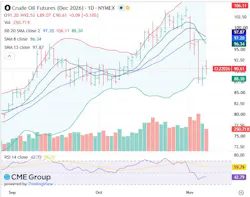
December WTI NYMEX futures settled Friday on thin volume. January traded below the 8-, 13, and 20-day Moving Averages. Volume is about the recent average at 250,000. The Relative Strength Indicator (RSI), a momentum indicator, is slightly oversold at 37. Resistance is now pegged at $84.65 (8-day MA) while near-term Support is $80.80 (Friday’s Low).
Looking ahead
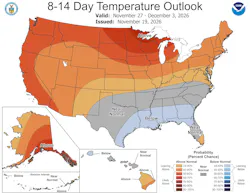
The sell-off this week flies in the face of on-going vessel attacks by Iran and the continuing Houthi/Saudi Arabia conflicts. With talks between the US and Iran going nowhere, the Bears need to be cautious as the current downside may be exhausted. Refinery runs remain seasonally high which is providing some otherwise absent demand. The 8-14-day forecast continues to look bearish for heating oil demand in those regions.
Natural gas, fundamental analysis
December NYMEX natural gas futures prices made a small gain this week mostly on a smaller-than-forecasted storage injection while weather has been decidedly bearish. The week’s High was $3.42/MMbtu on Friday and the Low was Tuesday’s $3.05. Natural gas demand this week has been estimated at 116 bcfd with an increase in residential and LNG feedstock while the supply was thought to be 119 bcfd. LNG exports were 21 bcfd while exports to Mexico were 6.4 bcfd. In the UK, natural gas prices at the NBP were most recently lower at $29.00/MMbtu. Dutch TTF futures were also lower at $27.22/MMbtu. Asia’s JKM was quoted at $27.52 MMbtu.
The EIA’s Weekly Natural Gas Storage Report indicated an injection of 20 bcf vs. a forecast of +28 and a 5-year average of +15 bcf. Total gas in storage is now 3.882 tcf, 1.7% below last year and 2.1% above the 5-year average.
Natural gas, technical analysis
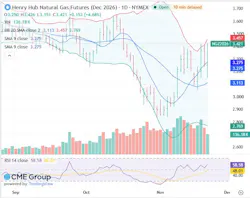
December 2026 NYMEX Henry Hub Natural Gas futures are trading above the 8- & 13-day Moving Averages but below the 20-day. Volume is below the recent average at 170. The RSI is oversold at 35. Support is $2.95 (8-day MA) with Resistance at $3.05.
Looking ahead
The EU has pushed back its rules on methane imports for another 2 years which will benefit US LNG exporters who are sending as much as 60% of their output to the EU and UK. Natural gas production remains fairly steady while above-normal temperatures have delayed the start of the normal fall demand.
LNG exports should stay strong given global demand and pricing. The storage surplus vs. the 5-year average increased last week. Based upon the 8-14-day forecast, storage injections could continue to occur over the next 2 weeks but it’s unlikely that totaled stored gas will reach 4.0 tcf before demand picks up.
About the Author
 Tom Seng
Dr. Tom Seng is an Assistant Professor of Professional Practice in Energy at the Ralph Lowe Energy Institute, Neeley School of Business, Texas Christian University, in Fort Worth, Tex.


