Oil moves higher just before midterms
Oil, fundamental analysis
Oil prices remained elevated this week as fears of an expected escalation in the Middle East following the US midterm elections while persistent threats to shipping in the Strait of Hormuz sustain a significant geopolitical risk premium. Another inventory draw helped support the rally. WTI’s High was Friday’s $104.99/bbl while the Low was Tuesday’s $99.45. Brent crude hit its High on Friday at $118.00/bbl with the low on Thursday at $114.90. Both grades settled higher on the week. The WTI/Brent spread is now $13.00. WTI is up $11.50/bbl since Oct. 1.
There is only 1 trading day remaining before the US midterm elections and the Trump administration has pledged to resume the war on Iran shortly thereafter. That is only adding more risk premium on top of the ongoing attacks on shipping in the Middle East. Iran had convened a meeting with Saudi Arabia, Turkey, and Pakistan this week to discuss the current situation but nothing positive has emerged as yet. Vice President Vance has reportedly sent a message to Iranian officials suggesting a resumption of talks but has not received a reply.
United Kingdom’s Maritime Trade Operations confirmed an incident Friday with a small ship deploying explosive devices at a tanker. Also, Iran’s IRGC has claimed an additional 3 vessels hit mines and were disabled. Meanwhile, oil shipments through the Strait of Hormuz are estimated to be about 49% of pre-war levels or 8.5 million b/d. The larger global problem, however, is the scarcity of refined products caused by damaged refiners in the Persian Gulf and in Russia.
Persian Gulf petrostates continue to work to have less reliance on the Strait of Hormuz for exporting crude and refined products. Saudi Arabia is looking for oil storage in countries outside of the region while ADNOC is telling its customers that a second oil pipeline terminating at Fujairah, UAE, in order to bypass the Strait of Hormuz, will be operational early next year. Qatar, concerned about the future of its LNG exports, has entered into supply arrangement with other countries including the US.
OPEC+ will meet virtually this Sunday, and its members are expected to maintain current output levels. In the EU, governments are tapping reserves with the release of 42 million b/d over the next 3 months with half of that being diesel. And Russia continues its own ban on diesel exports with the exception of their deal with President Trump. For its part, Ukraine continues to target Russian refineries despite the insistence by Trump that they cease. And Yemeni-Houthis are claiming they have damaged at least 2 refineries in Saudi Arabia.
The Energy Information Administration’s (EIA) Weekly Petroleum Status Report indicated that commercial crude oil inventories for last week decreased the Strategic Petroleum Reserve held at 283 million bbl (the lowest level since 1982). Production last week rose 725,000 b/d to 14.0 million b/d.
The PCE Index, the Fed’s preferred gauge of inflation, rose 3.6% last month, in line with forecasts and up from August’s 3.4% increase. The higher energy prices represent a threat to inflation which, in turn, could lead to another rate hike by the Fed. On Friday, 3 officials with the Federal Reserve signaled their support for an increase in December. US GDP grew 3.4% for second-quarter 2026, up from the first quarter's 2.2% increase. Much of the increase has been attributed to the capital influx for hyperscale AI datacenters. A sell-off in tech stocks Friday sent the S&P, NASDAQ, and Dow indexes lower. Intel lost as much as 30% at one point. All 3 settled down week-on-week. The USD was up slightly while gold traded below $4,000/oz.
Oil, technical analysis
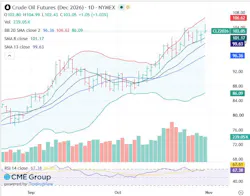
December WTI NYMEX futures traded above their 8-, 13, and 20-day Moving Averages. Volume is about the recent average at 240,000. The Relative Strength Indicator (RSI), a momentum indicator, is overbought at 67. Resistance is now pegged at $105.00 while near-term Support is $101.15 (8-day MA).
Looking ahead
Reports have emerged that the US military has plans in place for re-engaging with Iran after Tuesday’s elections and allies in the Persian Gulf region have been told to prepare for that eventuality.
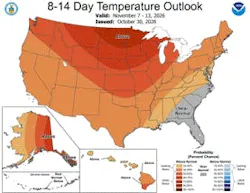
As colder temperatures emerge in the Northeast, demand for heating oil (ultra-low sulfur diesel) will increase. Some homeowners have already experienced sticker shock from their latest deliveries of fuel as they now compete with trucks and equipment. For the time being, the 8-14-day forecast does look bearish for heating oil consumption.
Natural gas, fundamental analysis
December is a winter month, but you wouldn’t know it looking at natural gas prices. December NYMEX natural gas futures prices this week fell again as production continues to increase but the normal seasonal temperatures have yet to materialize across the country. Additionally, there was an above-average storage injection.
The week’s High was $3.18/MMbtu on Monday and while the Low was Friday’s $2.62. Natural gas demand this week has been estimated at 105 bcfd with lower power consumption and higher residential while supply was thought to be 117 bcfd. LNG exports hit a new high of 20.6 bcfd while exports to Mexico were 6.9 bcfd.
Heating demand in Europe is kicking in while storage levels there are around 75% to start the winter season. European natural gas prices rose to levels not seen since 2022 over concerns regarding LNG supplies heading into winter. In the UK, natural gas prices at the NBP were most recently higher at $34.15/MMbtu. Dutch TTF futures were also higher at $32.80/MMbtu. Asia’s JKM was quoted at $32.05/MMbtu as Asian and European markets are essentially competing for the same shipments.
EU gas storage levels currently stand at only 75%. The EIA’s Weekly Natural Gas Storage Report indicated an injection of 80 bcf vs. a forecast of +75 and a 5-year average of +70 bcf. Total gas in storage is now 3.724 tcf, 3.5% below last year and 1.0% above the 5-year average.
Natural gas, technical analysis
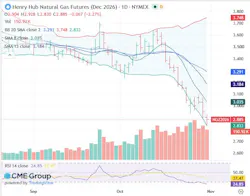
December 2026 NYMEX Henry Hub Natural Gas futures are flirting with the Lower-Bollinger Band trading below the 8-, 13-, and 20-day Moving Averages. Volume is below the recent average at 150. The RSI is very oversold at 25. Support is $2.85 (Bollinger Band) with Resistance at $3.05 (8-day MA).
Looking ahead
Natural gas production remains fairly steady while above-normal temperatures have delayed the start of the normal fall demand. LNG exports should stay strong given global demand and pricing. The storage surplus vs. the 5-year average continues to shrink. At 3.724 tcf with only 1 week remaining in the official storage injection season, it would take 276 bcf this week to hit the 4.0 tcf mark by Nov. 1.
About the Author
 Tom Seng
Dr. Tom Seng is an Assistant Professor of Professional Practice in Energy at the Ralph Lowe Energy Institute, Neeley School of Business, Texas Christian University, in Fort Worth, Tex.
Related
 downward trending line graph with pump jacks to the right
 oil market