Oil, fundamental analysis
While US President Trump pledged not to continue attacking Iran until after the midterms, the conflicts in the Middle East raged on leading December futures prices to continue November’s rally. An unexpectedly high inventory draw only added upward momentum. WTI’s High was Tuesday’s $110.50/bbl which was November’s settlement day and the result of traders closing out positions. The Low was Wednesday’s $96.25, the first day of trading for December. Brent crude hit its High on Friday at $116.35/bbl with the low on Tuesday at $105.95. Both grades settled higher on the week. The WTI/Brent spread has blown out to $14.00.
Iran continues to attack vessels in the Strait of Hormuz despite the halt of US attacks on them. Both crude tankers and regular cargo ships have been hit recently. They have further threatened increased aggression in the area should the US and Israel resume their strikes on Iran. The US has stepped-up its presence in the region with a third aircraft carrier and more Marines.
Meanwhile, the Yemeni-Houthi/Saudi Arabia conflict has escalated. Houthis have hit large metropolitan areas within Saudi Arabia including, the headquarters of Saudi Aramco, as well as one oilfield. Saudi troops have made their way into Yemen and the Saudi Air Force has attacked the country’s capital.
Despite the military actions on both sides, oil does continue to flow through the Strait of Hormuz with Kpler estimating as much as a 24 million b/d last week. Globally, however, a deficit in actual refined products remains the bigger issue. Less refined product leaving the Persian Gulf and the continuing Ukrainian attacks on Russian refiners are largely responsible for the shortfall.
Tanker-tracker service, Kpler, confirmed the loading of a Russian tanker with ultra-low sulfur diesel bound for NYC with an expected arrival date of Nove. 7, the first delivery under Pres. Trump’s recent deal with Putin. And tanker rates have risen to about $20/bbl all-in which is 7 times higher than a year-ago. Factors such as risk premium, day rates, the increase in ship-to-ship transfers and maritime insurance rates have all played a hand in the increases.
Given the increased demand for diesel, US refineries have been running at the highest operating rates since 1998. From May through September, utilization averaged 65%. However, total available capacity is down 4% since 2019. Two refineries in California were shut down in just the past year. US refiners have been recording record high crack margins over the past 5 months. And, despite being past the peak summer demand period and the need for periodic maintenance, refinery utilization remains above 90%.
The US Energy Information Administration’s (EIA) Weekly Petroleum Status Report indicated that commercial crude oil inventories last week decreased while the Strategic Petroleum Reserve (SPR) held at 283 million bbl (the lowest level since 1982). Production last week fell again by 300,000 b/d to 13.3 million b/d vs. 13.7 million b/d the prior week and 13.6 million b/d last year.
The higher energy prices are weighing on financial markets as stocks fall and treasury yields drop. Jobless claims last week dropped 6,000 to 194,000 vs. an expected 200,000. Housing starts last month were down 5.2% from August while pending home sales were down 7.3%. The Manufacturing PMI was 56 as activity continues to expand. Consumer sentiment remains weak at 48%. The Dow dipped on Friday but was positive on the week while the NASDAQ and S&P were lower. Gold settled down while the USD made slight gains.
Oil, technical analysis
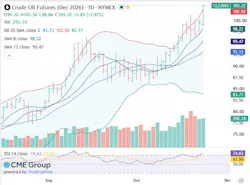
December WTI NYMEX futures carried forward November’s momentum have shot past the Upper-Bollinger Band limit and well-above their 8-, 13, and 20-day Moving Averages on the rally which broke the $103 mark. Volume is about the recent average at 292,000. The Relative Strength Indicator (RSI), a momentum indicator, is very oversold at 75. Resistance is now pegged at $103.50 while near-term Support is $102.50 (Bollinger Band).
Looking ahead
In the short-term, nothing appears to point to any easing of hostilities in the Middle East. Iran has no incentive to cease attacking ships and the Yemeni-Houthis have successfully attacked key Saudi Arabian sites. It may take an earlier intervention than planned by the US. The refined product shortages will be with us for a while yet and, at some point US refiners will have to reduce their utilization for routine maintenance as well as the turnaround to winter blending.
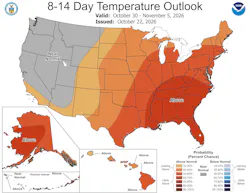
The next 2 weeks look very bearish for heating oil demand along in the Northeast.
Natural gas, fundamental analysis
November NYMEX natural gas futures prices this week tanked as production continues to increase but the normal seasonal temperatures have yet to materialize across the country. Additionally, there was an above-average storage injection. The week’s High was $3.18/MMbtu on Monday and while the Low was Friday’s $2.62. Natural gas demand this week has been estimated at 104.5 bcfd with lower power consumption while supply was thought to be 117 bcfd. LNG exports hit a new high of 19.8 bcfd while exports to Mexico were 6.8 bcfd.
European natural gas prices rose to levels not seen since 2022 over concerns regarding LNG supplies heading into winter. In the UK, natural gas prices at the NBP were most recently higher at $30.65/MMbtu. Dutch TTF futures were also higher at $29.60/MMbtu. Asia’s JKM was quoted at $30.63/MMbtu as Asian and European markets are essentially competing for the same shipments. The highest prices in 4 years. EU gas storage levels currently stand at only 75%. The EIA’s Weekly Natural Gas Storage Report indicated an injection of 77 bcf vs. a forecast of +80 bcf and a 5-year average of +70 bcf. Total gas in storage is now 3.644 tcf, 4.0% below last year and 1.0% above the 5-year average.
Natural gas, technical analysis
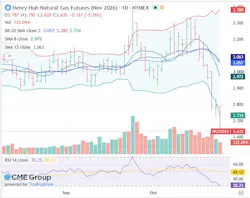
November 2026 NYMEX Henry Hub Natural Gas futures have fallen below the Lower-Bollinger Band and the 8-, 13- & 20-day Moving Averages. Volume is below the recent average at 125. The RSI is very oversold at 30. Support is $2.60 with Resistance at $2.73 (Bollinger Band).
Looking ahead
Natural gas production remains fairly steady while above-normal temperatures have delayed the start of the normal fall demand. LNG exports should stay strong given global demand and pricing. The storage surplus vs. the 5-year average continues to shrink. At 3.644 tcf with only 2 weeks remaining in the official storage injection season, it would take 178 bcf/week to hit the 4.0 tcf mark by Nov. 1.
About the Author
 Tom Seng
Dr. Tom Seng is an Assistant Professor of Professional Practice in Energy at the Ralph Lowe Energy Institute, Neeley School of Business, Texas Christian University, in Fort Worth, Tex.