Oil prices and the ceasefire that wasn't

Oil, fundamental analysis
Oil prices plummeted Wednesday after US President Trump announced Tuesday night that a 2-week ceasefire had been agreed to with Iran. This came after an early morning post on social media threatening that “a whole civilization will die tonight”.
May WTI fell $19.00/bbl on a day that saw a $20/bbl Hi/Lo range on the expectation that the Strait of Hormuz would reopen as a condition of the ceasefire. However, continuing hostilities have negated any ceasefire.
WTI saw a weekly High of $117.65/bbl Tuesday following the President’s social media post and a Low of $91.05/bbl on Wednesday after the prior night’s ceasefire announcement.
Brent crude, which is trading for June, hit a High of $111.65/bbl on Tuesday and a Low of $90.80/bbl Wednesday. This rare Brent/WTI spread “inversion” indicates the market believes there will be a positive change in the Middle East by June. The actual June spread for Brent/WTI is ($5.62)/bbl. Both grades are down this week by the highest percentage drop since June 2025.
Confusion over the exact terms of the proposed ceasefire has led to its demise as Iran insisted it required a cessation of Irael’s attacks on Lebanon as part of its “10-Point Plan”. Meanwhile, Israel maintained the right to continue its bombing of Lebanon while the US administration has not stated that the agreement included Israel backing down. As a result, Iran once again has closed the Strait of Hormuz and has been charging upwards of $2.0 million per ship for passage. Even prior to this past week, some tankers and cargo ships were allowed to traverse the Strait if agreements had been reached with nations “friendly” to Iran including China and India. (Satellite tanker-trackers are reporting that, between Mar. 1 and Apr. 7 only 92 tankers with crude, refined products, and LPG went through the Strait, 60 of which were Iranian.) Others were paying the tolls.
Control of the Strait has been a financial boost for Iran’s war efforts in the form of tolls extracted and the much higher price it is receiving for its oil exports. Normally trading at a steep discount to Brent, Iranian light and heavy crudes are now trading at a premium since delivery is guaranteed.
Iran has also attacked Saudi-Arabia’s East-West oil pipeline which has been able to divert as much as 7.0 million b/d to the Gulf of Oman. Current estimates of that damage have reduced the pipeline’s deliveries by about 600,000 b/d. A new “wrinkle” in the situation with the Strait is the reluctance of some crude and refined product shippers to pass through the Strait in order to load new cargoes as the fear of not being able to leave exists. Iraq, despite an agreement with Iran to allow its tankers to pass through the Strait, is having a hard time finding sufficient tanker takeaway capacity due to the currently heightened insurance rates for the crossing.
Iran is also considering controlling the Bab El-Mandeb Strait in an effort to choke off more oil and refined product shipments out of the Middle East. Also, a thin strait, it is the passageway from the Red Sea to the Gulf of Aden in between Djibouti and Yemen where Iran-backed Houthi rebels could take control.
On the global supply front, Argentina continues to see increased production from its Vaca Muerta shale, having reached 850,000 b/d this year with expectations of 1.0 million b/d by 2030. Venezuela has reached 800,000 b/d of exports almost hitting the 900,000 b/d pre-sanctions level.
Meanwhile, the International Energy Agency (IEA) has categorized the current global energy crisis as worse than those of 1973, 1979, and 2022 combined and is considering another coordinated release of oil reserves from among its membership.
The Energy Information Administration’s (EIA) Weekly Petroleum Status Report indicated that commercial crude oil inventories for last week increased while production was 13.6 million bbl vs. 13.7 the week prior. The SPR was -1.7 million bbl to 413 million bbl (part of the pledged release.)
The US Commerce Dept. is reporting a revised fourth-quarter 2025 GDP which rose only 0.5%, down from the previous +1.4% and against a forecasted +2.5%. Further negative economic news came in the form of higher inflation for March. The CPI rose 0.9% last month, leading to a year-on-year rise of 3.3%, the largest annual increase since May 2024. Initial jobless claims rose 16,000 this week to 219,000, above the forecasted 210,000. While down on the day, both the Dow and S&P are higher week-on-week while the NASDAQ is higher on the day and the week. Gold is higher than last week but staying below $5.00/oz. while the USD is lower, helping oil prices.
Oil, technical analysis
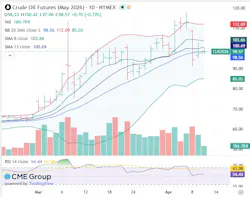
May 2026 WTI NYMEX futures are trading around the 13-, and 21-day Moving Averages but below the 8-day MA. They have also retreated to beneath the Upper-Bollinger Band limit after the breach last week. Volume is below the recent average at 185,000. The Relative Strength Indicator (RSI), a momentum indicator, has fallen back into neutral territory at 54. Resistance is now pegged at $100.70 (13-day MA) while near-term Support is $97.00, Friday’s Low. As has been the pattern for several weeks now, traders have to be cautious with their Friday positions as the market is closed until Sunday evening.
Looking ahead
Delegations from the US and Iran are expected to meet Saturday in Islamabad, Pakistan. Meanwhile, Israel’s PM Netanyahu has agreed to hold talks with Lebanon. Israel seeks to disarm Hezbollah fighters in Lebanon but will scale-back its attacks in the meantime. This weekend, oil markets will be monitoring statements coming out of Islamabad for signs of progress in the US/Iran talks. However, unless Israel cooperates with decisions made there, Iran has made it clear they will continue their attacks and could target the Bab El-Mandeb Strait next, as mentioned.
While still early, the University of Colorado’s first hurricane season forecast has been released and it calls for 13 named storms and 6 hurricanes, 2 of which could be “major”. US commercial crude oil and gasoline stockpiles are in a healthy position at +2% and +3% above the 5-year average, respectively. Distillate stocks are a concern, however, at -5% below the 5-year average with diesel prices skyrocketing.
Natural gas, fundamental analysis
May NYMEX natural gas futures have now been on a 4-week downtrend on mild weather and a larger-than-expected storage injections. The week’s High was Monday’s $3.50/MMbtu while the Low was Tuesday’s $2.95. Natural gas demand this week has been estimated at 70 bcfd while production was thought to be 111 bcfd. LNG exports have increased to about 20 bcfd.
US LNG exports reached a new record high of 11.7 metric tons last month and Qatar is preparing to restart its LNG production should the Strait of Hormuz remain open. In the US, Kinder-Morgan’s Elba Island, Georgia LNG export plant has received approval to increase its output to 0.4 bcfd.
In the UK, natural gas prices at the NBP were most recently at $15.74/MMbtu, down from last week’s $21.70. Dutch TTF futures were $15.12/MMbtu. Asia’s JKM was quoted at $19.90/MMbtu. The EIA’s Weekly Natural Gas Storage Report indicated an injection of 50 bcf vs. a forecast of +22 and a 5-year average of +13 bcf. Total gas in storage is now 1.911 tcf, now 4.9% above last year and 4.8% above the 5-year average.
Natural gas, technical analysis
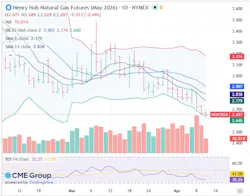
May 2026 NYMEX Henry Hub Natural Gas futures have fallen below the 8-, 13- & 20-day Moving Averages while touching on the Lower-Bollinger Band Limit. Volume is below the recent average at 76,000. The RSI is now slightly oversold at 35. Support is $2.65 (Bollinger Band) with key Resistance at $2.78 (8-day MA).
Looking ahead
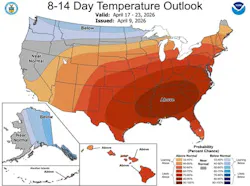
Despite the much higher global LNG prices, US exporters are “tapped-out” on capacity. The short-term weather is bearish for most of the country, but areas of above-normal temperatures could lead to some natural gas-fired power demand for A/C. Look for continuing storage injections that are above average as production increases and demand remains low.
About the Author
 Tom Seng
Tom Seng
Dr. Tom Seng is an Assistant Professor of Professional Practice in Energy at the Ralph Lowe Energy Institute, Neeley School of Business, Texas Christian University, in Fort Worth, Tex.