Oil prices fall as mid-terms signal possible end to Iran war
Oil, fundamental analysis
Oil prices plummeted this week following last week’s rally as the market viewed the results of the US mid-term elections as potentially bringing an end to the Iran war. Meanwhile, attacks on ships in the Persian Gulf region continue as does the Saudi-Houthi conflict. The fifth-straight weekly inventory decline could not support the downside either.
WTI’s High was Monday’s $102.75/bbl while the Low was Thursday’s $86.65. The December contract is down $13.00/bbl on the week. Brent crude hit its High on Monday at $106.65/bbl with the low on Wednesday at $93.40 and is down almost $15.00/bbl vs. last week. The WTI/Brent spread has now tightened to $7.50.
Prior to Tuesday’s elections, there had been talk of some level of diplomatic progress between the US and Iran with Qatar acting as an intermediary while President Trump pledged to hold off on any attacks until after the election. Instead, he ordered a strike on Qeshm Island prior to Tuesday’s voting.
The election results now have the market more optimistic about some form of settlement as the Democratic victories were, in part, in response to the unpopularity of the war and especially, its impact on energy prices. However, much uncertainty regarding the real situation in the Middle East remains. President Trump could continue military action against Iran and Iran has continued to attack vessels in the Persian Gulf even employing small boats to attach so-called, limpet mines to the hulls of ships. Meanwhile, the Yemeni-Houthis are still threatening the close-off Saudi Arabia’s Red Sea export access.
While estimates vary, flows of oil through the Strait of Hormuz do remain robust with upwards of 20 million b/d being reported. JP Morgan believes there may actually be a global surplus of crude to the tune of 1.1 million b/d on both loosening shipments and lower demand. However, shipments of refined products remain stifled largely do to damage suffered by refineries upstream of the Strait. Adding to the overall supply disruption picture, Ukraine continues to target Russian refineries, hitting 6 this week alone. And Russian continues its ban on diesel exports except for those already promised to the US.
The Energy Information Administration’s (EIA) Weekly Petroleum Status Report indicated that commercial crude oil inventories for last week decreased by 900,000 bbl from the previous week. The Strategic PEtroleum Reserve (SPR) held at 283 million bbl (the lowest level since 1982). Production last rose 11,000 b/d to 14.003 million b/d vs. 13.992 million b/d the prior week and 13.65 last year.
October job additions were up 165,000, up from September’s 29,000 increase, and higher than the 59,000 increase forecast. Unemployment dipped to 4.1% vs. an expected 4.2%. Personal income rose 0.37% to an annual average of +3.12% which is still lower than inflation. The surprise increase in employment may grant the Fed the ability to raise rates to curb inflation while not negatively impacting the job market. US stocks suffered a major selloff on Thursday and rebounded Friday but experienced losses week-on-week. A rally occurred on Wednesday when traders believed the mid-term results would lead to an eventual end to the inflation-raising Iran war.
On Thursday, however, tech stocks got hammered leaving the Dow down 1,800 pts, the S&P down 4.3%, and the NASDAQ down 5.5%. The USD and gold are both higher than last week.
Oil, technical analysis
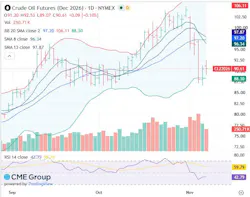
December WTI NYMEX futures traded well below their 8-, 13, and 20-day Moving Averages. Volume is about the recent average at 250,000. The Relative Strength Indicator (RSI), a momentum indicator, is neutral at 43. Resistance is now pegged at $93.00 while near-term Support is $88.30 (Lower-Bollinger Band).
Looking ahead
Some countries such as China and South Korea have begun to refill their strategic reserves after the drawdowns of the past 8 months. As the US and other countries start this same process, global oil prices will have an artificial floor as an estimated 1.0 billion bbl of reserves were drained thus far during the Iran war.
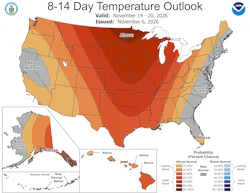
Once again, it will take an actual stop in hostilities and serious peace talks to remove the war risk premium. Prices fell dramatically this week in a “too far, too fast” fashion that led to a Friday rebound. The 8-14-day forecast looks bearish for heating oil demand.
Natural gas, fundamental analysis
December NYMEX natural gas futures prices this week made a small gain this week on some cooler fall weather but prices remain well below where they would normally be for a winter month as production continues to increase and the storage injection was above-average.
The week’s High was $2.97/MMbtu on Friday and while the Low was Wednesday’s $2.87. Natural gas demand this week has been estimated at 105 bcfd with lower power consumption and higher residential while supply was thought to be 117 bcfd. LNG exports were 20 bcfd while exports to Mexico were 6.9 bcfd. In the UK, natural gas prices at the NBP were most recently lower at $28.30/MMbtu. Dutch TTF futures were also lower at $29.90/MMbtu. Asia’s JKM was quoted at $31.60MMbtu as Asian and European markets are essentially competing for the same shipments. The EIA’s Weekly Natural Gas Storage Report indicated an injection of 77 bcf vs. a forecast of +81 and a 5-year average of +61 bcf. Total gas in storage is now 3.801 tcf, now 2.8% below last year and 1.4% above the 5-year average.
Natural Gas – Technical Analysis
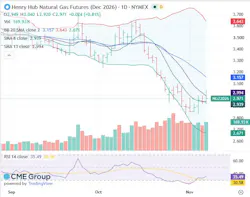
December 2026 NYMEX Henry Hub Natural Gas futures are trading above the 8- & 13-day Moving Averages but below the 20-day. Volume is below the recent average at 170. The RSI is oversold at 35. Support is $2.95 (8-day MA) with Resistance at $3.05.
Looking ahead
Natural gas production remains fairly steady while above-normal temperatures have delayed the start of the normal fall demand. LNG exports should stay strong given global demand and pricing. The storage surplus vs. the 5-year average increased last week. Based upon the 8-14-day forecast, storage injections could continue to occur over the next 2 weeks but it’s unlikely that totaled stored gas will reach 4.0 tcf before demand picks up.
About the Author
 Tom Seng
Dr. Tom Seng is an Assistant Professor of Professional Practice in Energy at the Ralph Lowe Energy Institute, Neeley School of Business, Texas Christian University, in Fort Worth, Tex.
Related
 chart trending downward
 Iran flag blending with line graph, coin stacks, and oil barrels