Oil prices fall on enhanced optimism in ending Iran war

Oil, fundamental analysis
Global oil prices fell dramatically this week as, once again, traders take a very optimistic view on the latest developments in the Iran war. An across-the-board draw in commercial crude, refined products and Stretegic Petroleum Reserve (SPR) stocks could not reverse the trend.
WTI’s high was Monday’s $99.45/bbl for July while the Low was Friday’s $86.35. Brent crude hit its high on Monday at $100.75/bbl with the low on Friday at $91.45. It was Brent’s largest weekly decline in 2 months. Both grades settled lower than last week, and the WTI/Brent spread has now tightened to $5.15.
A 60-day ceasefire extension in the Iran war is in the works according to the US while details of a peace plan are worked out. Both sides still have 'sticking points,' but oil markets believe this will lead to a true opening of the Strait of Hormuz. The issues of Iran continuing to charge tolls and disposal of its enriched uranium remain unsettled, however.
Meanwhile, the US Treasury has applied more pressure on Iran by sanctioning 8 more tankers and 15 companies doing business with them. Given the up-and-down nature of ceasefires and negotiations thus far, some shipping companies may be reluctant to transit the Strait regardless of an announced agreement. Additionally, maritime insurers may still place a large premium on this route. Tanker tracking services indicated that about 10-11 crude vessels have been able to move through the strait this past week.
While those trading financial energy derivatives react quickly to “bullish” or “bearish” signals in the market on a daily basis, those working with the physical commodities have to have a longer perspective. For those participants, high energy prices will be with us for a long time as infrastructure will need to be restored, inventories will need to be replenished, and global trade flows return to normal.
Despite this week’s precipitous decline, crude prices are still +25% since the beginning of the war and +50% from last year at this time. And global strategic oil reserves have been drawn down since the closure of the Strait of Hormuz represents a loss of about 10-14 million b/d every day since the start of the conflict. Analysts are now indicating that restoring global commercial and strategic reserves could take years and would represent a “floor” for demand that will keep prices higher than pre-war levels.
China is said to be relying heavily on the reserves of crude is has stockpiled over the last 1.5 years, which has been attributed to keeping a cap on global prices. The world’s No. 1 importer of crude has reduced its imports.
Meanwhile, higher prices and less oil flowing from the Middle East has caused Japan’s crude imports to drop to their lowest level since 1967.
The US set a new record for petroleum exports last week as 12.9 million b/d of commercial oil, SPR reserves, and refined products left US ports. Crude alone has set a recent export high of 6.4 million b/d while the SPR released a weekly total of 10 million bbl, part of the International Energy Agency (IEA) pledge.
The Energy Information Administration’s (EIA) Weekly Petroleum Status Report indicated that commercial crude oil inventories for last week decreased for the 5th straight weekly decline. The SPR was down 9.1 million bbl to 365 million bbl.
Oil, technical analysis
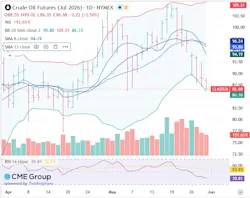
July WTI NYMEX futures have fallen back below the 8-, 13, and 20-day Moving Averages. Volume is below the recent average at 195,000. The Relative Strength Indicator (RSI), a momentum indicator, is diving into an oversold position at 40 just this week. Resistance is now pegged at $89.00 while near-term Support is $86.10 (Lower-Bollinger Band).
Despite the optimism in the market currently, traders still need to take cautious positions ahead of the weekend since the status of a ceasefire and peace accord are still unknown.
Looking ahead
Should a lasting ceasefire and subsequent peace accord be reached between the US and Iran, the focus in oil markets may shift to the status of global reserves, some of which are approaching dangerously low operational volumes. While storage facilities are rated on capacity, several factors play into the infrastructure needed to remove and transport those volumes. In many cases, minimum operating volumes differ from the capacity ratings which can impact the actual volumes that can be taken out. Additionally, attacks by both sides have continued despite ceasefire announcements. US inventories will now be squeezed even further as the summer travel season has officially commenced.
Natural gas, fundamental analysis
June NYMEX natural gas futures expired this week and July is now the prompt month. Price rose on a smaller-than-expected storage injection and on the outlook for warmer weather. The week’s High was Friday’s $3.39/MMbtu while the Low was Wednesday’s $2.98 (June Settlement day).
Natural gas demand this week has been estimated at about 103 bcfd on increased power consumption while supply was thought to be 106 bcfd, a 15-week low as supply losses were seen in the Marcellus and Fayetteville shales.
Input to LNG export plants rose as planned outages ended and ranged from 18-19 bcfd. Volumes are expected to rise throughout the summer. Exports to Mexico were 7.0 bcfd.
In the UK, natural gas prices at the NBP were most recently lower at $14.95/MMbtu. Dutch TTF futures were also lower at $15.80/MMbtu. Asia’s JKM was quoted at $18.35/MMbtu as Asian and European markets are essentially competing for the same shipments.
The EIA’s Weekly Natural Gas Storage Report indicated an injection of 92 bcf vs. a forecast of +96 and a 5-year average of +97 bcf. Total gas in storage is now 2.483 tcf, 0.9% above last year and 6.2% above the 5-year average.
Natural gas, technical analysis
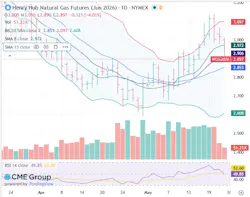
July 2026 NYMEX Henry Hub Natural Gas futures are above the 13- and 20-day Moving Averages this week with Friday’s High and Close breaching the Upper-Bollinger Band Limit. Volume is near the recent average at 127,000. The RSI is approaching overbought at 60. Support is $3.25 with key Resistance at $3.29 (Bollinger Band).
Looking ahead
Thailand is meeting with US officials and at least one LNG exporter in an effort to secure long-term LNG supply. These transactions are necessary to anchor both new and expansion projects. Meanwhile, record heat in Europe and Asia has utilities competing for cargoes of LNG needed for power generation and for summer storage ahead of next winter.
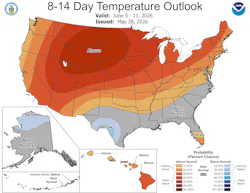
Cheniere LNG has signed with EPC firm Bechtel to build a 7th liquefaction train at its Sabine Pass plant. The 8-14-day forecast appears bullish for power generation. Look for LNG exports to continue to increase moderately over the coming months.
About the Author

Tom Seng
Dr. Tom Seng is an Assistant Professor of Professional Practice in Energy at the Ralph Lowe Energy Institute, Neeley School of Business, Texas Christian University, in Fort Worth, Tex.