EOG accumulates Austin Chalk position that adds a year to inventories
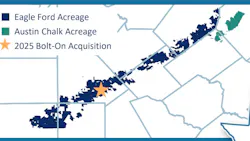
EOG Resources Inc., Houston, has added to its Eagle Ford asset base via the leasing of a 60,000-net acre Austin Chalk holding that chief operating officer Jeff Leitzell labeled as “truly a sweet spot.”
Speaking to analysts after EOG reported second-quarter results, Leitzell said the new position in Lavaca County was acquired at an average of $1,200/acre. Based on EOG teams’ calculations and about a dozen wells already drilled, the new property should pay for itself in less than a year at an average West Texas Intermediate price of $65/bbl.
“These high-pressure wells offer high deliverability and benefit from our learnings in other basins,” Leitzell said on an Aug. 5 conference call. “We have confidently identified one year’s worth of two-mile lateral inventories at current Eagle Ford activity levels. Furthermore, we continue to gather data and evaluate [the acreage’s] extent.”
Leitzell said the additions to EOG’s South Texas portfolio are likely to produce more associated gas than the operator's core Eagle Ford assets, and that they should, over time, be able to house another 125 two-mile locations.
 oil_well_2067615_natalia_bratslavsky_dreamstime
 Oil and gas drilling operations in the Permian basin at night
The Austin Chalk properties add about a year of drilling inventory at EOG’s current pace and build on an Eagle Ford bolt-on acquisition EOG finalized last year to the southwest. That deal also padded the company’s inventories by about 1 year.
In the short to medium term, the Austin Chalk acquisition won’t be a meaningful driver of production growth. Chairman and chief executive officer Ezra Yacob told analysts that the $5.6 billion acquisition last year of Encino Acquisition Partners, which provided EOG with scale in the Utica basin, will be the main contributor to growth over the next 3 years. Production in the Delaware basin, where EOG runs 305 of its 590 wells, will likely be flat or maybe show moderate growth, Yacob added.
During the second quarter, EOG’s production averaged 549,000 b/d of oil and 1.41 MMboe/d total. That put the company slightly ahead of executives’ full-year targets of 548,7000 b/d oil and 1.4 MMboe/d, respectively, which would equate to 5% oil volume growth and a 14% increase in total production from 2025.
Net income for the quarter was a little more than $2.7 billion on revenues of $8.6 billion, year-over-year increases from nearly $1.4 billion and $5.5 billion, respectively. Yacob said his team’s primary focus is still to efficiently grow cash flows and sustainably create value.
Crescent’s Q2 drives full-year production uptick
On a similar efficiency journey–and also building on a 2025 acquisition, in this case the $3.1 billion purchase of Vital Energy–are the leaders of Crescent Energy, Houston. They reported second-quarter earnings of $493 million on total revenues of $1.39 billion that were powered by gains in production that totaled 335,000 boe/d (140,000 b/d oil).
The company’s teams got more from assets in the Eagle Ford, Permian, and Uinta basins, which allowed chief executive officer David Rockecharlie to nudge up Crescent’s full-year production forecast to 327,000-335,000 boe/d.
Speaking to analysts on Aug. 4, chief financial officer Brandi Kendall said the company’s performance so far this year means that its likely capital spending this year will tick down inside her guidance range of $1.325 billion and $1.425 billion rather than the previous expectation that it would be nearer to the high end.
“The capital program is executing very well,” Kendall said. “We would expect to hit the midpoint of capital and for Q3 [and] Q4 to be fairly ratable with respect to the remaining capital left to spend.”
About the Author
 Geert De Lombaerde
Geert De Lombaerde
Senior Editor
A native of Belgium, Geert De Lombaerde has more than two decades of business journalism experience and writes about markets and economic trends for Endeavor Business Media publications Healthcare Innovation, IndustryWeek, FleetOwner, Oil & Gas Journal and T&D World. With a degree in journalism from the University of Missouri, he began his reporting career at the Business Courier in Cincinnati and later was managing editor and editor of the Nashville Business Journal. Most recently, he oversaw the online and print products of the Nashville Post and reported primarily on Middle Tennessee’s finance sector as well as many of its publicly traded companies.