Morningstar holds 2027 Brent forecast at $71/bbl as Persian Gulf supply recovers
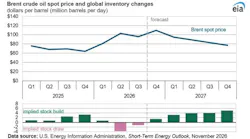
Morningstar DBRS maintained its full-year 2027 Brent and West Texas Intermediate (WTI) crude oil price forecasts at $71/bbl and $68/bbl, respectively. In its Nov. 11 outlook, the ratings agency projected that prices would ease from 2026 highs as Persian Gulf supply recovers. Depleted inventories and geopolitical risk are expected to keep WTI near the upper end of its $50/bbl to $70/bbl midcycle range.
Morningstar DBRS forecasts Brent at $66/bbl and WTI at $63/bbl in 2028. Its WTI forecast assumes further normalization of global production, shipping, inventories, and geopolitical risk.
Oil supply, inventories
The International Energy Agency (IEA) and the Organization of the Petroleum Exporting Countries (OPEC) each forecast global oil demand growth of around 2.6 million b/d in 2027 as consumption recovers from price spikes and supply disruptions in 2026. The US Energy Information Administration (EIA) forecast implies growth of about 2.4 million b/d.
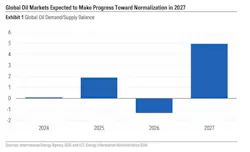
Both EIA and IEA estimate that global oil production will exceed demand by an average of 4-5 million b/d in 2027. Morningstar DBRS expects supply to recover sufficiently to eliminate the shortage experienced in 2026, with some of the additional production going toward rebuilding commercial and government inventories.
The Strait of Hormuz remains the principal geopolitical risk to the outlook. Morningstar DBRS assumes shipping conditions will continue to improve in 2027 and Persian Gulf production will move toward pre-conflict levels. Renewed disruptions could tighten the market quickly while inventories remain below pre-conflict levels.


North American natural gas
Morningstar DBRS kept its 2027 NYMEX natural gas price forecast at $3.50/Mcf. Growing LNG exports and electricity demand are expected to support prices, while rising production and relatively ample storage should limit sustained increases.
EIA expects US dry gas production to reach about 116 bcfd in 2027 and LNG exports to rise to about 19 bcfd. US LNG export capacity is nearly fully utilized, limiting how much additional gas producers can send overseas when European or Asian LNG prices rise.
In Western Canada, production growth from the Montney, Duvernay, and other liquids-rich formations is expected to outpace additional LNG demand in 2027. LNG Canada has added a source of demand, and the expected startup of Woodfibre LNG during 2027 should provide further price support.
Canadian crude
Canadian crude oil production is expected to rise modestly in 2027, particularly at oil sands projects where producers can add volumes through optimization and brownfield expansions. The Trans Mountain Expansion Project has improved access to Pacific markets. Morningstar expects a $14/bbl differential between WTI and Western Canadian Select (WCS) in 2027.
Morningstar expects the credit profiles of most rated North American oil and gas producers to remain broadly stable under its 2027 price assumptions. For oil-weighted producers, $68/bbl WTI should generally provide enough cash flow to fund maintenance capital spending, support moderate production growth, and maintain shareholder distributions. Lower oil prices than in 2026 are expected to reduce excess free cash flow.