EIA sees Brent near $100/bbl through yearend 2026 as Middle East supply constraints persist
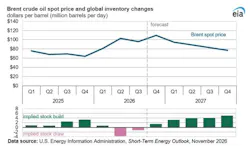
Global crude oil prices are expected to remain near $100/bbl through yearend 2026 as continued Middle East supply disruptions, tanker attacks, and constrained shipping capacity keep oil markets tight, the US Energy Information Administration (EIA) said in its November Short-Term Energy Outlook (STEO).
EIA forecasts Brent crude oil spot prices will average about $100/bbl in November and December before gradually declining in 2027 as Middle East production recovers and global inventories rebuild. Brent is projected to average $97/bbl in 2026 and $86/bbl in 2027, falling to $77/bbl by fourth-quarter 2027.
Brent averaged $124/bbl in October, up $10/bbl from September and the highest monthly average since July 2022 on an inflation-adjusted basis. Prices rose for a third consecutive month as declining inventories, tanker attacks in the Middle East and Black Sea, and higher shipping costs disrupted global oil flows.
However, Middle East exports increased slightly in October following the restart of Saudi Arabia's East-West Pipeline, according to Vortexa vessel-tracking data cited by EIA. Continued shipments through the Strait of Hormuz, supported by ship-to-ship transfers along Oman's coast, also helped ease supply constraints. Brent fell below $100/bbl on Nov. 4.
Middle East crude oil production shut-ins averaged an estimated 2.5 million b/d in October, down sharply from a peak of 10.9 million b/d in May. EIA expects disruptions to remain near 2.5 million b/d through fourth-quarter 2026 before declining to 1.9 million b/d in first-half 2027 and 1.3 million b/d in the second half.
EIA assumes most Middle East production outside Iran will return to pre-conflict levels by mid-2027, supported by pipeline bypass routes, ship-to-ship transfers, and additional pipeline capacity in the United Arab Emirates. Iranian exports, however, are expected to remain constrained throughout the forecast period.
Global oil inventories declined by an estimated 1.2 million b/d in third-quarter 2026 but are expected to begin rebuilding in the fourth quarter. Stock builds are projected to accelerate to an average 3.5 million b/d in first-half 2027, pushing Brent below $90/bbl in the second quarter.
Global liquid fuels production is forecast to rebound to 108.4 million b/d in 2027 from 101.7 million b/d in 2026. OPEC liquid fuels production is expected to increase to 28.4 million b/d from 24.5 million b/d over the same period.
Oil consumption has weakened amid prolonged supply disruptions and elevated prices, particularly in China and the Middle East. EIA estimates global liquid fuels consumption will decline by 2.0 million b/d in 2026 before recovering by 2.0 million b/d in 2027 as supply flows improve and prices ease.
US crude production to reach new record
US crude oil production is forecast to average a record 13.9 million b/d in 2026 and increase to 14.3 million b/d in 2027, compared with 13.7 million b/d in 2025.
US commercial crude inventories fell by 14.1 million bbl in October to about 410 million bbl, the lowest end-of-October level since 2014. EIA attributed the decline to strong refinery demand and a wide Brent-West Texas Intermediate (WTI) price differential that encouraged exports while discouraging imports.
Inventories are expected to remain below the 5-year average through mid-2027 before increasing to about 444 million bbl by yearend as domestic production rises and net imports recover.
Refining margins are expected to remain elevated through much of 2027 because of continued disruptions to global petroleum product supplies. EIA raised its forecast for average US retail diesel prices in 2027 by 12% from its October outlook to $5.03/gal, while its gasoline price forecast increased nearly 5% to $3.73/gal.
US natural gas prices weaken despite rising LNG exports
A warmer-than-expected start to the winter heating season and continued production growth are putting downward pressure on US natural gas prices.
EIA forecasts Henry Hub spot prices will average $2.87/MMbtu from November through March, 16% below its previous outlook and 36% lower than last winter. The agency expects working natural gas inventories to reach 3,840 bcf at the end of November, 67 bcf above its October forecast.
Henry Hub prices are forecast to average $3.37/MMbtu in 2026 and decline to $2.88/MMbtu in 2027 as production growth outpaces increases in domestic consumption and exports.
US marketed natural gas production is expected to increase from 118.4 bcfd in 2025 to 124.4 bcfd in 2026 and 129.4 bcfd in 2027, supported by continued growth in the Permian and Haynesville regions.
Meanwhile, elevated international gas prices are supporting US LNG exports. European and Asian benchmark gas futures averaged more than $28/MMbtu in October, their highest levels since December 2022, as tanker attacks and shipping disruptions continued to constrain LNG shipments through the Strait of Hormuz.
US LNG gross exports are forecast to increase from 15.1 bcfd in 2025 to 17.6 bcfd in 2026 and 19.0 bcfd in 2027 as new liquefaction capacity ramps up and existing plants expand.