EIA raises third-quarter Brent forecast to $85/bbl on Strait of Hormuz disruptions
The US Energy Information Administration (EIA), in its August Short-Term Energy Outlook (STEO), raised its forecast for global oil prices, citing continued severe constraints on transits through the Strait of Hormuz.
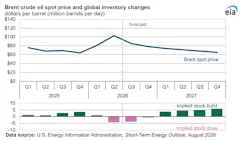
Following the signing in June of the memorandum of understanding between the US and Iran, the spot price of Brent crude oil fell as low as $69/bbl on July 2. However, following renewed attacks on tankers transiting the Strait of Hormuz and the related reduction in oil shipments through the waterway, global crude oil prices rose and volatility increased later in July. The Brent spot price reached as high as $105/bbl on July 23.
EIA now expects Brent crude to average $85/bbl in third-quarter 2026, $11/bbl higher than forecast in last month's STEO. The agency raised its estimate of Middle East shut-in crude oil production for the coming months, assuming disruptions through the Strait of Hormuz persist through August before flows slowly increase in September.
EIA assessed that production shut-ins averaged 5.5 million b/d in July, with crude oil and petroleum liquids transported through the Strait of Hormuz averaging 4.9 million b/d in second-quarter 2026, down from 21.6 million b/d in fourth-quarter 2025 before the conflict began. Saudi Arabia has re-routed crude away from the strait through the East-West pipeline to Yanbu, while Bab el-Mandeb Strait volumes rose to 8.1 million b/d in second-quarter 2026 from 5.4 million b/d in fourth-quarter 2025.
EIA forecasts oil prices will remain elevated until inventories, drawn down by 4.2 million b/d in second-quarter 2026 and a projected additional 3.8 million b/d in third-quarter, begin to rebuild.
Brent is expected to ease to $78/bbl by fourth-quarter 2026 as shut-in production restarts, then average $69/bbl in 2027 once most Persian Gulf output returns to pre-conflict levels, expected in early 2027. EIA does not assume the recent threats against Saudi crude shipments through Bab el-Mandeb have resulted in additional production shut-ins.
US crude, refining
EIA forecasts US crude oil production will average 13.80 million b/d in 2026 and 14.15 million b/d in 2027, up from 13.59 million b/d in 2025.
EIA expects US commercial crude oil inventories to remain below the 5-year low through year-end 2026 amid high refinery runs and reduced net imports. US crude stocks fell 25 million bbl in May, 15 million bbl in June, and 4 million bbl in July on surging exports and softer imports. EIA's outlook assumes no additional Strategic Petroleum Reserve releases beyond levels announced Mar. 13, 2026.
US refinery crude demand is projected near 17 million b/d through August, in line with the 5-year average, before easing below 16 million b/d in October for seasonal maintenance. Lower Russian product exports, reduced Saudi and Kuwaiti refinery flows amid the Hormuz conflict, and reduced Chinese refinery runs, have all contributed to lower global refining activity and ongoing tightness in global petroleum product markets, thereby supporting refinery margins for US refiners through the end of the year.
US LNG exports, gas prices
US LNG exports are expected to average 16.5 bcfd in third-quarter 2026, down slightly from last month's forecast due to Freeport LNG maintenance that began July 10 and is expected to conclude in late August, affecting 2.0 bcfd of nominal capacity.
However, “even with Freeport fully operational, exports would remain limited due to slow growth in additional export capacity despite US price spreads to Europe and Asia remaining elevated due to ongoing disruptions,” EIA said.
US pipeline natural gas exports are forecast to average 9.6 bcfd in 2026 and 10.0 bcfd in 2027, boosted by Mexico's new Energia Costa Azul LNG terminal, which shipped its first cargo July 8.
The Henry Hub spot price is forecast to average $2.87/MMbtu in third-quarter 2026, down 50¢ from last month's outlook, reflecting reduced LNG feedgas demand and record production. EIA projects natural gas inventories will reach a record 3,985 bcf by the end of October, 5% above the 5-year average, keeping Henry Hub prices below $3.00/MMbtu until November. Henry Hub is expected to average $3.44/MMbtu for full-year 2026 and $3.31/MMbtu in 2027.
About the Author
 Conglin Xu
Conglin Xu
Managing Editor-Economics
Conglin Xu, Managing Editor-Economics, covers worldwide oil and gas market developments and macroeconomic factors, conducts analytical economic and financial research, generates estimates and forecasts, and compiles production and reserves statistics for Oil & Gas Journal. She joined OGJ in 2012 as Senior Economics Editor.
Xu holds a PhD in International Economics from the University of California at Santa Cruz. She was a Short-term Consultant at the World Bank and Summer Intern at the International Monetary Fund.