EIA sees Brent near $90/bbl in second-half 2026 amid Middle East disruptions
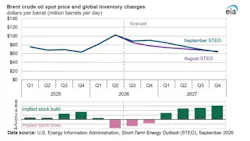
Global crude oil prices are expected to remain elevated through yearend 2026 as Middle East production disruptions and constrained exports continue to draw down inventories, the US Energy Information Administration (EIA) said in its September Short-Term Energy Outlook (STEO).
EIA forecasts Brent crude oil spot prices will average about $90/bbl in second-half 2026, $8/bbl higher than projected in its August outlook. Brent averaged $91/bbl in August, up $7/bbl from July, as constrained Middle East exports led to additional production shut-ins.
Middle East crude production shut-ins averaged an estimated 6.7 million b/d in August, up from 5.0 million b/d in July. EIA expects disruptions to ease gradually but remain substantial, with shut-in volumes averaging about 5.7 million b/d in fourth-quarter 2026. Oil flows through the Strait of Hormuz and Bab el-Mandeb remain constrained, although producers and shippers are increasingly using pipeline and overland bypass routes and ship-to-ship transfers.
Stay updated on oil price volatility, shipping disruptions, LNG market analysis, and production output through OGJ's Iran war content hub.
Renewed US blockade of Iranian exports after Iran's tanker attacks in Hormuz, plus the Treasury Department’s Office of Foreign Assets Control (OFAC) sanctions against Iranian economic and oil interests, will cut Iran's exports and production, EIA said.
In addition, attacks in Bab el-Mandeb roughly halved August loadings at Yanbu, the Red Sea port that bypasses Hormuz, according to Vortexa estimates. Saudi Arabia has rerouted barrels through the Suez Canal—longer and costlier for Asian buyers—and reportedly started ship-to-ship transfers outside the Persian Gulf, but EIA expects Red Sea constraints to cap Saudi supply near term.
The disruptions have led to sharp inventory draws. EIA estimates global oil inventories fell by an average 3.9 million b/d in second-quarter 2026 and forecasts additional draws of 3.0 million b/d in the third quarter and 1.7 million b/d in the fourth quarter.
As Middle East exports gradually recover and shut-in production returns, Brent is forecast to decline to an average $77/bbl by second-quarter 2027. EIA expects most shut-in production to be largely restored in second-half 2027, allowing global inventories to begin building and pushing Brent to an average $67/bbl during the period. Brent is forecast to average $74/bbl for full-year 2027 compared with $91/bbl in 2026.
US crude oil production is forecast to average 13.8 million b/d in 2026 and increase to 14.3 million b/d in 2027, compared with 13.7 million b/d in 2025.
US distillate markets also remain tight. EIA expects inventories to fall below 100 million bbl in September and remain below the 2021-25 low through yearend 2026 and most of 2027. Tight global distillate supplies have supported US exports and contributed to higher domestic diesel prices. EIA estimates US average diesel crack spreads will exceed $2/gal from August through November before declining steadily through mid-2027.
US natural gas supply grows
US natural gas inventories are expected to enter the winter heating season at relatively high levels as production continues to increase. EIA forecasts working gas inventories will total 3,969 bcf on Oct. 31, 5% above the 2021-25 average and 1% above October 2025 levels.
US marketed natural gas production is forecast to increase by 4.5 bcfd in 2026 and another 4.6 bcfd in 2027. The Permian and Haynesville regions together account for more than 70% of forecast production growth. Permian production is expected to rise by 1.7 bcfd in 2026 and 2.2 bcfd in 2027, while Haynesville output increases by 1.4 bcfd and 1.3 bcfd, respectively.
Henry Hub natural gas prices are forecast to average $3.43/MMbtu in 2026 and $3.28/MMbtu in 2027. US LNG gross exports are expected to increase from 15 bcfd in 2025 to 17 bcfd in 2026 and 19 bcfd in 2027.