Woodfibre LNG receives additional modules as construction advances
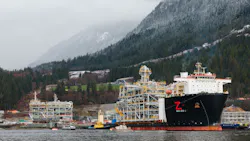
Woodfibre LNG LP has received two major modules within a week for its under‑construction, 2.1‑million tonne/year (tpy) LNG export plant near Squamish, British Columbia, advancing construction to about 65% complete.
The deliveries include the liquefaction module—the project’s heaviest and most critical process unit—and the powerhouse module, which will serve as the plant's central power and control hub.
The liquefaction module, delivered aboard the heavy cargo vessel Red Zed 1, is the 15th of 19 modules scheduled for installation at the site, the company said in a Mar. 24 release. Weighing about 10,847 metric tonnes and occupying a footprint roughly equivalent to a football field, it is among the largest modules fabricated for the project.
Once installed and commissioned, the liquefaction module will cool natural gas to about –162°C, converting it into LNG for export.
Shortly after the liquefaction module’s arrival, Woodfibre LNG received the powerhouse module, the 16th module delivered to site. Weighing more than 4,200 metric tonnes, the powerhouse module will function as a power and control system, receiving electricity from BC Hydro and managing and distributing power to the plant's electric‑drive compressors.
The Woodfibre LNG project is designed as the first LNG export plant to use electric‑drive motors for liquefaction, replacing conventional gas‑turbine‑driven compressors. The Siemens electric‑drive system will be powered by renewable hydroelectricity from BC Hydro, eliminating the largest operational source of greenhouse gas emissions typically associated with liquefaction, the company said.
The project is being built near the community of Squamish on the traditional territory of the Sḵwx̱wú7mesh Úxwumixw (Squamish Nation) and is regulated in part by the Indigenous government.
All 19 modules are expected to arrive on site by spring 2026. Construction is scheduled for completion in 2027.
Woodfibre LNG is owned by Woodfibre LNG Ltd. Partnership, which is 70% owned by Pacific Energy Corp. (Canada) Ltd. and 30% by Enbridge Inc.