Delfin LNG seeks sixth FERC extension, pushing deadline to 2030
Delfin LNG has asked the Federal Energy Regulatory Commission (FERC) for another 3 years to complete its onshore gas infrastructure in Cameron Parish, La., pushing the deadline to Sept. 28, 2030, from Sept. 28, 2027.
Delfin filed the request Oct. 30, and FERC's notice appears in the Nov. 16 Federal Register. If approved, it would mark FERC’s sixth extension since the project’s original 2017 authorization, giving the company 13 years from its original certificate to complete the onshore project.
Delfin Midstream Inc. is developing a floating LNG export plant about 40 miles offshore, with planned capacity of 13.2 million tonnes/year (tpy) from three floating liquefaction vessels.
The company reached a $5 billion final investment decision in June 2026 for its first 4.4-million tpy vessel, backed by investors including Global Infrastructure Partners/BlackRock, Mitsui OSK Lines, and Vitol. Samsung Heavy Industries holds a $2.88-billion construction contract for the vessel, with Black & Veatch serving as a major engineering partner.
The project would use existing offshore gas pipelines connected to new onshore compression, metering, and pipeline infrastructure, including a 120,000-hp compressor station in Cameron Parish. The offshore infrastructure received a deepwater port license from the US Maritime Administration in March 2025.
Delfin expects its first vessel to begin commercial operations in first-half 2031, with two additional 4.4-million tpy vessels potentially following in 2032, subject to final investment decisions.
Sierra Club opposed Delfin's 2023 extension request, arguing that market conditions did not justify further delays. FERC rejected the challenge, but another protest remains possible. Delfin counters that the infrastructure are intended solely to supply its offshore LNG port and therefore do not need to be operational until the first floating liquefaction vessel is installed in 2030 and commercial operations begin in 2031.
About the Author
Cathy Landry
Washington Correspondent
Cathy Landry has worked over 20 years as a journalist, including 17 years as an energy reporter with Platts News Service (now S&P Global) in Washington and London.
She has served as a wire-service reporter, general news and sports reporter for local newspapers and a feature writer for association and company publications.
Cathy has deep public policy experience, having worked 15 years in Washington energy circles.
She earned a master’s degree in government from The Johns Hopkins University and studied newspaper journalism and psychology at Syracuse University.
Related
 Artist rendering of Delfin LNG and FLNG vessel
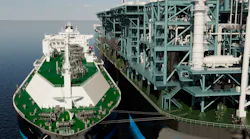 FLNG offtake illustration.

