Delfin Midstream takes $5-billion FID for first FLNG vessel
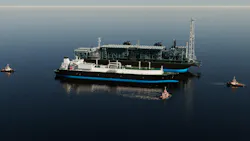
Delfin Midstream Inc., Houston, has taken a final investment decision (FID) for the first floating liquefied natural gas (FLNG) vessel of the Delfin LNG project under development in Louisiana and offshore in the Gulf of Mexico.
Delfin FLNG 1 will be the first FLNG vessel in the US and the largest FLNG project globally, with an expected export capacity of 4.4 million tonnes/year (tpy) of LNG, the company said in its June 3 release.
Concurrent with the FID, a group of investors led by Global Infrastructure Partners (GIP), a part of BlackRock—including existing Delfin investors Mitsui OSK Lines Ltd. (MOL), Vitol, and Diameter Capital Partners—has agreed to invest in the first phase of the project.
The vessel is backed by long-term LNG sales agreements with Vitol, Expand Energy, Centrica, and Gunvor, Delfin said, and all necessary permits and licenses required to begin construction have been secured. Construction contracts have been executed with Samsung Heavy Industries Co. Ltd. and Black & Veatch.
LNG production is scheduled to begin in 2030. The company continues to advance toward FIDs for FLNG vessels two and three over the coming year.
Delfin LNG is a brownfield deepwater port project designed to support up to four FLNG vessels producing up to 13.3 million tpy of LNG connected to onshore gas supplies via subsidiary-owned pipelines. Delfin’s Offshore Gas Pipeline is a 42-in. OD natural gas pipeline that begins at the Genesis Energy junction platform at West Cameron Block 167 (WC-167) in the Gulf of Mexico and runs about 30 miles north to a termination point at Williams/Transco Station 44 onshore near Johnson Bayou, Cameron Parish, La.
From the platform, gas travels to the Delfin Deepwater Port site via the HIOS pipeline, for which Delfin holds a long-term lease.
FID timeline
The investment decision comes years after the company first projected a year-end 2022 FID, with operations then expected to begin in 2026. The timeline slipped as Delfin assembled its investor consortium, sought DOE export license extensions, and worked toward construction contracts.
A Feb. 3, 2026, rupture of the offshore gas pipeline in Louisiana during pigging operations delayed FID further until the line was repaired and regulatory approval to resume flows was obtained.