Federal court voids Texas GulfLink license over agency’s ‘serious procedural errors’
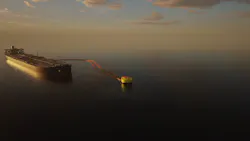
The US Court of Appeals for the Fifth Circuit Aug. 12 vacated the license for Sentinel Midstream LLC’s Texas GulfLink project (GulfLink), revoking federal authorization citing “serious procedural errors.” The court ruled that the US Maritime Administration (MARAD) violated the Deepwater Port Act by drawing an improper boundary mapping that overlooked overlapping pipeline infrastructure with a competing project, the Sea Port Oil Terminal (SPOT). The ruling requires the agency to reevaluate the approval.
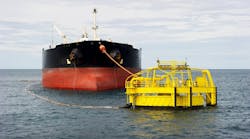 Catenary Anchor Leg Mooring (CALM) SPM buoy
 Sentinel Midstream receives MARAD record of decision for Texas GulfLink port
The ruling voids the license, halting all construction or progress. Sentinel Midstream declined comment on the ruling and would not answer questions about the status of construction.
GulfLink, sited about 30 miles offshore Freeport, Tex., is designed to export up to 1 million b/d via Very Large Crude Carriers (VLCCs) to the government of Japan and Freeport Commodities. The project involves a 44-mile, 42-in. OD pipeline and was scheduled to begin operations around 2028. The estimated $2.1 billion investment was funded as part of a broader trade agreement between the US and Japan.
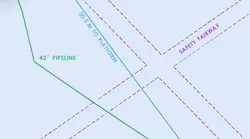
The legal battle stems from a specific rule in the Deepwater Port Act of 1974 that dictates that the federal government can only permit one crude oil deepwater port, including any supporting infrastructure, within a single designated “application area.” Because the competing SPOT project’s pipeline route physically overlaps and intersects GulfLink’s lines, the plaintiff—Citizens for Clean Air & Clean Water in Brazoria County (Better Brazoria), represented by Earthjustice—successfully argued that MARAD violated the “one port” rule when issuing GulfLink’s license in February.
The three-judge panel found that MARAD “improperly drew” the map designing the project’s official boundaries to exclude the pipelines and approved two overlapping projects in the same zone instead of only licensing one. The court wrote that the scope of the error made vacatur, not the less serious remand without vacatur, the appropriate remedy. Vacatur deems the license invalid and is used when the court finds “serious procedural errors” that cannot be easily explained or fixed with minor changes. Remand without vacatur sends the decision back to the agency for corrections but leaves the current license in place in the meantime.
SPOT project status
The $2.5-3-billion SPOT project, developed by Enterprise Products Partners in partnership with Enbridge Inc., also lies about 30 miles from Freeport. Designed to handle VLCCs, SPOT would export up to 2 million b/d. The project requires 140 miles of pipelines including onshore lines to connect to the Enterprise Crude Houston (ECHO) in southeast Houston.
That project, which faced and prevailed in legal challenges, is under construction. However, the sponsors have slowed the project as the changing global market landscape has introduced challenges to securing sufficient long-term customer commitments.
When SPOT was first designed, the goal was to send VLCCs to Asia. Now, geopolitical shifts have pushed US crude to flow heavily to Europe instead, which relies on smaller vessels that can load at existing nearshore terminals. Originally slated for service in 2026, the project officially slipped to 2027 at the earliest.
Better Brazoria hailed the ruling, with Executive Director Melanie Oldham calling it “an important victory for Brazoria County communities and for lawful, transparent decision-making.”
About the Author
Cathy Landry
Washington Correspondent
Cathy Landry has worked over 20 years as a journalist, including 17 years as an energy reporter with Platts News Service (now S&P Global) in Washington and London.
She has served as a wire-service reporter, general news and sports reporter for local newspapers and a feature writer for association and company publications.
Cathy has deep public policy experience, having worked 15 years in Washington energy circles.
She earned a master’s degree in government from The Johns Hopkins University and studied newspaper journalism and psychology at Syracuse University.