US approves license for Texas GulfLink deepwater oil export terminal
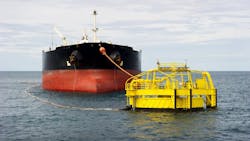
The US Department of Transportation (DOT) Feb. 3 approved a license for Sentinel Midstream to build and operate its proposed Texas GulfLink project to export crude oil from a deepwater port near Freeport, Tex.
Located 26.6 nautical miles off the coast of Brazoria County, Texas GulfLink will include an onshore terminal with as much as 18 million bbl of storage, a 42-in. OD offshore pipeline, and a manned offshore platform. Loading rates could reach 85,000 bbl/hr, with a nominal capacity of 1.2 million b/d over the course of a year.
The port’s ability to handle very large crude carriers (VLCCs) will reduce vessel congestion in nearshore waters, improve navigational safety, and enhance the logistical efficiency of US crude oil exports, DOT said in a statement. “Loading these massive vessels offshore is faster, cheaper, and more efficient than transferring cargo in nearshore waters,” DOT added.
Currently, the Louisiana Offshore Oil Port (LOOP), 18 miles offshore Grand Isle, La., is the only US port that can fully load VLCCs. Other US ports can only partially fill supertankers due to restrictions that require smaller ships to transport crude to the VLCCs.
The Texas GulfLink project is proof that when we slash unnecessary red tape and unleash our fossil fuel sector, we create jobs at home and stability abroad,” Transportation Secretary Sean Duffy said. The project could support the creation of 720 jobs for construction and operation, DOT said.
The USDOT Maritime Administration (MARAD) coordinated with the US Coast Guard, the state of Texas, and several federal agencies to review the Texas Gulf Link application to ensure it meets strict safety and security standards, DOT continued.
Duffy announced in January that MARAD would take over deepwater port licensing from the US Coast Guard, a move that DOT said would streamline environmental reviews and hasten license approvals.
About the Author
Cathy Landry
Washington Correspondent
Cathy Landry has worked over 20 years as a journalist, including 17 years as an energy reporter with Platts News Service (now S&P Global) in Washington and London.
She has served as a wire-service reporter, general news and sports reporter for local newspapers and a feature writer for association and company publications.
Cathy has deep public policy experience, having worked 15 years in Washington energy circles.
She earned a master’s degree in government from The Johns Hopkins University and studied newspaper journalism and psychology at Syracuse University.