Slim tubing-anchor improves well productivity
Tubing-anchor catchers (TACs) significantly affect production efficiency, equipment reliability, and operating costs. Traditional B2-style TACs, widely used across the oil and gas industry, create a restriction in the annular space between tubing and casing that acts as a choke point, limiting fluid flow and increasing gas interference. Wells suffer from poor pump fillage despite favorable operating conditions if the TAC restricts liquid movement to the pump intake.
Slim-style TACs provide greater flow-by area and reduce pressure drop, turbulence, and vorticity. Field results showed that wells in the DJ basin doubled production and an Eagle Ford well experienced about a three-fold increase in production after replacing conventional anchors with slim-style TACs. A Permian basin operator using the slim anchors extended runtime about six-fold from its historical average.
Rethinking TACs
TACs eliminate tubing movement (Fig. 1). This functionality increases rod-pump efficiency, prevents unnecessary tubing and sucker-rod wear, stops parted pipe from falling down the well, and reduces energy consumption. Despite this important service, it is usually treated as an afterthought. Unfortunately, the design of the traditional B2-style TACs, a standard in the oil and gas industry for decades, can create as many problems as it solves.
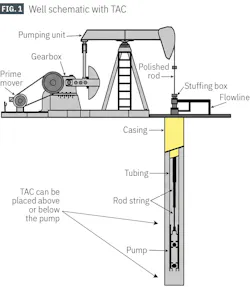
This article explores the engineering science behind those difficulties as well as the benefits exploration and production (E&P) companies have realized by replacing standard B2 TACs with slim-style anchors. Benefits include a significant reduction in workover costs, mitigation of chronic gas interference and scale buildup, and production increases.
Choke-point effect
In a rod-pumped well, the fluid—a mixture of oil, water, and gas—must travel from the reservoir formation, past the exterior of the tubing and any tools attached to it, and finally into the pump intake.
The standard B2 anchor features a large OD and heavy block-type construction. When placed inside a well, this tool creates a massive restriction in the annulus between the outside of the tubing and the inside of the casing. The annular area between the OD of a standard B2 TAC and the ID of the well casing is small compared with the flow area in the rest of the casing-tubing annulus. The anchor essentially acts as a choke point.
Research by Echometer Co. confirmed the flow-by area issues inherent with standard B2 TACs. The firm studied the production rates of 11 oil wells. Each well had a high fluid level, and the pump intake was below the perforations. Yet despite these seemingly favorable conditions, nine of the wells showed less than 90% pump fillage.
Their report stated that wells which exhibited high fluid levels had uneven fluid distributions in the wellbore below the liquid level. The area near pump intakes were primarily filled with gas with a minimal volume of liquid. A tubing anchor set high above the pump intake caused this uneven fluid distribution.
Fig. 2 shows an 800-min liquid depression test demonstrating this effect. At 2:21 AM, the liquid level resides at the tubing anchor set at 9,140 ft. Fifteen minutes later at 2:36 AM, the liquid level drops to the pump-intake depth. The liquid-level depression test verifies the existence of a gas column with little liquid below the tubing anchor.
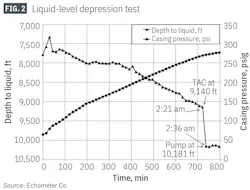
The tubing anchor in these wells provided a 2.9-sq in. flow area between the body of the anchor and the casing compared with a 14.4-sq in. flow area between the casing (4.892-in. ID) and the tubing (2.375-in. OD). The small flow area increases the upward flowing gas velocity above the critical velocity to suspend liquids, thereby preventing liquids in the upper part of the annulus from flowing downwards past the depth where the tubing anchor is set and into the pump. The anchor acts as a choke, increasing annular back pressure and restricting gas flow up through the annulus of the well.
The gas that escaped had higher velocity which made it difficult for fluid above the anchor to fall past it and reach the pump. In turn, the fluid around the pump contained high gas content, making efficient production impossible.
But inefficient production isn’t the only difficulty. The choke point created by a standard B2 TAC also produces a pressure drop which can lead to the formation of scale, iron sulfide, and paraffin. Eventually these materials plug the small annular area around the anchor, trapping formation gas and leading to a gas locked rod-pump.
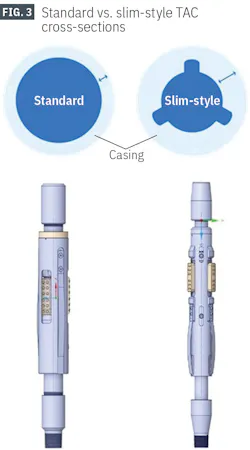
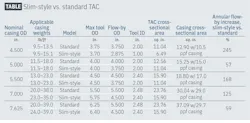
Slim-style tubing anchors mitigate these problems. These tools secure the tubing while creating more flow area around the anchor due to a reduced OD (Fig. 3, Table). Two operator case studies highlight the benefits obtained by this downhole equipment change.
Slim-style TAC performance
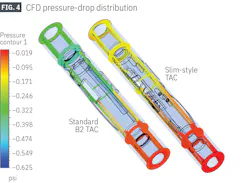
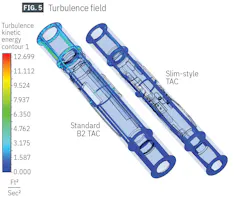
A computational fluid dynamics (CFD) study compared gas flow within the annular space around a conventional and slim 5.5-in. TAC to assess differences in flow parameters between the designs. Specifically, the analysis evaluated the performance of the anchors relative to fluid velocity, pressure drop, turbulence, and vorticity. The results highlighted two key findings: a significant pressure drop around the standard B2 tubing anchor and less turbulence and vorticity around the slim-style TAC.
The study found that the net pressure drop around a standard B2 TAC as fluid and gas pass through the annular cavity around the anchor more than doubled that around the slim-style TAC due to a wider slim-style TAC annular cavity compared with the standard TAC (Fig. 4). The slim-style TAC also had a less abrupt pressure-drop change than the standard TAC.
The slim-style TAC also reduced overall turbulence and vorticity strengths within the flow field relative to the standard B2 TAC. The abrupt changes in the pressure field in the standard TAC, along with the potential presence of flow-field obstacles, generated more turbulence and vorticity compared with the slim-style TAC (Fig. 5).
Slim-style anchor setting
The increased flow-by capacity of slim-style anchors isn’t the only recent innovation in the TAC market. The slim-style TAC product suite also includes a quick-setting tubing anchor.
Traditionally, setting a mechanical TAC requires six to eight rotations at the tool to fully extend the slips. In deep or deviated wells, surface rotations may not reach the tool. A quick-setting tubing anchor requires only one to three turns to fully set. Although requiring less turns, tension is not reduced compared with a standard B2 TAC.
Another tubing-anchor design combines the slim-style anchor with a full-bore ID. The reduced OD of previous slim-style TACs required a reduced ID that would sometimes dictate where the anchor could be placed within a well. In the case of a 5.5-in. well with 2 ⅞-in. tubing, these TACs did not support large pumps deployed through the tubing.
In these instances, the anchor needed to be positioned below the seat nipple. Sometimes factors like excess sand or regional preferences, however, necessitate an assembly with the TAC above the seat nipple, even with 2 ⅞-in. tubing. For these cases, a full-bore slim-style TAC featuring a slim OD and a full-bore ID (2.40 in. on the 5.5-in. model) allows the anchor to be placed above the seat nipple where 2 ⅞-in. tubing and associated pumps are installed.
Case Study A: Production increase
Recently, two separate E&P companies both reported a significant increase in daily crude production just by switching from standard B2 anchors to slim-style TACs. One of those companies made the switch across three mature wells in DJ basin.
The new anchor’s slim design minimized gas interference in wells with 5.5-in. casing. Specifically, the wells each experienced a 25-30% increase in the volume of gas discharged on the surface. Pump fillage improved 15-25% in each well according to dynamometer card data.
During 5 months of production, all three mature wells continued production without requiring workovers or interventions. The tubing anchors maintained tension in the production string, enabling efficient operations and avoiding unnecessary wear and tear. The increased volume of gas coming off the wells remained consistent, mitigating the risk of gas-locking despite gassier composition in this area.
The most significant benefit, however, was increased production. Each of the three wells experienced an increase in production without any notable changes to the production strings other than using the slim-style anchor. All three wells improved production to 80 b/d from about 40 b/d.
A second E&P company with a mature well in Eagle Ford basin achieved better results just by changing the TAC design. The daily production of the well also increased to 10-15 b/d from 5 b/d, with rates occasionally reaching 20 b/d.
Case Study B: record uptime
A production company operating in the Permian basin needed a solution for a well which experienced gas interference and sand fill. This 5.5-in. well used 2 ⅞-in. tubing to support a large pump. In such a design, a traditional slim-style TAC would have to be placed below the seat nipple because the anchor’s reduced OD necessitated a reduced ID. This placement was not practical, however, due to the fill.
The company used a 5.5-in. standard B2 TAC which would typically last about 30 days before the anchor had to be pulled because of gas locking or sediment buildup. The record for the longest stretch between workovers for this well was about 70 days.
The production company became an early adopter of the slim-style full bore TAC. The anchor combined a full-bore ID (2.4 in. for the 5.5-in. anchor) with a reduced OD. The design provided significantly more flow-by area around the tubing anchor than the standard anchor while maintaining an ID large enough to allow rod pumps designed for 2 ⅞-in. tubing to pass through the TAC.
The new anchor was run as part of a workover in summer 2025. With the full bore slim-style TAC in place, the well flowed without incident for more than 180 days. An eventual workover was required to replace the rod pump, not because of an issue with the anchor. This time interval represented more than a 2.5-fold improvement over the previous record and about a 6-fold greater time between workovers than the historical average. With a typical workover lasting 3 days, this well added more than a dozen production days just by replacing the standard TAC.
The author
Brad Crist ([email protected]) is owner and president of TechTAC. He holds an MBA (2006) from the University of Pennsylvania’s Wharton School of Business and a BA (1999) in Economics from Brigham Young University.
Reference
McCoy, J.N, Rowlan, O.L., Taylor, C.A., and Podio, A.L., “Tubing Anchors Can Reduce Production Rates and Pump Fillage,” URTEC-1918491-MS, Unconventional Resources Technology Conference, Denver, Colo., Aug. 25-27, 2014.