Polish Oil and Gas Congress
Key Highlights
- Oil and gas will remain important to the global energy mix, with demand expected to stay high through the middle of the century as electricity needs grow and many industries continue to depend on hydrocarbons.
- Energy security is increasingly central to Poland and Central Europe, with natural gas providing stability while investment in LNG infrastructure strengthens the region’s resilience and supply flexibility.
- The future of energy will depend on pragmatic transition and innovation, combining existing oil and gas expertise with technologies such as carbon capture, hydrogen, AI and low-carbon energy while maintaining reliable energy supplies.
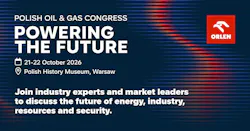
The Congress (www.polishoilandgas.com) – under the slogan ‘Powering the future’ - will take place in Warsaw in October 21-22. It is organised by ORLEN – a leading multi-energy company in the Central and Eastern European region.
Energy is the key to security and development
In Central Europe, where renewable energy sources can meet between two-thirds and three-quarters of energy demand due to geographical conditions, natural gas remains a stabilising factor for the system. Today, access to gas and oil is a guarantee of the country’s security and a prerequisite for the stable functioning of the economy. The crises of recent years have made it abundantly clear to us just how crucial stable supplies are.
More and more energy will be needed
Global demand for electricity will continue to rise, mainly due to the development of energy-intensive digital technologies, the ongoing reindustrialisation of many regions of the world, and a sharp increase in energy consumption in developing countries. The International Energy Agency’s World Energy Outlook 2025 report, in one of the scenarios presented — ‘Current Policies’ — which describes a reality based on policies actually being implemented, rather than those merely announced — indicates that demand for oil and gas will remain high until the middle of the century, and that both commodities will remain a significant part of the global energy mix.
Natural gas is supplied to industry, households and the energy sector. It is the basis for the operation of many combined heat and power plants, petrochemical plants and fertiliser plants. The outlook for the district heating sector is particularly significant, given the major role played by coal in its energy supply. Crude oil, on the other hand, forms the basis of the fuel industry, plastics production and, consequently, the majority of the economy. Looking at the situation from a different angle, one could say that these commodities are too valuable to be burnt, and there is often no viable alternative for them.
Empowering the Baltic Eagle Gas Hub
ORLEN is not only expanding its hydrocarbon production, with a view to achieving its strategic goal of increasing its own production of natural gas in Poland and abroad to 12 billion cubic metres per year, but it also trades in gas and oil. The company uses the LNG terminal in Świnoujście, Poland, which has a capacity of 8.3 billion cubic metres per year. Poland’s import capacity is set to increase shortly thanks to the planned FSRU floating terminal in the Gdańsk area. This facility, which ORLEN will also use, will enable receiving at least 6.1 billion cubic metres of gas per year. In addition, the Polish company has flexible access to regasification capacity at terminals abroad, in Klaipėda, Lithuania, and in Montoir, France. To ensure its logistical independence and strengthen its position in the global market, ORLEN has chartered a fleet of eight state-of-the-art LNG vessels.
ORLEN is a key player in the Central and Eastern European market. The scale of the Polish group’s operations, its modern transmission infrastructure and strategic connections with neighbouring countries create the ideal conditions for Poland to serve as the Baltic Eagle Gas Hub, thereby strengthening energy security in this part of the continent. Poland, and more broadly the entire region, is still seeking ways to capitalise on its potential in the development of biogas plants, carbon capture and storage technologies, and establishing a foothold in the hydrogen economy. This future will not materialise if it cannot be financed, nor if we fail to make use of the expertise and technologies we currently employ in the oil and gas industry.
A debate on the future of oil and gas
Today, there is a need for a wide-ranging discussion on the future of the oil and gas sector. The Polish Oil and Gas Congress provides a forum for discussing the challenges facing the Polish and regional industries and the energy sector. The discussions will extend far beyond the role of these hydrocarbons. A multipolar world, disruptions to supply chains, trends relating to the reindustrialisation of Europe and mounting geopolitical challenges forcing a shift in approach to energy sources and industrial commodities — these are the topics to be discussed.
Most of the discussions will focus on new technologies, including the role of artificial intelligence, machine learning and advanced solutions supporting operations in the oil and gas sector. The Young Professionals Forum will form an integral part of the event. It is a dedicated platform focusing on innovation and new directions for the sector’s development, aimed at young engineers, digitalisation specialists and local leaders. Another key point of discussion will be the domestic component – that is, the expansion and strengthening of the capacity of domestic companies, as well as their role as a modern driving force for consumer-oriented development.
The transformation of the energy sector is progressing thanks to ORLEN, which is investing in solar power, building offshore wind farms and developing the hydrogen sector. However, a stable and secure future requires pragmatism and constructive dialogue. The modern world has called into question plans for an immediate phase-out of fossil fuels. Until stable, large-scale low-carbon technologies, including nuclear power, are fully implemented, traditional energy sources will provide a safety net for energy systems.
This content is sponsored by: