Cover Critical Visibility Gaps with Rapidly Deployable, AI-Powered Video
Key Highlights
- A surge in oilfield theft risks personnel safety and operational efficiency.
- AI secures oil environments with real-time threat detection and deterrence.
- LVT security solutions augment humans for optimal coverage.

By Chad Stevens, Vice President (AVP) - Business & Market Development - Industrials
Oilfield security teams are battling a surge in coordinated criminal activity, causing costly operational disruptions, EHS incidents, and widespread economic impacts.
The Permian Basin, as one example, has experienced a spike in illegal loading at tank batteries, infrastructure cannibalization, and supply chain contamination. Annual losses in Texas are estimated at over $1 billion, excluding the opportunity cost of downtime for operators.
As an oil and gas industry security executive and integrator with over 20 years of experience developing strategies to mitigate risks, I understand why operators have traditionally accepted upstream risks when security solutions can’t provide cost-effective coverage—especially at remote sites that can rarely justify the construction of permanent power and connectivity infrastructure.
These risks and security tradeoffs are converging at a critical inflection point, however, given economic conditions, geopolitical uncertainty, and evolving crime tactics. Leadership teams in the oilfield are increasingly looking to leverage any tool that provides them with visibility and insights into their operations.
Rapidly deployable security solutions that leverage artificial intelligence are quickly becoming an essential part of active deterrence of oilfield crime, extending coverage beyond security in a unified platform that also offers visibility to enhance worker safety and increase operational effectiveness.
LVT’s mobile security units and complementary video security solutions, in particular, have contributed to more than $400,000 in annual savings for Marathon Petroleum by reducing guard spend while decreasing trespassing by 43% and all incidents by 56%.
To help you evaluate your security investments to achieve similar savings and reduce overall incidents, let’s explore four specific areas where AI-powered visibility can augment your existing risk mitigations, based on LVT’s proven results in this space.
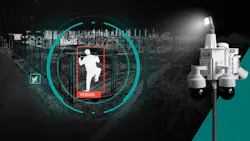
How AI Helps Secure Oil and Gas Environments
Every business investment needs justification. Your security strategy must derive the most value from humans and technology to:
● Increase operational efficiency
● Reduce cost and operational downtime
● Protect employees and security personnel
In the oilfield, it’s impossible to cover every risk efficiently when left entirely to human observation or static video/visibility tools that do not enable proactive deterrence or mitigation.
Artificial intelligence is a vital tool many of our customers are using for oilfields across a range of use cases. Although AI is still a relatively new tool in practical application, its capabilities are advancing rapidly with proven results in key security areas.
Let’s consider four areas in particular.
Real-time threat and anomaly detection
AI can learn from historical incidents and industry patterns to continually improve its threat intelligence and forecast likely attack paths. This allows security, EHS, and operational teams to anticipate issues before they occur and implement preventative measures.
AI-powered surveillance and video analytics, in particular, play a key role in this process. By overlaying AI software onto existing surveillance systems—or deploying LVT Units, which connect to your existing security monitoring platform—teams can achieve real-time threat or anomaly detection that identifies patterns, shapes, and situations like:
● Perimeter breaches
● Loitering
● Unauthorized vehicles
● Workers in red/no-go zones
● Work being done at heights, in line-of-fire areas, and in other unsafe situations
● Environmental conditions (obstructions, leaks, tank levels, etc.)
The system uses this intelligence to automatically alert personnel to review potential risks before they become problems. LVT’s system learns over time and adjusts to provide only high-value insights, helping eliminate alert fatigue.
Rapid incident response and automation
When detecting a risk, AI can initiate predefined actions for specific incidents without human intervention. For example, a perimeter breach could trigger a customized audio announcement through LVT’s AI capabilities to alert that the area is being monitored and the trespasser must leave immediately. Automated deterrence and response drastically reduce critical event response times.
LVT’s rapidly deployable platform and ease of operations extend this coverage to workover activities in the oilfield. LVT Units follow workover rigs as they move from location to location, ensuring that cameras monitor workover operations to identify if workers enter red zones or other high-risk areas.
Incident investigations
AI streamlines incident investigations by sifting through volumes of video footage and system evidence to isolate evidence of a specific incident and also identify patterns across incidents. It takes weeks or months for humans to manually review footage from multiple cameras, and it is easy to miss trends or information to effectively identify vulnerabilities and pursue bad actors. Artificial intelligence identifies specific video clips for humans to review, which significantly increases the speed and accuracy of investigations.
AI also enables very powerful search capabilities through functions like native language search for previous incidents. Search phrases like “Show me every time someone was in a no-go zone” and “Show me every time [a specific truck] entered the site” can yield immediate footage to review.
Compliance and reporting
Reporting and compliance processes are operational necessities; however, they often require manual effort that distracts teams from focusing on potential situations as they arise in real time. Reporting errors could also lead to costly fines or penalties. AI systems can greatly accelerate these reporting and compliance needs to help mitigate overall operational risk.
LVT AI is a Force Multiplier for Utilities
Although AI is not an effective standalone solution to oilfield risks, it is becoming increasingly essential for protecting against loss and preserving site safety by significantly augmenting the capabilities of security and site personnel.
When considering which AI use cases are worth exploring, ask yourself:
● What security processes take the most time for your team?
● What are your greatest vulnerabilities that present a significant risk to the organization?
These are great areas to identify where AI may integrate into your existing workflows and security ecosystem to deliver immediate time savings and significantly improve efficiency.
Human security personnel and guards will always be essential for monitoring sites and pursuing bad actors. Through the effective use of AI, teams can quickly stay ahead of their risks and ensure safety at a scale never before possible.