Why Oil & Gas Operators Are Rethinking Security Readiness
Key Highlights
- Rising geopolitical instability is reshaping oil and gas security readiness priorities.
- Traditional perimeter security models struggle against fast evolving operational threats.
- Integrated security operations improve resilience, continuity, and incident response coordination.
- Security incidents now represent major operational and financial continuity risks.
- Operators are adopting proactive security strategies supported by technology and trained personnel.
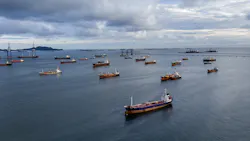

Recent instability surrounding the Strait of Hormuz has once again reminded the oil and gas sector how quickly geopolitical tensions can affect operational planning, supply movement, and business continuity.
But for many operators, the implications extend beyond global shipping lanes or commodity markets.
Periods of heightened instability often place additional pressure on onsite operations, workforce coordination, facility access control, and incident readiness. At the same time, industrial facilities are managing larger contractor populations, more complex operating environments, and growing expectations around uninterrupted operations.
As a result, many operators are reassessing whether traditional security models are still sufficient for today’s operational realities.
The challenge is no longer simply maintaining a visible security presence at the perimeter.
Increasingly, it is about improving situational awareness, accelerating response coordination, and reducing the likelihood that a security incident escalates into operational disruption.
The Limits of Traditional Security Models
Many industrial security programs were originally designed around deterrence, perimeter control, and compliance-driven staffing models.
Those functions remain essential. But elevated threat environments are exposing the limitations of security structures built primarily for static physical risk.
Today’s incidents are more dynamic and less predictable. Protest activity can escalate rapidly through social amplification. Operational interruptions can emerge from vulnerabilities that exist between physical security, workforce movement, site operations, and contractor activity.
In this environment, the challenge is no longer simply preventing intrusion.
It is identifying and managing operational disruption before it escalates into downtime, safety exposure, or continuity risk.
This is particularly relevant for facilities operating with large contractor populations, remote assets, multiple access points, or aging operational coordination models.
Security and Operations Are No Longer Separate Conversations
Historically, physical security and operations have often functioned as separate disciplines with distinct reporting structures, priorities, and response protocols. Under normal operating conditions, those divisions may appear manageable.
Elevated threat environments change that equation.
Today’s incidents move faster, escalate more unpredictably, and can quickly extend beyond perimeter concerns into operational disruption. A single security incident that causes a refinery shutdown can result in disruption of costs exceeding $1 million per day, not including downstream impacts tied to production delays, contractor idle time, workforce disruption, or reputational exposure.
In this environment, security incidents are no longer isolated site events. They are operational continuity risks.
For many organizations, the greater vulnerability is not necessarily a lack of physical barriers. It is a lack of integrated situational awareness during rapidly evolving events. Delays caused by fragmented communication, disconnected monitoring functions, or unclear escalation protocols can significantly increase operational exposure during fast-moving incidents.
“Security can no longer be treated as a support function or a nice to have. In today’s environment, strong onsite security operations are essential to maintaining safe, uninterrupted business operations.”
— David Bradney, Regional Vice President Central United States, GardaWorld Security – US
From Reactive Security to Proactive Operational Readiness
Another shift emerging across the oil and gas sector is the movement away from purely reactive security models.
Traditional guarding approaches have often focused primarily on incident response after an event occurs. While physical presence remains important, many operators are recognizing that “boots on the ground” alone are no longer sufficient in increasingly complex operating environments.
Forward-looking organizations are instead building integrated security layers designed to identify risks earlier, improve operational awareness, and support continuity before incidents escalate.
That includes frontline personnel who are:
- Familiar with the operational realities of industrial and energy-sector environments
- Trained to recognize behavioral, procedural, and environmental anomalies
- Integrated into escalation and continuity protocols
- Supported by advanced surveillance and monitoring technologies
- Capable of operating effectively during periods of elevated uncertainty
Increasingly, security functions as an operational intelligence layer that helps organizations improve visibility, accelerate decision-making, and reduce disruption risk across complex environments.
The objective is no longer simply stronger security coverage or visible perimeter presence but rather improving operational resilience.
Security Readiness Is Becoming an Operational Advantage
For oil and gas operators, the role of onsite security is evolving beyond traditional guarding responsibilities.
In increasingly complex operating environments, frontline security personnel are becoming part of the broader operational readiness strategy helping organizations improve visibility, strengthen coordination, and reduce the likelihood that isolated incidents escalate into costly disruptions.
As a result, the conversation around security investment is shifting.
It is no longer focused solely on coverage, headcount, or perimeter presence. Increasingly, operators are prioritizing operational continuity: maintaining safe, stable, and uninterrupted operations in environments where disruptions can escalate quickly and carry significant financial consequences.
Leading organizations recognize that resilience is not simply built through a larger security footprint. It comes from smarter, more integrated security operations designed to support the realities of modern industrial environments.
Organizations are increasingly exploring integrated approaches to security readiness that combine trained frontline personnel, advanced surveillance technologies, and stronger operational coordination strategies.
Learn more about modern security readiness for oil and gas operations.