Triple-action chemicals assure Permian basin flow

Permian oil and gas production systems require multifunctional chemical treatments which simultaneously address scale formation, corrosion, asphaltene-paraffin deposition, and hydrate formation. Additionally, Delaware and Permian basins produce hydrogen sulfide (H2S) gas which needs to be controlled.
Ideally, multifunctional chemical products include H2S scavenging, scale inhibition, and corrosion protection, but combining H2S scavengers with other treatments typically leads to chemical incompatibility or application limitations due to well and equipment constraints.
SLB developed a multi-functional solution to address chemical compatibility, cost reduction, and environmental exposure. A Permian basin trial tested the package against H2S coming from a new asset tie-in.
The downhole treatment minimized exposure to H2S and avoided a shutdown. H2S levels dropped from 200 ppm to 0.3 ppm on the casing, and the treatment saved $3,000 in pad equipment.
Permian flow-assurance operational, asset integrity demands
Permian oil and gas production systems operate under chemically aggressive and highly dynamic conditions. The increasing complexity of production environments has amplified the demand for multifunctional chemical treatments which simultaneously address multiple flow assurance and integrity issues.
Scale formation, corrosion, asphaltene-paraffin deposition, and hydrate risk often coexist, posing significant operational and economic burdens. This is particularly true in Delaware and Permian basins which are characterized by high-volume produced water cycles and increasing H2S concentrations, creating an environment in which mineral scaling and aggressive corrosion often occur at the same time.
Despite numerous advancements, integrating H2S scavengers into other products has faced persistent hurdles due to formulation constraints and application-specific limitations. Ideal multifunctional chemical products tailored for gas lift and capillary-string applications effectively combine H2S scavenging, scale inhibition, and corrosion protection in one solution.
The use of a single product streamlines field operations, reduces total chemical dosage, minimizes handling and logistics, and contributes to sustainability goals by lowering chemical footprints.
Combined flow assurance, asset management threats
As hydrocarbons are extracted from subsurface reservoirs, the associated fluid often contains aggressive constituents, such as dissolved gases, salts, and organic compounds which pose significant risks to infrastructure integrity, personnel safety, and production efficiency. Scale formation, corrosion, and H2S contamination represent the most persistent flow-assurance problems. Each disrupt operations, and they frequently occur in tandem.
Historically, these problems have been addressed through either discrete chemical treatments or combinations of mechanical interventions with chemical solutions tailored to resolve a specific issue. While effective when applied individually, combined treatments introduce significant inefficiencies such as increased system complexity and rigorous compatibility management. Due to the need for multiple injection systems, this approach can also lead to higher capital and operating costs, extensive chemical storage, and logistical complications.
Scale deposition occurs when dissolved minerals in produced water precipitate due to changes in pressure, temperature, or chemical equilibrium. Common scales such as calcium carbonate (CaCO3) and barium sulfate (BaSO4) form hard, adherent deposits that restrict flow, damage equipment, and reduce productivity. These deposits accumulate in tubing, valves, pumps, and surface facilities and often require mechanical removal or chemical remediation, both of which disrupt operations and increase costs.
Effective scale inhibition demands proactive chemical intervention and compatibility with formation fluids. While squeeze treatments can be effective, they are costly and require frequent reapplication. Although generally preferred, continuous-injection suffers from limited injection infrastructure in most wells, forcing operators to prioritize one treatment over others.
Both continuous and batch treatments are commonly employed to mitigate corrosion-related issues, though continuous treatment is generally preferred for its ability to provide more precise and consistent protection.
Hydrogen sulfide presents as a toxic, corrosive, and environmentally hazardous gas commonly encountered in sour reservoirs. Even at low concentrations, H2S poses significant health risks, accelerates equipment degradation, and can result in regulatory non-compliance. Mitigation typically involves chemical scavengers or mechanical separation technologies, both of which require careful management to ensure efficacy and compatibility.
Multifunctional solution
As industry embraces digital monitoring, real-time diagnostics, and automated chemical delivery systems, multifunctional products are becoming central to modern flow assurance and integrity management strategies. The simultaneous presence of scale, corrosion, and H2S issues in production systems led SLB to develop a multi-functional solution to address:
- Compatibility management: Coordinated chemical development to minimize adverse chemical interactions and enhance treatment reliability
- Cost reduction: Consolidated chemical programs and fewer injection systems to lower both capital and operational expenditures.
- Environmental and safety benefits: Optimized chemicals to reduce volumes, handling requirements, exposure risks, and environmental impact.
The primary objective required designing a single product capable of mitigating three major production issues relating to mineral scaling, corrosion, and H2S while maintaining stability and efficacy across a broad range of operational environments, including harsh downhole conditions. To meet these stringent requirements, particular emphasis was placed on achieving a balance of performance, compatibility, and deliverability during the selection of appropriate chemical building blocks.
In addition to meeting core performance criteria through targeted inhibitor chemistries, secondary additives were judiciously incorporated to provide:
- Thermal stability aligned with application-specific temperature and pressure conditions.
- Balanced pH to minimize scaling and corrosion risks while maintaining H2S scavenging efficacy.
- Reduced interfacial tension and improved fluid dispersion.
The formulation combined multiple chemistries: film-forming amines, imidazolines, quaternary ammonium compounds, and phosphonates for corrosion inhibition; phosphonate-based inhibitors and chelating agents for scale control; and triazine-based or hemiacetal-amine systems for H2S scavenging. Surfactants were also incorporated to improve wetting and fluid interaction.
Triple formula evaluation
Several triple-function formulations were screened against benchmark combined scale inhibitor and corrosion inhibitor (SICI) and standalone H2S scavengers. A comprehensive test program evaluated performance across H2S scavenging, corrosion inhibition, scale control, and field-relevant properties. Due to limited availability of inhibitor-free crude oil, mineral oil was used as a hydrocarbon surrogate in most tests.
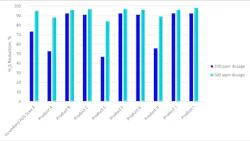
A dynamic vapor phase method assessed H2S scavenging under simulated field conditions. Formulations were tested at 200 ppm and 500 ppm with a 50% water cut at 75° C. Several formulations, notably B, F, I, and J achieved greater than 92% H2S removal at 200 ppm, with Product J reaching up to 98% reduction (Fig. 1). Other formulations showed improved performance at higher dosages, confirming a clear dose-response relationship. Importantly, the inclusion of corrosion and scale inhibitors did not negatively impact scavenging efficiency.
H2S scavenger performance (Fig. 1)
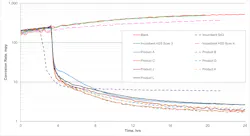
Corrosion inhibition was evaluated using bubble-cell testing with CO2-saturated brine at about 65° C. All multifunctional formulations significantly reduced corrosion rates compared with untreated conditions (Fig. 2). Products B, C, and J demonstrated the strongest performance, reducing corrosion rates to below 2 mils/year (mpy) within 24 hours. Even the lower-performing formulations maintained rates under 3 mpy. By contrast, standalone H2S scavengers showed no measurable corrosion protection, highlighting the advantage of integrated formulations.
Triple combination corrosivity (Fig. 2)
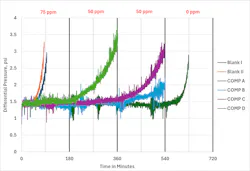
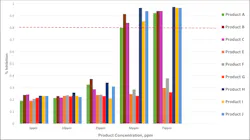
Scale inhibition was investigated using both dynamic scale loop (DSL) and static bottle testing (SBT). DSL results showed all scale inhibitor components delayed scaling relative to untreated brine, with effectiveness dependent on dosage (Fig. 3). Minimum effective dosages (MED) ranged from 25 ppm to 75 ppm, with some chemistries demonstrating higher potency. Static bottle tests confirmed that several formulations achieved more than 80% inhibition at ≥50 ppm, indicating strong scale-control capability as shown in Fig. 4.
Dynamic scale loop (Fig. 3)
Scale inhibition efficiency (Fig. 4)
Additional evaluations focused on field applicability. Product A demonstrated excellent thermal compatibility with field brine, showing no precipitation or phase separation after 24 hours at 80° C. It also exhibited minimal emulsion tendency, with rapid phase separation (<30 sec). Gas-lift testing confirmed no gunking or solids formation under vacuum and elevated temperature, indicating suitability for injection systems.
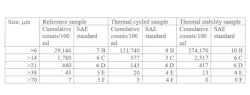
The product’s particle size was measured following Society of Automotive Engineers Aerospace Standard 4059 (SAE AS4059). The method employs a HIAC/Royco Model 8011 automatic particle-counting system. This method classifies product cleanliness according to the SAE AS4059 standard.
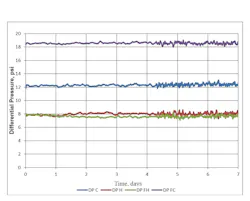
Although particle counts increased under thermal stress, dynamic testing indicated no significant deposition or plugging risk with pressure remaining stable across all temperature zones throughout the 7-day period (Table, Fig. 5). Material compatibility tests across multiple alloys showed low corrosion rates (<1 mpy), with no localized damage. Capillary string qualification testing further validated Product A’s stability and compatibility.
Dynamic stability loop (Fig. 5)
Product A particle count (Table)
Overall, the results demonstrate that properly formulated triple-function chemistries can effectively address scaling, corrosion, and H2S simultaneously without compromising individual performance. Product A showed strong potential for field deployment, meeting key operational and stability requirements across a range of simulated conditions.
Permian field trials
During a recent project in Permian basin, a major US-based operator faced the risk of full site shutdown after H2S was unexpectedly introduced from a new asset tie-in. Following successful laboratory testing, the triple-combination solution was deployed to remediate the issue.
To handle H2S treatment, the entire facility would have to be shut down to install new infrastructure. After a flowline application proved inefficient, SLB completed a health check on the well and determined how to effectively scavenge H2S while also protecting downhole equipment from corrosion and scale. The increased levels of H2S in the produced gas created significant operational problems for the producer.
To prevent production shutdowns due to third-party oil and gas transportation infrastructure compliance contracts, the producer turned to traditional commodity product methods of treating H2S in gas streams, such as MEA-triazines.
These methods, however, did not properly address the producer’s situation effectively as they only focused on the gas phase. The incumbent chemical management program also lacked the flexibility to target assets that were contributing most to H2S levels, hindering long-term optimization of the treatment programs and constraining the existing infrastructure when the new assets were brought online.
To address the issue, stakeholders selected Product A, which combined asset integrity, flow assurance, and H2S treatments. The combination product allowed for a single point of treatment, eliminating the need for multiple tanks and pumps on site, while also achieving the most contact time to scavenge H2S. The product was applied via capstring-gas lift injection to prevent solids formation and gunking.
Introducing Product A into the problem well and monitoring the outlet gas composition of the facility to measure H2S over time showed that the treatment consistently delivered significantly lower levels of H2S when compared with untreated outlet gas. With the combination product in place, the team implemented a monitoring and surveillance plan to ensure successful asset integrity and flow assurance. During the 70-day trial period, a total of 63 samples were collected from the production system including corrosion coupons, water analysis, chemical residuals, and H2S-in-gas samples.
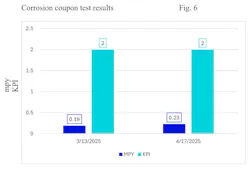
Per the company’s standard operating procedures for new chemistry applications, the team utilized weight loss corrosion coupons with an average exposure time of 33 days. The low material loss in coupons confirmed the successful performance of Product A when compared with the operator’s KPIs (Fig. 6).
Corrosion coupon test (Fig. 6)
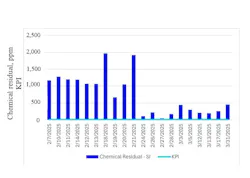
Chemical residuals monitored the consumption of the scale inhibitor portion of Product A. Results confirmed Product A’s successful performance in a production system known for high-risk mineral scale deposition when compared with the operator’s KPI (Fig. 7). The levels of scale inhibitor observed in the samples collected confirmed that, at the prescribed dosage, the product was capable of adequately inhibiting mineral scales.
This novel application avoided a 7,000-boe/d shutdown estimated to cost $400,000. It delivered an estimated chemical cost-savings of $182,680/yr and minimized exposure to H2S due to its downhole application. H2S levels dropped from 200 ppm to 0.3 ppm on the casing. The treatment also saved $3,000 in pad equipment by eliminating 50% of the necessary chemical tanks and a pump.
Chemical residuals (Fig. 7)
The authors
Subhasis De is a staff scientist in the new product development team within the sustainability group at SLB. Dr. De holds a PhD (2007) in Organic Chemistry from Wake Forest University in North Carolina.
John Salcido is a Technical Service Professional for SLB ChampionX. He holds a BS (2011) in biology from St. Mary’s University in San Antonio, followed by graduate studies (2020) in biomedical engineering at UTSA and the University of Texas Health Science Center at San Antonio.
Miranda Lozoya is a senior chemist at SLB in Sugar Land, Tex., supporting upstream oil and gas operations. Miranda holds a BS (2021) in chemistry from Texas Tech University in Lubbock, Tex.
Don Baeza is a technical advisor at SLB within chemical technologies. Don holds a BS (1996) in chemistry from Angelo State University, San Angelo, Tex.