Chlorine dioxide removes Permian basin fracture damage
Chlorine dioxide (ClO2) provides strong oxidization to break down scale, biofilms, and heavy hydrocarbon build-ups in unconventional fracture wells. A 10-well Permian basin ClO2 restimulation trial showed an average 76% increase in flowing bottom-hole pressure, and an additional 60 treatments increased bottom-hole pressures by 70-300%.
Recovery factors (RF) for most Wolfcamp wells exceeded 10%. The average gas RF among six treated wells was 20% with an average 69% improvement over pretreated RFs.
An economic and production performance analysis compared a ClO2 treatment with a refracture stimulation (refrac) for a Permian basin well. Post-ClO2 stimulation production data came from actual well service and performance, while refrac data came from a theorical production model.
Although the ClO2 treatment produced less oil than the refrac stimulation, it paid off in about half the time due it its lower cost. The ClO2 restimulation had about 2.7 times more estimated ROI than the refrac.
ClO2 for well remediation
ClO2 serves as a broad-based biocide and oxidizer to destroy biofilm and is registered by the US Environmental Protection Agency (EPA) as a disinfectant and sanitizer in its liquid form.
It is an unstable gas and is typically generated at point of use by reacting an aqueous solution of sodium chlorite with acid. The resultant ClO2 gas dissolves in the water, making it convenient for oilfield applications. Best field practice, however, uses three rather than two precursors and generates ClO2 gas directly dissolved in water.
Reacted ClO2 degrades within hours and leaves no byproducts, which makes it ideal for wellbore clean-up and stimulation operations. ExxonMobil has used it to remove lost fluid materials, residual polyacrylamide friction reducers, polymers, and other permeability-damaging species.
The oxidizer has also been used in more traditional biocide applications such as removing biofilms in saltwater disposal wells. In conjunction with HCl, it removes scale and other inorganic elements which lead to injectivity or productivity declines.
ClO2 with acid (ClO2+acid) produces a reaction to break down scale, biofilms, and heavy hydrocarbon build-ups. It keeps iron, sulfide, strontium, barium, biomass, paraffin, and asphaltene in solution for flowback and clean-out. Due to the rapid degradation of ClO2 in solution, flow back needs to occur within 36 hr of pumping the job.
In unconventional well-propped fractures, scales such as iron sulfide, strontium-barium sulfide, and calcite, as well as oil-related species such as asphaltene, paraffin, and biofilms, all degrade fracture conductivity and lead to premature production decline. Treatment chemistry needs to be tailored to the contaminants. Iron sulfide, barium sulfate, strontium sulfide, and calcite scales require specific acid-ClO2 ratios for breaking down the species and keeping them in solution during flowback. Biomass removal requires about 4,000 ppm ClO2 concentration in combination with nano-surfactants.
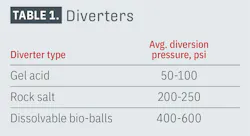
The treatment needs diversion to effectively contact the entire interval. Without diversion, the treatment will flow to the path of least resistance and bypass much of the damage. Common diversion methods include gelled acid, rock salt, and dissolvable bio-balls. Table 1 lists the average diversion pressure for these agents. Diversion improves with increasing diversion pressure, and bio-balls provided diversion for over 90% of the treatments.
A 10-well Permian basin ClO2 restimulation trial in Reeves and Culberson Counties showed an average 76% increase in flowing bottom-hole pressure, indicating that the treatment successfully removed these contaminants.
Based on this initial success, more than 40 wells and 60 treatments were trialed in Reeves, Culberson, Pecos, and Martin Counties. Table 2 details the oil and contaminant attributes in the regions. After treatment, bottom-hole pressures increased 70-300%.

ClO2 treatments were also tested in artificial lift systems using electric submersible pumps, gas lift, and rod pumps, with similar improvements in bottom-hole pressure, static liquid level, or production.
Treatments required several frac pumps, ClO2 generation equipment, and diverters with associated tools. Nano-surfactants were mixed in the water and acid tanks before pumping the jobs. Treatments typically used 1,500-4,000 bbl of total fluid which included acid, ClO2, spacers, and diverters. Pump rates were typically 15-32 bbl/min and jobs took 1-2.5 hr.
ClO2 case studies
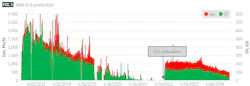
Well A-0 in Delaware basin, Reeves County, provided the first ClO2 stimulation trial. Production was via gas lift, but the well had been shut in and was considered a plug and abandoned candidate. In January 2023, ClO2+acid stimulation addressed scale damage from iron sulfide and barium sulfate.
Immediately after stimulation, oil and gas production increased to 125 bo/d from about 1 b/d before shut in (Fig. 1). Cumulative recovery increased to 870,000 boe from about 623,000 boe in 18 months. Fig. 1 shows plateaued production immediately after stimulation for 7 months before entering a decline rate like the previous pre-stimulation decline.
A pressure diagnostic analysis (PDA) of production versus material balance time (MBT) revealed a linear flow regime before transitioning to boundary dominated flow (BDF). That the well could return to linear flow after stimulation showed that it had not reached BDF before shut in. The decline between 2016-20 therefore came mostly from damage rather than reservoir depletion. This trend was observed in about 60-70% of ClO2+acid stimulated wells.
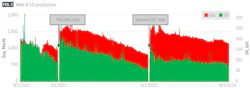
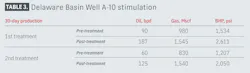
A similar result was observed in a well using an electric submersible pump (ESP) for artificial lift. Well A-10 produced about 90 b/d before treatment (Table 3). Two stimulations performed 15 months apart improved production to 187 b/d from 90 b/d after the first treatment and to 125 b/d from 60 b/d after the second treatment (Fig. 2). ESP sensors recorded increases in downhole pressure from each stimulation. PDA analysis showed that oil EUR increased 48% to 395,000 bbl from about 273,000 bbl.
Production data showed a smaller decline 12 months after the second ClO2 EOR treatment compared with the first treatment’s decline (Fig. 3). Based on PDA analysis, both linear flow and BDF were observed in the first treatment, but a transition to BDF did not occur within the time of the second treatment’s flow analysis.
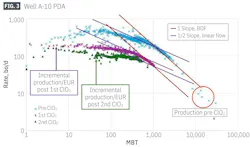
The linear flow period in the second treatment was longer, in dimensionless time, than the linear flow period in the first treatment. This analysis indicates that the second treatment further cleaned the well, and similar second-treatment improvements were observed in multiple wells.
A total of 10 ClO2 treatments pumped into six Reeves County wells produced about 480,000 bbl and 5.3 bcf (1.385 MMboe) of incremental production with an overall treatment cost of about $900,000.
Well B-1 in Wolfcamp B, Pecos County, provided an opportunity to test ClO2 treatments in a different area than the first trials. The formation contained lower API gravity oil and exhibited different contaminants than the Reeves County wells. Well B-1 used an ESP for artificial lift.
The study compared treatment results from Reeves County with those in a part of Delaware basin which contained different reservoir, hydrocarbon, scale, and PVT properties. Initial production started in May 2022, and the ESP needed replacement a year later. During replacement, a ClO2 treatment cleaned scale and paraffin.
After the first treatment, production increased to 400 b/d from 180 b/d. A second ClO2 treatment 12 months later increased production to 225 b/d from 145 b/d. Static BHP pressure increased to 3,580 psi from about 975 psi after the first treatment, and to 2,700 psi from 1,210 psi after the second treatment.
The well produced a cumulative 6,600 bbl of oil 30 days after the first treatment and an additional cumulative 3,500 bbl of oil 30 days after the second treatment.
Offset Well B-2 experienced similar performance uplift with a ClO2 treatment. After initial treatment, the well experienced an increase in GOR to 650 Mscfd from 230 Mscfd. This increase resulted from two large gas-filled reservoir zones which had been isolated from the wellbore due to scale, biofilm, or fracturing fluid gel. ClO2 broke and removed these contaminants, allowing gas to flow from these previously isolated intervals.
Recovery factors for the Reeves County Delaware basin Wolfcamp wells showed significant improvement over estimated RF pre-treatment. RF calculations began with stimulated reservoir volume (SRV) estimates derived from pilot-well open-hole logs and core samples, fracture propagation modeling, stress and geo-mechanical profiles, and stimulation design.
The SRV produced oil and gas in-place estimates (OIP & GIP), and RF was determined by comparing cumulative production before and after ClO2 treatments to the OIP & GIP estimates.
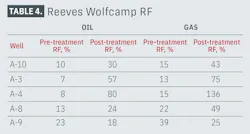
After treatment, most wells exceeded 10% RF. The average oil RF among the six treated wells was 12% with an average 42% improvement over pre-treated RFs (Table 4). The average gas RF among the six treated wells was 20% with an average 69% improvement over pre-treated RFs. The gas improvement may have occurred from contact with new gas bearing sands post-treatment as observed in Well B-2 in Pecos County.
ClO2 stimulation vs. refracs
Refracture treatments for RF improvement were common in unconventional wells with sub-par early completion designs which under-stimulated the reservoir. Refracs, however, require new liners, additional cementing, new perforations, isolation equipment, and stimulation services, making them expensive to implement.
Due to these costs, wells with later, more efficient stimulations rarely provide viable candidates for refracs. Between 2023-25, for example, the Permian basin only had 53 refracs out of 15,392 total completions.
In cases where formation and proppant damage produce subpar well performance, however, both refracs and ClO2 treatments can provide uplift by bypassing or cleaning damage, respectively. Such damage occurs from degraded gel residue, scale, asphaltene, and paraffin.
An economic and production performance analysis compared a refrac with a ClO2 treatment for a Permian basin well. The test well (Well R) was drilled and completed in 2025 in Wolfcamp A, Culberson County. Post-ClO2 workover production data came from actual well service and flow performance, while refrac data derived from a theoretical production model based on fit-for-purpose reservoir, production, and RTA modeling.
Wolfcamp Well R
Well R contains a 7,058-ft lateral. The first 4,300 ft included 20 stages in Zone A with six clusters 8 ft apart and 183 ft of blank between clusters. The remaining lateral contained 13 stages in Zone B with clusters 38 ft apart. The stimulation used a hybrid slickwater-X-link gel fluid. Most of the proppant was 40/70 and 30/50 mesh. Both stages were completed with about 440,000 lb of proppant and 7,800 bbl of fluid.
During 2017, hydrocarbon production declined to less than 20 boe/d while water cut increased to 99%, making the well uneconomic. The operator shut it in and considered plugging and abandoning it before deciding on a ClO2 stimulation.
ClO2, refrac treatments
For the ClO2 stimulation, treatment required removing the jet pump artificial-lift system, cleaning out the lateral to TD, pumping ClO2, installing single-point gas lift (to avoid damage previously experienced in the jet pump from scale and reservoir solids), and bringing the well back on production.
Workover operations started early 2025. Lateral cleanout proceeded to about 16,685 ft with only one hard tag encountered from a scale bridge at the heel above the first perforations. Treatment included six stages with about 2,900 bbl ClO2+acid treatment volume. Nano-surfactants added to the treatments aided long-term productivity.
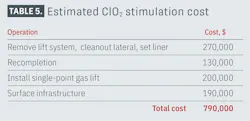
Fluid samples collected during the first weeks of flowback contained a high-viscosity substance most likely comprised of residual degradation products from the crosslinked gel which had not flowed back since the original production in 2015. Table 5 lists the cost breakdown of the ClO2 operation. Total cost was $790,000.
For the hypothetical refrac case, initial procedures would require removing the jet pump artificial-lift system, pressure testing the casing, cleaning out the lateral to TD, and running wireline to identify tie-in points for the new stages and perforations.
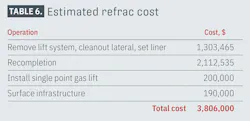
An expandable liner would be subsequently set inside the existing production casing and the well restimulation performed using the plug-and-perforate technique for 32 stages containing 170-ft stage lengths and nine clusters per stage. After stimulation, a single-point gas lift would produce the well. Table 6 lists the expected cost breakdown of the operation. Estimated total cost is $3,806,000.
Production analysis
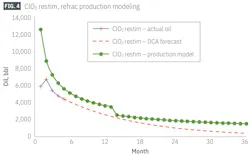
Production analysis of the ClO2+acid restimulation included the first 4 months of actual production data. Initial 30-day (IP30) rates were about 230 bo/d and 1.7 MMscfd, which represented about 65% of the initial 2015 rates. The well produced more cumulative hydrocarbons 9 months after the treatment than the 9-month cumulative after its initial completion. Decline analysis (DCA) on these data produced a 5-yr production projection. Fig. 4 shows post-treatment rates and the extended forecast.
Production analysis of the refrac required an estimate of the refrac’s SRV based on a calibrated model of the initial fracture network along Zones A and B. A fracture propagation model required the stress profile of Well R for input to estimate the SRV. Estimated oil and gas in place within the SRV came from a petrophysical model which included porosity, permeability, and water saturation.
The theoretical production from the refracture operation was based on production modelling using the depletion that the existing fracture system created, and the additional depletion caused by fractures created by the refrac based on a realistic completion schedule.
The post-refrac production profile used a late linear flow model to produce a 5-yr production forecast for economic analysis and net present value (NPV) calculations. Fig. 4 compares this prediction with the ClO2+acid stimulation production.
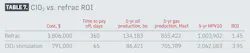
The ClO2+acid stimulation had a lower production profile than the refrac, but it paid off in about 65 days compared with about a year for the refrac. The significantly lower cost of the ClO2+acid stimulation provided better NPV, with a $2.1 million 5-yr NPV(10) for the ClO2+acid restimulation vs. $1 million for the refrac option (Table 7). ROI for the ClO2+acid restimulation was 3.95 vs. 1.45 for the refrac.
Bibliography
Dalamarinis, P. and Fusselman, S., “A New Concept of Enhanced Oil Recovery (EOR) in Permian Basin. Chlorine Dioxide (CLO2) as Re-Stimulation Agent in Unconventional, Multi-Fractured Horizontal Wells,” SPE-223521-MS, SPE Hydraulic Fracturing Technology Conference and Exhibition, The Woodlands, Tex., Feb. 4-6, 2025.
Dalamarinis, P., Proaño, E., Fusselman, S., and Hoehner, A., “Chlorine Dioxide (ClO2) Fracless Re-Stimulation in Legacy Hydraulic Fractured Wells. An Alternative to Refrac Operations,” SPE-230595-MS, SPE Hydraulic Fracturing Technology Conference and Exhibition, The Woodlands, Tex., Feb. 3-5, 2026.
Dalamarinis, P., Smith, B., and Stephen Fusselman, S., “Acid Restimulation in Legacy Wolfcamp Wells Utilizing Chlorine Dioxide (ClO2). An Operator Case Study of Reservoir Conductivity and Near Wellbore Fracture System Reactivation,” URTeC: 3818857, Unconventional Resources Technology Conference, Denver, Colo., June 13-15, 2023.
About the Author
 Alex Procyk
Alex Procyk
Upstream Editor
Alex Procyk is Upstream Editor at Oil & Gas Journal. He has also served as a principal technical professional at Halliburton and as a completion engineer at ConocoPhillips. He holds a BS in chemistry (1987) from Kent State University and a PhD in chemistry (1992) from Carnegie Mellon University. He is a member of the Society of Petroleum Engineers (SPE).