IEA sees potential for looser oil, LNG markets after Hormuz crisis

Global oil and natural gas markets could face a period of more abundant supply and lower prices once disruptions in the Middle East ease, although the timing and extent of any recovery remain uncertain, according to the International Energy Agency's (IEA) World Energy Outlook 2026.
The outlook points to sharply different demand trajectories depending on how governments respond to the 2026 energy crisis. Under IEA's Stated Policies Scenario (STEPS), global oil demand levels off at around 103 million b/d by 2030 before declining gradually, while natural gas demand continues growing until the mid-2030s. Under the Current Policies Scenario (CPS), consumption of both fuels continues to increase.
The projections assume that constraints on Gulf oil and gas exports will ease into 2027 and that conditions will allow unimpeded transit through the Strait of Hormuz by end-2027. IEA cautioned that the scenarios are not forecasts and that considerable uncertainty remains over the duration of the crisis and the future of Middle East exports.
The disruption to energy flows through the Strait of Hormuz has resulted in cumulative losses of 2.8 billion bbl of oil and 60 billion cu m (bcm) of natural gas supply from the Gulf. At its peak, global oil supply fell by 16.1 million b/d from pre-conflict levels.
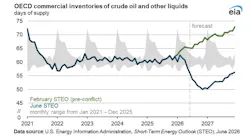
Ample inventories, increased production and exports from non-Gulf suppliers, alternative export routes, and reduced Chinese crude imports helped cushion the initial impact. IEA member countries also coordinated the release of 400 million bbl of emergency oil stocks, announced Mar. 11, 2026.
As inventories declined and supply disruptions continued, however, higher prices increasingly weighed on consumption. Diesel markets have been particularly strained, with prices exceeding $200/bbl amid disruptions to Middle Eastern product exports and reduced Russian supplies.
IEA's November 2026 Oil Market Report expects global oil demand to decline by around 2.7 million b/d in 2026, its first annual decrease since 2020. Natural gas demand is expected to fall by around 1.5%, or 65 bcm.
Oil demand and price outlook
IEA's longer-term projections differ considerably across scenarios.
In the CPS, which considers policies and regulations already in place, global oil demand rises to around 106 million b/d in 2035 and 114 million b/d by 2050. Reduced passenger car consumption from electrification, efficiency improvements, and biofuels is more than offset by rising demand from petrochemicals, aviation, and heavy freight trucks.
In the STEPS, which also accounts for formally proposed policies and government strategies, oil demand levels off at around 103 million b/d by 2030 before declining to 102 million b/d in 2035 and 96 million b/d by 2050.
The Additional Response Case (ARC) examines further measures under consideration by governments to reduce import dependence, diversify energy supplies, and accelerate electrification. Oil demand in this case is more than 4 million b/d below the STEPS level by 2035 and falls to 85 million b/d by 2050.
The differences in demand are reflected in IEA's oil price projections. Under the CPS, crude prices reach $85/bbl in 2035 and $106/bbl in 2050, compared with $75/bbl and $70/bbl, respectively, in the STEPS. The ARC puts prices at $72/bbl in 2035 and $62/bbl in 2050.
LNG expansion raises prospect of prolonged surplus
Natural gas markets face a similar divergence, with a major expansion in LNG export capacity expected over the next decade.
Around 350 bcm of new LNG supply is set to enter global markets between 2025 and 2035. The US leads the expansion, and IEA estimates that LNG supply capacity could increase by more than 50% if all planned projects proceed.
In the CPS, stronger gas consumption absorbs the new LNG supply, requiring prices in major importing markets to rise again in the 2030s to support additional investment.
Under the STEPS, slower demand growth leaves an LNG supply overhang that persists for longer. Gas demand levels off at around 4,800 bcm from the 2030s onward, and excess supply pushes import prices toward the short-run marginal cost of supply.
The imbalance could be more pronounced in the ARC. Persistent uncertainty over Middle East exports leads price-sensitive Asian importers to rely more heavily on domestic energy resources and invest less in LNG import terminals, pipelines, and other gas infrastructure. If Middle East supplies subsequently recover and exporters proceed with their expansion plans, IEA sees the potential for a large and lasting LNG surplus.
By 2050, global natural gas demand reaches approximately 5,800 bcm in the CPS, compared with around 4,800 bcm in the STEPS and 4,100 bcm in the ARC.
Despite the possibility of weaker prices, IEA expects continued upstream investment to be necessary to replace declining production from existing fields.
Oil and gas fields naturally decline at around 8-9% annually, with generally higher rates outside the Middle East. Nearly 90% of the $550 billion invested annually in upstream oil and gas over the past 5 years has gone toward offsetting production declines rather than meeting demand growth.
Global upstream investment is estimated at around $550 billion in 2026, about 1% above 2025, while the IEA Upstream Capital Cost Index is expected to increase by around 8%.
Additional production could come from countries including the United Arab Emirates (UAE) and Venezuela. The UAE, which left OPEC in May 2026, plans to expand crude production capacity to 5 million b/d by 2027. Its production reaches 5.8 million b/d in 2035 under the STEPS.
Venezuelan production is projected to rise to 1.5 million b/d by 2035 in the STEPS, supported by around $70 billion in cumulative investment to refurbish existing facilities and develop new fields.
IEA estimates that even in the ARC, where oil and gas demand declines, around 9 million b/d of new oil projects and 500 bcm of new natural gas projects will be required by 2035 to offset declining output from existing fields.