IEA sees oil market surplus returning as Gulf exports recover
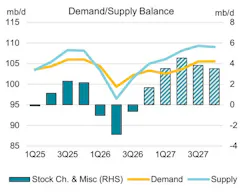
The global oil market is showing signs of rebalancing as recovering crude exports from the Middle East lift supply, although persistent disruptions to refined product markets, particularly diesel, continue to weigh on consumers, the International Energy Agency (IEA) said.
In its Nov. 13 Oil Market Report, IEA said global oil supply increased 2.3 million b/d month-on-month to 105.4 million b/d in October, following a 3 million-b/d increase in September. Output has risen 5.3 million b/d since August as Gulf exports recovered despite continued attacks on energy infrastructure and commercial tankers.
The stronger supply outlook has prompted the agency to raise its fourth-quarter 2026 supply estimate by 3.3 million b/d. Global supply is now expected to decline by an average 4.8 million b/d for the full year before rebounding by 6.6 million b/d in 2027 to average 108.1 million b/d.
The recovery in exports has eased market tightness and pushed crude prices lower. North Sea Dated crude fell 32% from an early-October high of $136/bbl to about $93/bbl at the time of the report, although prices remained $22/bbl above prewar levels.
Gulf oil exports, excluding Oman, reached 18.4 million b/d in October, about 26% below prewar levels. Crude exports accounted for most of the recovery, reaching 15 million b/d, equivalent to 82% of prewar volumes.
However, IEA cautioned that continued attacks on shipping remain a significant downside risk to the supply outlook.
Demand under pressure
Global oil demand is forecast to decline by 2.7 million b/d in 2026 to 102.3 million b/d, reflecting disruptions to refined product and liquefied petroleum gas exports from the Gulf, elevated fuel prices, and weaker consumption across major markets.
The contraction is expected to moderate in fourth-quarter 2026 to 2.7 million b/d year-on-year, compared with an average decline of 4.4 million b/d in the second and third quarters.
IEA expects demand to rebound by about 2 million b/d in 2027 to 104.3 million b/d as supply chains normalize and economic activity improves. However, the recovery will be uneven across products.
LPG and ethane, together with naphtha, are expected to account for nearly 80% of incremental demand in 2027 as petrochemical feedstock availability improves. By contrast, gasoline and diesel consumption are forecast to remain nearly flat, as elevated fuel prices accelerate vehicle electrification and improve fleet efficiency.
China remains a major source of demand weakness. Chinese oil demand fell 1.3 million b/d year-on-year in September, a 7.1% decline, with reductions across gasoline, diesel, naphtha, LPG/ethane, and fuel oil. IEA attributed the weakness to high fuel prices that are accelerating electrification, and a sluggish economy.
The agency expects Chinese oil demand to decline by 560,000 b/d in 2026 before recovering by 540,000 b/d in 2027.
US oil demand is also expected to weaken, declining by an average 130,000 b/d in 2026 before remaining virtually flat next year.
Diesel supply
Despite improving crude availability, refined product markets remain tight, particularly for middle distillates.
Global refinery throughputs declined by 1.3 million b/d month-on-month to 81.3 million b/d in October as seasonal maintenance peaked. Runs are expected to recover to 84.7 million b/d in December, with global throughputs projected to increase by 2.5 million b/d in 2027 to average 84.3 million b/d.
Refinery margins weakened in October as record freight costs squeezed refiners, particularly in Asia. US refiners benefited from lower domestic crude costs, although weaker gasoline prices partly offset the advantage.
The product market recovery also remains uneven. In the Atlantic Basin, middle distillate cracks averaged about $80/bbl in October, compared with $22/bbl for gasoline. Naphtha and fuel oil cracks were heavily negative for much of the period.
European diesel prices declined 11% from early-October levels but remained close to $180/bbl, about 77% above prewar levels.
IEA said continued attacks on Russian energy infrastructure have further constrained diesel supplies to international markets, adding to losses from the Middle East. Although Russian net product exports increased by 20% in October, diesel exports doubled to 270,000 b/d, their highest level since June.
The agency expects the accelerated release of emergency diesel stocks to help bridge the supply gap until refinery operations and product output recover.
Inventories show mixed recovery
Observed global oil inventories increased by 52 million bbl, equivalent to 1.7 million b/d, in October, marking the first monthly increase since June.
The increase was largely driven by oil on water, which rose by 86 million bbl to its highest level since January as Gulf crude exports strengthened. However, inventories held on land continued to decline and remained at their lowest level since at least 2016.
OECD total inventories fell by 47 million bbl, including a 41-million-bbl decline in industry stocks. Since the outbreak of the war, observed global inventories have fallen by a cumulative 462 million bbl.
IEA member countries have released about 349 million bbl of emergency stocks since Mar. 11. A further 71 million bbl is scheduled for release through February 2027, providing an average of about 600,000 b/d of additional supply over the period.
About 15 million bbl of diesel is scheduled for release, primarily from government stocks in France and Germany.
IEA said the global oil market is expected to return to surplus in fourth-quarter 2026, with a more substantial surplus projected for 2027. However, the outlook remains vulnerable to renewed attacks on shipping and energy infrastructure, while tight refined product supplies, especially diesel, remain a major concern.
About the Author
 Conglin Xu
Managing Editor-Economics
Conglin Xu, Managing Editor-Economics, covers worldwide oil and gas market developments and macroeconomic factors, conducts analytical economic and financial research, generates estimates and forecasts, and compiles production and reserves statistics for Oil & Gas Journal. She joined OGJ in 2012 as Senior Economics Editor.
Xu holds a PhD in International Economics from the University of California at Santa Cruz. She was a Short-term Consultant at the World Bank and Summer Intern at the International Monetary Fund.
Related
 Global known crude stock builds
 Demand/Supply Balance.

