JPMorgan sees global oil market return to surplus

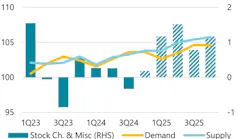
The global oil market returned to surplus in September as recovering Middle Eastern exports and weaker demand eased supply pressures stemming from the Iran war, according to JPMorgan estimates. The assessment contrasts with the International Energy Agency's (IEA) October outlook, which projected continued supply deficits through yearend.
JPMorgan estimated that global oil supply exceeded demand by 1.1 million b/d in September, with the surplus widening to 1.4 million b/d in October. By comparison, IEA's Oct. 14 Oil Market Report estimated a supply deficit of about 790,000 b/d in September, a difference of nearly 1.9 million b/d between the two assessments.
IEA's estimates indicated continued inventory depletion. Global observed oil stocks declined by about 10 million bbl in September, as a 113 million bbl draw in onshore inventories more than offset a 103 million bbl increase in oil on water. At the end of September, global observed inventories were 509 million bbl below end-February levels.
The contrasting assessments may reflect differences in supply and demand estimates, inventory coverage, and reporting cutoffs. IEA's October report projected a fourth-quarter supply deficit of about 1.8 million b/d, based on global supply of 101.7 million b/d and demand of 103.5 million b/d.
Supply recovery
According to JPMorgan, Middle Eastern oil exports recovered to about 20.7 million b/d in October from a low of 9.8 million b/d in March, although volumes remained below prewar levels. Global crude imports reached 44.9 million b/d, up 1.3 million b/d year over year (y-o-y).
Supply growth outside the Middle East also contributed to the improving balance. JPMorgan estimated Latin American crude production increased by about 1.5 million b/d y-o-y, supported by gains in Brazil, Venezuela, Guyana, and Argentina. At the same time, global oil demand has declined by an estimated 3.3 million b/d since the conflict began in late February, reflecting the impact of elevated fuel prices and supply disruptions on consumption.
IEA similarly reported a substantial recovery in Gulf crude exports, which increased by 4.4 million b/d to 13.9 million b/d in September, reaching more than 75% of prewar levels. IEA figure covers Gulf crude exports, a narrower category than JPMorgan's broader Middle Eastern oil export estimate.
IEA cautioned that refined product supplies remained severely constrained. Refined product and LPG shipments from the Middle East remained below half their prewar levels, while global observed oil inventories were 509 million bbl below end-February levels at the end of September.
Outlook for 2027
For 2026, IEA forecast global oil supply would average 100.7 million b/d, down 5.8 million b/d from 2025, while demand would decline by 2.6 million b/d to 102.4 million b/d.
The agency expects a substantial recovery in supply next year, with global production rising by 7.7 million b/d to 108.3 million b/d, compared with projected demand growth of 2 million b/d to 104.4 million b/d. The figures imply a return to surplus in 2027, although IEA warned that diesel markets could remain tight well into the year because of depleted inventories and continued refining disruptions.
Separately, HSBC raised its fourth-quarter 2026 crude production forecast for Saudi Aramco to 8.3 million b/d from 6.3 million b/d, citing a faster-than-expected recovery in exports. The bank also increased its 2027 production forecast to 9.8 million b/d from 8.8 million b/d and expects Saudi output to approach 10 million b/d by mid-2027.
Oil price movements
Oil prices fell over 8% on Nov. 4 as investors weighed the implications of the US midterm elections, which gave Democrats control of both chambers of Congress.
The results raised expectations of increased political pressure on President Donald Trump to seek a diplomatic resolution to the Iran conflict, potentially reducing the geopolitical risk premium embedded in crude prices.
About the Author
 Conglin Xu
Managing Editor-Economics
Conglin Xu, Managing Editor-Economics, covers worldwide oil and gas market developments and macroeconomic factors, conducts analytical economic and financial research, generates estimates and forecasts, and compiles production and reserves statistics for Oil & Gas Journal. She joined OGJ in 2012 as Senior Economics Editor.
Xu holds a PhD in International Economics from the University of California at Santa Cruz. She was a Short-term Consultant at the World Bank and Summer Intern at the International Monetary Fund.
Related
 oil market representation
 Demand/Supply Balance.

