Tight product supplies lift US summer refinery utilization to highest level since 1998
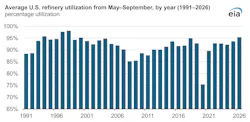
US refinery utilization averaged more than 95% during May–September 2026, the highest for those months since 1998, as tight global product supplies, particularly for diesel, strengthened margins, and demand for US exports, according to the US Energy Information Administration (EIA).
The strong operating rates coincided with a widening profitability gap between US refiners and those in Europe and Asia. In its October Oil Market Report, the International Energy Agency (IEA) said relatively inexpensive crude supplies helped US refiners achieve record margins in September, while rising feedstock and freight costs squeezed competitors overseas.
Despite elevated utilization, total US refinery output reached only its highest level since 2019. US refining capacity has declined 4% since then, limiting the output gains available from higher operating rates, EIA said.
Utilization eased during the first 3 weeks of October from its summer highs, but remained above the 2021–25 seasonal average.
US margins outperform
IEA’s US Gulf Coast light sweet cracking margin indicator averaged $49.84/bbl in September, up $5.97/bbl from August. Heavy sour coking margins rose $11.57/bbl to $61.36/bbl, reflecting the advantage of access to lower-cost crude.
By comparison, light sweet cracking margins averaged $30.15/bbl in Northwest Europe and $19.26/bbl in Singapore, down $5.97/bbl and $7.34/bbl, respectively. Medium sour cracking margins briefly turned negative in both regions during September.
Record tanker freight rates widened regional crude cost differences, helping US refiners outperform competitors in Europe and Asia. IEA warned that deteriorating profitability could prompt some European refiners to reduce runs despite tight product supplies and low inventories.
US product inventories also remained tight despite high refinery activity. Combined gasoline, jet fuel, and gasoil/diesel stocks entered October at 352 million bbl, their lowest seasonally adjusted level since 2008, according to IEA. Robust exports and autumn maintenance added pressure on inventories, while unplanned Midwest refinery outages further supported regional margins.
Maintenance reduces global runs
Global refinery crude throughput fell 1.2 million b/d month on month (m-o-m) to 81.8 million b/d in September as seasonal maintenance in the US, Canada, and parts of Europe outweighed a recovery in Chinese runs.
IEA forecast a further decline to a seasonal low of 81.3 million b/d in October, followed by a recovery to 84.6 million b/d in December. For 2026 overall, the agency projected throughput of 81.7 million b/d, down 2.3 million b/d from 2025.
About the Author
 Conglin Xu
Managing Editor-Economics
Conglin Xu, Managing Editor-Economics, covers worldwide oil and gas market developments and macroeconomic factors, conducts analytical economic and financial research, generates estimates and forecasts, and compiles production and reserves statistics for Oil & Gas Journal. She joined OGJ in 2012 as Senior Economics Editor.
Xu holds a PhD in International Economics from the University of California at Santa Cruz. She was a Short-term Consultant at the World Bank and Summer Intern at the International Monetary Fund.