S&P Global: Refined product tightness deepens

Declining inventories, constrained refinery operations, and limited spare capacity are tightening global refined products markets, according to S&P Global Energy, with diesel supplies facing the greatest pressure as seasonal demand begins to accelerate.
Refined product inventories tighten
Refined product inventories, which serve as a buffer against supply disruptions, continue to decline. By early September, global gasoline stocks had fallen to their lowest levels in at least a decade. Diesel inventories are also trending downward, approaching historic lows.
Analysts note that while the end of the peak summer driving season has eased gasoline demand to some extent, the global diesel market is just entering its most challenging period of the year.

With fall harvests approaching in the Northern Hemisphere and the winter heating season drawing near in the US Northeast, Europe, and North Asia, global diesel exports averaged just 5.85 million b/d in August 2026—a 25% drop compared to August 2025.
In the US, despite record-high refinery runs, diesel prices have surged to historic highs, while inventories remain below the 5-year seasonal low.
S&P Global Energy now projects that global diesel crack spreads will average around $84/bbl for the remainder of 2026—an upward revision of $31/bbl from previous forecasts.
“Winter is coming for diesel markets. The industry has spent 6 months managing a record disruption, but the next challenge is adapting to a world where supply remains constrained for longer than expected. Inventories are low, spare refining capacity is scarce, and seasonal demand is about to strengthen at exactly the wrong moment,” said Karim Fawaz, executive director, S&P Global Energy.
Refinery disruptions constrain supply
Overall, the situation driving the severe tightness in refined product supplies continues to deteriorate; global refinery runs and capacity are expected to remain well below pre-crisis levels for a much longer period than previously projected.
Global refinery runs in August were down more than 6 million b/d compared to previous year. S&P Global Energy now expects global refining runs in fourth-quarter 2026 to be 79.4 million b/d, more than 2 million b/d lower than the previous outlook.
In the Middle East, S&P Global Energy no longer expects crude production and refining operations to return to prewar levels before the end of 2027. Regional crude runs are expected to average about 7.7 million b/d in 2026, roughly 2 million b/d below 2025 levels as a large share of capacity remains either physically impaired, logistically stranded, or operationally unable to restart with confidence.
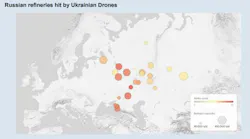
Russian refinery runs remain near July 2026 lows and are likely to recover only gradually from September onward. Russia’s ban on diesel exports has already removed 10% of waterborne supply from the global market. Further decline in Russian refinery runs could amplify the risk to global diesel markets by leading Russia to import fuel to backfill domestic needs, compounding the outright loss of the near 1 million b/d of diesel exports.
Limited spare capacity raises winter risks
Meanwhile, the world's remaining unconstrained refining capacity is already running at close to maximum levels. Refinery utilization in the US has approached 97% this summer, while Europe and North America continue to operate at or near multi-decade highs in response to record margins. The industry is now approaching fall turnaround season with a significant incentive to keep pushing and little spare capacity left to offset unexpected disruptions.
"The market has survived the first phase of the crisis because inventories, trade flows, and refinery flexibility absorbed much of the shock. Those shock absorbers are not disappearing, but they are becoming progressively weaker. Markets are entering winter with less room for error than they had in the spring," said Daniel Evans, global head of fuels and refining research, S&P Global Energy.
For governments and policymakers, the challenge is increasingly likely to center on balancing energy price affordability, inflation, and security of supply. High diesel prices directly impact costs for freight transport, agriculture, construction, manufacturing, and residential heating. Although the market has so far avoided an outright supply crisis, persistently low inventories, high prices, and limited spare capacity have heightened the risk of government interventions.
Diesel remains the fuel most vulnerable to shortages. With a surge in demand during the harvest season, the approach of winter heating needs, depleted inventories, and no immediate prospect of supply recovery, the market’s margin for error is rapidly shrinking; even minor supply fluctuations could cause the market to shift from a state of extreme tightness to outright collapse.
"Policymakers may soon face uncomfortable tradeoffs. Protecting consumers from higher fuel costs, preserving energy security and maintaining open trade flows becomes increasingly difficult when the world is short available refining capacity. The longer this disruption lasts, the harder those choices become," Fawaz said.