IEA: Ukrainian drone campaign degrades Russian refining resilience
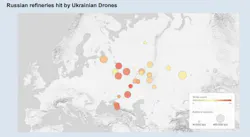
Increasingly frequent and precise Ukrainian drone attacks are damaging Russian processing units and lengthening repair times, forcing Moscow into unprecedented export bans, relaxed fuel-quality standards, and imports to protect domestic supply, according to the International Energy Agency (IEA).
Russia's 32 major refineries, with 6.5 million b/d of nameplate capacity, make it the world's third-largest refined-products producer after the US and China. But crude runs fell to 3.8 million b/d in June 2026, down 30% year on year and the lowest since May 2004. Gasoline output is reportedly down about 20%.
Ukraine has targeted Russian oil infrastructure since the 2022 full-scale invasion, but IEA said the campaign's scale, range, and effectiveness increased sharply during 2025-26. A Russian refinery was successfully struck once every 3 days on average in the first 8 months of 2026. Ukrainian forces are now sending multiple drone waves against single sites, overwhelming protective netting and air defenses.
Reach has expanded as well. On July 7, Ukraine struck Gazprom Neft PJSC's 450,000-b/d Omsk refinery, Russia's largest, some 2,500 km from the border, while several refineries closer to Ukraine have been hit as many as 15 times. By late August, only four major refineries—all in Eastern Siberia or farther east, 3,500-6,500 km from Ukraine—remained untouched.
Secondary units targeted
Targeting also appears more precise, increasingly hitting secondary units alongside crude distillation units. Fluid catalytic crackers, reformers, and hydrotreaters are critical to light-product yields and fuel specifications.
Minor damage to a crude distillation unit can often be repaired in 1-2 weeks, but serious damage to more complex units can require 6-8 months, IEA said. The 250,000-b/d Moscow refinery, heavily damaged in June, is reportedly offline until early 2027. Sanctions are compounding the problem by restricting access to replacement equipment and specialist suppliers.
Refiners have tried to preserve throughput by postponing maintenance, restarting mothballed equipment, and making quick repairs. Repeated attack-and-repair cycles, however, risk degrading reliability, particularly at plants near Ukraine that have been struck multiple times.
Domestic supply measures
Russia banned gasoline exports in April, a familiar step given its structurally tight gasoline balance. As attacks intensified, the government imposed its first-ever jet fuel and diesel export bans, on June 1 and on July 8 respectively—a major shift for a country that had exported about half its diesel and gasoil output. The diesel ban was later extended to Aug. 31, then Sept. 30.
Shortages spread anyway during the summer demand season, reaching 92% of Russian regions by late June. Conditions stabilized in late July before renewed attacks tightened supply again in the second half of August.
The Energy Ministry also temporarily relaxed fuel-quality rules, allowing Euro 2, 3, and 4 gasoline to be produced, imported, and sold through July 1, 2027—the first such move since 2016—and eased blending rules to let naphtha with octane enhancers count as gasoline. The measures stabilized supply but point to severe damage to upgrading units and could raise the risk of engine and emissions-system problems.
Imports are another buffer. Rail cargoes have come from Belarus and Kazakhstan, neither with enough spare capacity to close the deficit, and seaborne cargoes from Morocco, South Korea, India, and Türkiye arrived in July and August. September gasoline imports could reach 500,000 tonnes, about one-sixth of monthly demand.
Ukraine's campaign aims both to bring the war's costs home to Russian consumers and to weaken oil-sector revenues. Refiners received the equivalent of $14 billion in subsidies during April-July, including damper payments that compensate domestic fuel sales when export prices are higher. Despite higher crude prices linked to the US-Iran war, the federal deficit reached the equivalent of $76 billion in the first 7 months, already above the full-year 2025 shortfall.
IEA has lowered its baseline forecast for Russian throughput to about 4 million b/d on average for the balance of 2026 and 2027, citing cumulative damage, longer repair times, sanctions constraints, and rising reliability risks. Even that may understate the problem, the agency cautioned, with longer lead times for parts and colder weather ahead.
About the Author
 Conglin Xu
Conglin Xu
Managing Editor-Economics
Conglin Xu, Managing Editor-Economics, covers worldwide oil and gas market developments and macroeconomic factors, conducts analytical economic and financial research, generates estimates and forecasts, and compiles production and reserves statistics for Oil & Gas Journal. She joined OGJ in 2012 as Senior Economics Editor.
Xu holds a PhD in International Economics from the University of California at Santa Cruz. She was a Short-term Consultant at the World Bank and Summer Intern at the International Monetary Fund.