Fitch: Market will again be oversupplied in fourth quarter if Strait of Hormuz opens by end-July

Assuming fighting in and near Iran ends soon and the Strait of Hormuz reopens by end-July, the global oil market will become oversupplied by the fourth quarter, a team of analysts at credit risk agency Fitch Ratings said June 8.
“We continue to assume a quick recovery in production following the strait’s reopening, as there has been no material damage to oil infrastructure,” Fitch’s analysts wrote in a note detailing that the firm’s 2026 outlook for the oil-and-gas sector has moved to ‘improving’ from ‘neutral.’ “We expect production to ramp up to broadly normalized levels within several weeks, reflecting the region’s geology and producers’ ability to manage output under OPEC quotas.”
Members of the Organization of the Petroleum Exporting Countries are likely to produce at or near their maximum capacity of 3.6 million b/d once the Hormuz passage has reopened, the analysts said. By the fourth quarter, they added, the market could be oversupplied by about 4 million b/d, depending on OPEC’s policy.
 Oil pumpjack with line graph and world map
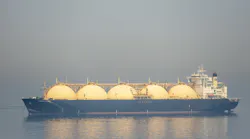 LNG cargo ship
Such a jump in production, the analysts wrote, will push down the price of Brent crude to about $70/bbl from the range of $100-110 expected for this month and next. In early-afternoon trading June 8, Brent was trading around $94.10, up about 1% on the day.
That June-July price forecast from Fitch, which acknowledged the high level of uncertainty around the end of hostilities and their effect on production and markets, is substantially lower than the range forecast late last month by senior executives of ExxonMobil Corp. and Chevron Corp.
Speaking at a conference hosted by research and brokerage firm Bernstein, both Neil Chapman of ExxonMobil and Mike Wirth of Chevron forecast mid-summer prices of $150 or higher as a result of inventories being depleted in the next few weeks.
“Over the next few weeks, we’re likely to see those pressures flow through more directly to physical prices,” Wirth said then. “There [will be] more upward pressure that I would expect as we get into June and certainly into July.”
The price action on June 8 reflected air attacks by both Iran and Israel during the night before but also statements by both parties since then about ceasing strikes. In overnight trading, oil prices had risen as much as 5%.
About the Author
 Geert De Lombaerde
Geert De Lombaerde
Senior Editor
A native of Belgium, Geert De Lombaerde has more than two decades of business journalism experience and writes about markets and economic trends for Endeavor Business Media publications Healthcare Innovation, IndustryWeek, FleetOwner, Oil & Gas Journal and T&D World. With a degree in journalism from the University of Missouri, he began his reporting career at the Business Courier in Cincinnati and later was managing editor and editor of the Nashville Business Journal. Most recently, he oversaw the online and print products of the Nashville Post and reported primarily on Middle Tennessee’s finance sector as well as many of its publicly traded companies.