Oil prices rise as Iran, proxies lash out
Oil, fundamental analysis
Confirmed attacks on vessels and reduced traffic, along with a large hurricane-related inventory draw, rallied crude prices this week. WTI’s High was Friday’s $101.80/bbl while the Low was Monday’s $89.60. Brent crude hit its High on Friday at $110.00/bbl with the low on Monday at $102.30. Both grades settled higher on the week. The WTI/Brent spread has tightened to $8.10.
President Trump struck a deal for Russian diesel this week which represents a policy reversal by both countries. The US had sanctions in place over Russian exports while Russia itself has banned diesel exports from time-to-time due to the damage inflicted by Ukraine on its refineries. Analysts report that the volume of diesel in the deal would only represent about 12 days of supply in the US and it is not new diesel being produced in Russia. It is production others won’t receive including the Russian people.
Iran struck two cargo ships and a crude tanker this week in a sign of escalation and desperation in the Persian Gulf region. This, Pres. Trump’s pledge of no military action against Iran until after the mid-terms. The new rounds of direct vessel attacks have only served to increase shipping rates along with the routes taken and maritime insurance, all of which play into keeping prices high.
Part of the shipping costs has to do with the ship-to-ship transfers designed to sneak through the Strait of Hormuz as more tankers are used to move a single cargo. Shipments of crude had averaged 13.9 million b/d last month or about 75% of the pre-war level. However, the recent hostilities have reduced the daily throughput down to just 2.9 million b/d, according to tanker trackers. Refined product shipments remain at about 50% below pre-war volumes.
Meanwhile, Yemen-based Houthi rebels continue to send missile into Saudi Arabia including the Riyadh airport. The Saudis have engaged with the Houthis in Yemen including attacks on the capital city there. For its part, Saudi Arabia is looking at alternative routes to move its oil out of the Persian Gulf including utilizing a natural gas pipeline.
The International Energy Agency (IEA) stated this week that total release from member countries’ strategic reserves could total more than the 400 million bbl pledged back in March. Releases are now being accelerated and include refined products such as diesel. Crude and diesel prices rose nonetheless as Ukraine continues to target Russian refineries. JP Morgan estimates that last month’s diesel deficit was as much as 1.0 million b/d while other analysts believe the diesel shortages will last for months to come. The agency also reported that global onshore oil inventories are at their lowest level since 2016. September oil supply had rebounded to 102.3 million b/d but the recent escalation in attacks in the Middle East is reducing that figure. On the flip side, IEA estimates that global demand will be an average of 2.6 million b/d lower vs. last year due to higher prices for fuel.
The Energy Information Administration’s (EIA) Weekly Petroleum Status Report indicated that commercial crude oil inventories for last week decreased while production last week was lower for the first time in several weeks. The SPR held at 283 million bbl.
The Consumer Price Index for September was 3.7% vs. a year earlier with core inflation +2.6% and energy +5.2%. Meanwhile, “real” average weekly wages declined 0.5%. Wholesale inventories grew last month by 0.4%, in line with expectations while industrial production improved 0.7% vs. a forecasted +0.4%. While the Dow is higher week-on-week, the S&P and NASDAQ are lower on the inflation report and on a movement out of tech stocks into “safer” havens. The USD and gold are both lower this week.
Oil, technical analysis
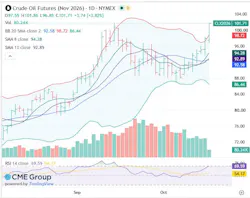
November WTI NYMEX futures have shot past the Upper-Bollinger Band limit and well-above their 8-, 13, and 20-day Moving Averages on the rally which broke the $101 mark. Volume is below the recent average at 80,000 as traders begin to look towards December. The Relative Strength Indicator (RSI), a momentum indicator, is oversold at 69. Resistance is now pegged at $102.00 while near-term critical Support is $98.70 (Bollinger Band).
Looking ahead
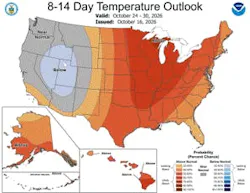
Iran appears to be lashing out in desperation by continuing to inflict damage in the Middle East along with the aid of the Yemeni Houthis. Global diesel supplies are in trouble while here in the US, fall has settled in which has already brought some cold to the heating oil-consuming region in the Northeast. The near-term forecast, however, indicates above-normal temperatures settling-in late month.
Natural gas, fundamental analysis
November NYMEX natural gas futures prices this week moved higher early on a brief cold snap in the Northeast and on a smaller-than-expected storage injection. Prices fell late week on the impending warmer weather. The week’s High was $3.30/MMbtu on Tuesday and Wednesday while the Low was Friday’s $3.06.
Natural gas demand this week has been estimated at about 104 bcfd with while supply was thought to be 110 bcfd. LNG exports were 18.0 bcf while exports to Mexico were 7.0 bcfd. In the UK, natural gas prices at the NBP were most recently higher at $28.20/MMbtu. Dutch TTF futures were also higher at $28.40/MMbtu. Asia’s JKM was quoted at $26.53/MMbtu as Asian and European markets are essentially competing for the same shipments. Spain has managed to fully wean-off of Russian natural gas imports thanks to US LNG supplies which are now about 48% of the country’s needs. The EIA’s Weekly Natural Gas Storage Report indicated an injection of 67 bcf vs. a forecast of +75 and a 5-year average of +90 bcf.
Total gas in storage is now 3.567 tcf, 3.9% below last year and 1.3% above the 5-year average.
Natural gas, technical analysis
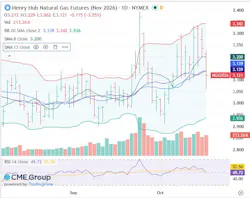
November 2026 NYMEX Henry Hub Natural Gas futures rallied mostly on the Hurricane Isaias outages of last week and some early Northeast cold but fell later on warming temps. Prices are around the 8-, 13- & 20-day Moving Averages. Volume is aboutthe recent average at 213. The RSI is neutral at 50. Support is $3.10 with Resistance at $3.20 (8-day MA).
Looking ahead
Natural gas production remains fairly steady while normal fall heating consumption has not yet emerged across the country. LNG exports should stay strong given global demand. The storage surplus vs. the 5-year average continues to shrink. At 3.57 tcf with only 3 weeks remaining in the official storage injection season, it would take 143 bcf/week to hit the 4.0 tcf mark by Nov. 1.
About the Author
 Tom Seng
Tom Seng
Dr. Tom Seng is an Assistant Professor of Professional Practice in Energy at the Ralph Lowe Energy Institute, Neeley School of Business, Texas Christian University, in Fort Worth, Tex.