Tetragon Energy increases prospective resources offshore Philippines
Key Highlights
- Tetragon Energy increased prospective resources in gas permits north of Borneo.
- The permits contain multiple discoveries and prospects.
- Seismic reprocessing and geological analysis are ongoing, expected to further delineate the prospects by mid-2027.
Tetragon Energy Ltd. increased its estimate of prospective resources in the Halcon prospect covered under permits SC-80 and 81 offshore Philippines, north of Borneo.
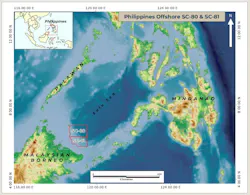
The permits lie in Sandakan basin of the Sulu Sea in the Bangsamoro Autonomous Region of Muslim Mindanao (BARMM). It is a relatively underexplored part of the broader Circum-Borneo hydrocarbon province with no production to date.
The Gross 2U (P50) prospective resource was increased to 8.0 tcf of recoverable gas from 2.6 tcf of recoverable gas, with a Gross 1U (P90) increase to 1.7 tcf from 188 bcf and a Gross 3U increase to 22.6 tcf from 19.9 tcf. The geological chance of success has improved to 24% from 18%, the company said.
This increase follows a more detailed evaluation of the available seismic data obtained from the Philippines Department of Energy and the engagement of a sedimentological expert to make comparisons to recent analogous discoveries made in nearby basins.
The company believes recent discoveries by ENI and Petronas in the Indonesia and Malaysia deepwaters of Borneo are geologically analogous to its acreage in the Philippines deepwaters of Borneo. Specifically, Tetragon believes that Eni's 2023 Geng North discovery (5 tcf gas initially in place and 400 million bbl of condensate) is highly analogous to the Halcon prospect in SC-80.
Seismic reprocessing of the 4,600 sq km of existing 3D seismic data is ongoing and will be used to further delineate the Halcon prospect, the existing discoveries Dabakan and Palendag (2C 470 bcf), and to mature other prospects. Early reprocessing results are expected in 2027, with the full dataset available around midyear.
SC-80 contains the Dabakan-1 gas and Palendag-1A gas-condensate discoveries which are classic Circum-Borneo toe thrust fold belt structures containing multiple turbidite sandstone reservoirs. SC-81 lies in shallower water nearer to the Borneo shelf than SC-80. It contains exploration prospects mainly in the eastern portion of the permit in slope fan channel facies and deepwater fold belt settings. These prospects and leads formed in similar structural and depositional settings to the SC-80 contract area to the North.
In addition to the discovered gas, there are exploration prospects in SC80 and SC81 in turbidite fans within the fold belt and basin floor fans within and outboard in the foredeep. There also are indications of older carbonate deposits which exhibit reef-like characteristics, the company said.
The discoveries were drilled by Exxon in 2009 and 2010 but were not developed due primarily to low gas prices and economic materiality concerns at the time.
Tetragon Energy is operator of permits SC-80 and 81 (37.5%) with partners Sunda Energy, Philodrill Corp., and PXP Energy Corp.