Real-time ESP sensor data optimizes well killing
Workover well killing has long been governed by estimation, conservative design, and iterative brine weight adjustments. However, for electric submersible pump (ESP) equipped wells, operators already possess powerful real time measurement capability through ESP intake pressure sensors: a capability that has not been utilized in well-kill decision making.
Two field cases show that using ESP data to derive real-time bottomhole pressures provides an accurate basis for kill-mud weight determination. This approach improves safety, reduces unnecessary fluid-density increases, minimizes operational delays, and delivers material cost savings.
The same methodology can be utilized for completions using progressive cavity pumps (PCPs) or sucker-rod pumps (SRPs) if they incorporate downhole telemetry.
Kill-mud weight selection
Successful well killing during workover operations relies on the optimum selection of kill-mud weight (KMW). Low KMW can result in well kick or blowout. If too high, overbalance may cause formation damage or losses due to fracturing. Petroleum engineers usually rely on historical records, offset well information, and reservoir pressure assumptions when providing KMW for workover plan preparation. These assumptions often fail to capture reservoir depletion, pressure recharge from recent water injections, changes in fluid gradient, and variations in reservoir behavior between wells.
Consequently, workover programs sometimes prescribe brine weights that are either insufficient or excessively high. When the prescribed kill brine fails to stop the well from flowing, the traditional response involves increasing mud weight, sometimes in multiple increments. This approach produces slow, costly, and, in some cases, incorrect results. Conversely, brine weight in excess of required mud weight can lead to formation damage and additional costs due to increased loss of brine into the formation.
Pressure through ESP sensor data
ESPs provide one of the most common and widely used artificial lift methods (Fig. 1). Nearly all ESP-lifted wells are equipped with downhole gauges which continuously transmit key parameters to the surface utilizing electric-cable telemetry (Fig. 2). These gauges measure intake pressure (Pi), discharge pressure (Pd), temperature, motor load, and vibration. The data collected help optimize, diagnose, and troubleshoot well and ESP performance, thereby extending ESP run life.
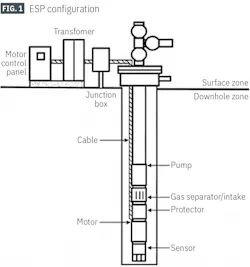
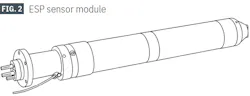
With suitable assumptions, ESP pressure data estimates reservoir pressure during shutdown and stable conditions. For example, Pi provides downhole hydrostatic pressure at the sensor for a shutdown and stable ESP with a working sensor above perforations. Pi can be read directly from the surface unit of an ESP control panel, but in the case of a disconnected surface unit, the ESP vendor can arrange a mobile gauge reader unit during workover. This unit connects to the surface junction box. The panel energizes the downhole gauge and retrieves downhole data including Pi.
Equation 1 calculates reservoir pressure from the addition of Pi to the hydrostatic pressure of the static fluid column from the sensor to perforation depth. This method provides a realistic, real-time estimate of formation pressure, eliminating uncertainty inherent in traditional sources and assumptions.
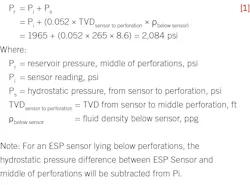
This methodology applies only in cases where ESP sensors are active and accurately transmitting pressure data after ESP failure. The example will not work when telemetry is not working in cases such as a damaged ESP cable or failed gauge electronics. Also, it does not apply to an operating ESP. The ESP should be shut down for sufficient time for the well to stabilize.
The density of fluid below the ESP sensor (ρbelow sensor) typically comes from production gas-oil ratio (PGOR) measurements or laboratory analysis. Large errors in this assumption, however, will not normally lead to significant deviations from true reservoir pressure due to the usual short column height between the sensor and the perforations.
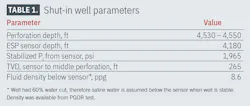
Table 1 shows the details of a shut in ESP in a deviated well. Under these conditions, Equation 1 calculates a reservoir pressure of 2,084 psi. The estimate is not as accurate as a manometer study, but it provides a good starting point for short-term operational purposes.
There may be instances when the workover plan’s KMW significantly overestimates or underestimates an appropriate KMW due to an error in predicted reservoir pressure. The former may lead to excessive fluid losses resulting in long term formation damage due to kill-fluid invasion and extra salt cost. The later may result in well activity that leads to operational delays and extra salt costs before the well is properly killed.
Other complications in killing operations include a failure of circulation to completely displace oil and gas from the well, leading to an active well even though the prescribed KMW may be accurate. In such instances, the rig crew may incorrectly assume that prescribed KMW is inadequate in relation to reservoir pressure. This erroneous assumption could lead to an unnecessary increase in KMW which will kill the well but may result in reduced operational efficiency and formation damage.
On the other hand, when the well activity comes from inadequate KMW specified by the workover plan, the crew will increase KMW based on build-up pressure with the assumption that uniform kill fluid exists in the tubing and annulus from surface to the perforations. Residual oil or gas, however, may still be in the annulus due to inefficient circulation, and the new KMW could therefore overshoot the ideal value, leading to problems associated with excess overbalance.
The above pitfalls can be avoided by using Pi from ESP sensor readings. Two case studies based on actual killing operations illustrate the methodology.
Case 1: Well not killed, no pressure build-up
The workover plan called for killing a deviated well before pulling out the completion. Table 2 provides well parameters.
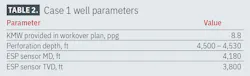
A well kill was attempted after spudding the rig before pulling out of the existing completion. Two full circulation cycles were completed with the prescribed brine. The well continued to flow during flow checks. The blow out preventer (BOP) was closed, but no build-pressure appeared either in tubing or casing. Traditionally, this condition triggers a nominal increase of 0.02-0.03 ppg in KMW in stages until the well is controlled. The formation was known to be fragile, however, and increasing the mud weight posed a meaningful risk of lost circulation.
Instead of immediately increasing brine weight, the team decided to leverage the active ESP sensor suite. The ESP vendor assisted in retrieving stabilized Pi value from the downhole gauge of the shutdown ESP. Using the calculation for hydrostatic pressure with 8.8-ppg KMW, the team expected 1,739-psi hydrostatic pressure at the ESP sensor depth. However, the actual hydrostatic pressure read from the sensor after circulation was 1,692 psi.
The difference between the expected and actual hydrostatic pressure signified that the well had not been fully displaced with kill fluid. The persistent flow could have resulted from trapped oil and gas not fully circulated out rather than inadequate KMW. Without the ESP sensor measurement, the crew might have assumed that the hydrostatic pressure from the 8.8-ppg brine was insufficient to control the well.
Rather than increasing brine density, the team decided to recirculate using the 8.8 ppg brine. The rig crew increased the brine circulation rate, added high-viscosity pills, and succeeded in flushing out oil and gas residues after two more circulation cycles. The well stabilized, confirmed by a Pi recheck showing that it almost equaled the expected hydrostatic pressure.
Benefits accrued by using ESP sensor readings to modify well killing procedure included:
- Successfully killing at the original density: Further circulations with original KMW successfully killed the well. The rig team was thus able to avoid guess work and killed the well based on actual well condition.
- Minimizing losses to the formation: Higher KMW than required could have resulted in inducing losses in weak formation intervals, leading to extra salt cost and long-term formation damage.
- Avoiding additional costs: By not increasing KMW, the rig team avoided extra salt cost and rig time to prepare a new brine.
- Improving diagnostic accuracy: ESP data enabled correct interpretation of well behavior during well killing. This data enhanced rig-team confidence in the killing process and removed guess work.
Case 2: Well not killed, pressure build-up observed
The workover plan called for killing a deviated well using 8.9-ppg brine before pulling out the completion. The tubing was punched with slickline to provide convenient circulation path for killing. Well parameters are given in Table 3.
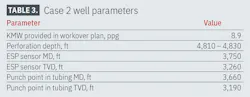
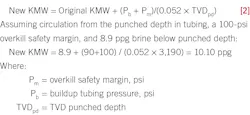
After spudding the rig, a well kill was attempted before pulling out the existing completion. Flow checks showed that the well was not killed after 2.5 circulations with the prescribed brine. Pressure records showed a pressure buildup of 90 psi in the tubing and 95 psi in the casing. The classical well control procedure would dictate increasing the KMW to 10.1 ppg per Equation 2. Increasing KMW, however, carried risk of potential formation damage due to excessive overbalance.
The team decided to avoid risk of formation damage by including ESP sensor readings to optimize the killing process. The ESP vendor was utilized in retrieving stabilized Pi data. The measured intake pressure gave the team insight into downhole hydrostatic pressures.
The team expected 1,566 psi for hydrostatic pressure at the punched tubing depth after initial circulation (assuming well is efficiently displaced with KMW fluid, Equation 3), however, the ESP sensor after circulation showed Pi = 1,464 psi. The correlated hydrostatic pressure at punched tubing depth was 1,432 psi, by correlation from Pi at sensor depth, assuming kill brine below the punch point (Equation 4).
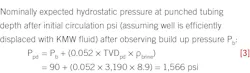
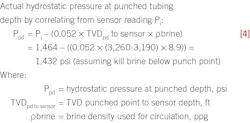
The difference between expected and actual hydrostatic pressure at the punched depth revealed that the well existed in an underbalanced state but not yet fully and efficiently displaced with the prescribed brine. Trapped oil and gas still existed in the well. Build up tubing pressure would reduce under an efficiently circulated well, reducing the required KMW.
Armed with this insight, it was decided to re-circulate the well with the original 8.9-ppg brine weight before increasing KMW. The rig crew circulated with increased rate and high viscosity pills and succeeded in flushing out oil and gas residues after a further two circulation cycles. The well was still active, resulting in BOP closure and recording of build-up pressure. This time, records showed a pressure buildup of 42 psi in the tubing and 45 psi in the casing.
A new recorded Pi was 1,542 psi which correlated to 1,510 psi at punched depth, 8 psi below the 1,518 expected hydrostatic pressure. The close readings signified an efficient displacement with the original brine.
Recalculation resulted in 9.8-ppg KMW based on a new 42-psi build-up pressure and 100-psi overbalance (Equation 5). Further rework yielded 9.7-ppg KMW by reducing overbalance from 100 to 80 psi to further safeguard the weak formation (Equation 6). The well was successfully killed and stabilized after 1.5 circulations with this brine, and the rig moved on to the next step as per workover plan.

Benefits accrued by using ESP sensor readings to optimize this well-killing procedure included:
- Successfully killing with lower KMW fluid: The ESP sensor provided actual bottomhole pressure readings, and the rig team successfully killed the well at a lower KMW than conventionally calculated KMW.
- Avoiding formation damage: The well could have been controlled at 10.1 ppg, however, it carried higher risk of formation damage.
- Reducing formation losses: Circulating KMW higher than required could have resulted in inducing losses in weak formation intervals.
- Reducing additional salt cost: Avoiding higher KMW eliminated extra salt.
- Improving diagnostic accuracy: ESP data enabled correct and real-time interpretation of well behavior, and the selection of the proper KMW was based on actual downhole measurement and conditions instead of theoretical calculation.
The author
Sushil Kumar Raturi was a senior drilling engineer at Kuwait Oil Co. and a workover engineer at Oil & Natural Gas Corp. (India). He holds a bachelor of engineering degree (1988) from National Institute of Technology, Raipur (India).