Devon takes FID on 4.5-bcfd Permian pipeline
Key Highlights
- Devon holds a 25% stake in the joint venture, partnering with WhiteWater, MPLX, Diamondback Energy, and Western Midstream Partners.
- The company is actively securing international LNG-linked pricing agreements, including 100-MMcfd starting in 2027 and 150-MMcfd in 2028, to enhance revenue stability.
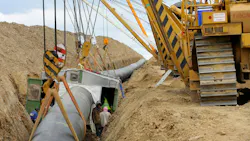
Devon Energy Corp. has taken final investment decision (FID) on the Solitude Pipeline System, a WhiteWater-led joint venture that will build two 48-in. OD natural gas pipelines connecting the Permian basin to Katy, Tex. Devon describes Solitude as the latest in a series of steps it has taken to integrate and consolidate the infrastructure supporting its Delaware basin position.
Solitude is designed for a phased build-out of 2.25 bcfd entering service second-half 2029, followed by a similarly sized second phase in 2030 and the ability to expand further to meet shipper demand. Construction and in-service timing remain subject to customary regulatory approvals.
Devon has secured firm transportation capacity and will hold a 25% equity interest in the joint venture, alongside WhiteWater (50%), MPLX (10%), Diamondback Energy (7.5%) and Western Midstream Partners (7.5%).
Permian producers have long absorbed volatile and periodically negative pricing at the Waha hub, where takeaway capacity has repeatedly failed to keep pace with associated gas growth. Devon says the pipeline will move the majority of its Delaware gas out of Waha and into markets that will be tied to expanding LNG export and power generation.
Devon has initiated the process of securing international LNG-linked pricing, including a 100-MMcfd agreement beginning in 2027 and an additional 150 MMcfd in 2028.
“Solitude is not a standalone investment; it is the next step in an integrated model we have been building for years,” said Clay Gaspar, Devon’s president and chief executive officer. “We have taken the hardest constraints in the Delaware [b]asin: water, processing, compression, takeaway and power, and have de-risked the physical constraints turning each one into a source of value rather than a tax on our returns. The company’s integrated model continues to lower our cost of supply, driving free cash flow higher and deepening our peer-leading Delaware inventory. Our advantaged position will continue to enhance the company’s Delaware return profile and will enable Devon to achieve differentiated resource capture.”
Devon holds one of the largest operated positions in the economic core of Delaware basin and says the asset anchors more than half of its production and free cash flow. Over the past several years, Devon has systematically taken ownership or long-term contractual control of the infrastructure that position depends on for optimal and profitable development. These include:
- Crude market access. Devon exports crude on an FOB basis across five to seven loading windows per month, through its VLCC position at Ingleside, Tex., and through Pin Oak terminals in Corpus Christi and Taft, Tex., where Devon holds an equity interest, providing direct waterborne access to international buyers.
Pin Oak’s 5.1-million bbl Corpus Christi terminal has deepwater dock access capable of accommodating Suezmax-sized vessels. It is approved for loading WTI Midland crude into the Dated Brent assessment process. The Taft terminal adds 1.2 million bbl of storage to this. The two are connected to the Gray Oak (Enbridge, 980,000 b/d), Cactus II (Plains All American, 670,000 b/d), and Cactus III (Plains All American, 600,000 b/d), pipelines and provide direct links to Flint Hills Resources (350,000 b/d), Valero (370,000 b/d), and CITGO (175,000 b/d) refineries as well as truck and rail terminals. - Gas takeaway. Devon was a founding equity owner in the 2.5-bcfd Matterhorn Express pipeline, which it monetized in 2025 at a substantial gain while retaining its transportation rights. Devon has secured an additional 550 MMcfd of firm transportation capacity on the Blackcomb (WWM Operating LLC) and Eiger (WhiteWater) pipelines, further expanding its access to US Gulf Coast markets. The Solitude pipeline represents the next step in that progression, adding long-dated capacity and further diversifying Devon’s pathways to growing LNG and power-generation demand.
- Gas processing. Devon owns a 50% interest in Catalyst Midstream Partners, its gas gathering and processing joint venture with Howard Energy Partners, which serves Devon’s Stateline development with more than 600 MMcfd of gas processing capacity.
- Gas gathering and compression. In August 2025, Devon acquired the remaining third-party interests in Cotton Draw Midstream, moving to 100% ownership of the gathering and compression system serving the company’s Cotton Draw development. Combined with the company’s Stateline and Triple Crown gas gathering and compression systems, Devon has 3.4 bcfd of operated compression.
- Power and in-basin demand. Devon has built roughly 1,200 miles of electrical distribution infrastructure and four in-basin microgrids with roughly 75 Mw of installed capacity, securing reliable electricity in a supply-constrained region. Devon is simultaneously underwriting new local demand for its own gas, agreeing to supply 115 MMcfd over a 7-year term to Competitive Power Venture’s 1,350-Mw CPV Basin Ranch Energy Center in Ward County, Tex., beginning in 2028 at pricing indexed to ERCOT West.
- Produced water. In 2023, Devon combined its Stateline produced-water gathering and disposal system with WaterBridge NDB, contributing 210 miles of pipeline and 18 disposal wells. Following WaterBridge Infrastructure’s September 2025 initial public offering, Devon retains an approximate 13% ownership position in what it describes as one of the largest produced-water platforms in Delaware basin. Devon continues to build out its owned and operated water systems in Delaware basin with nearly 1,000 miles of water pipeline and a system capacity of 2.2 million b/d.
About the Author
 Christopher E. Smith
Christopher E. Smith
Editor in Chief
Chris joined Oil & Gas Journal in 2005 as Pipeline Editor, having already worked for more than a decade in a variety of oil and gas industry analysis and reporting roles. He became editor-in-chief in 2019 and head of content in 2025.