Phillips 66, Kinder Morgan, HF Sinclair sanction Western Gateway pipeline
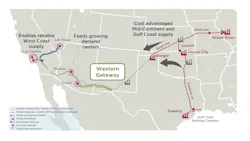
Phillips 66 Co., Kinder Morgan Inc., and HF Sinclair Corp. have executed a joint venture agreement and taken a final investment decision (FID) to advance the proposed Western Gateway Pipeline system.
The partners will own 49.9%, 35.1%, and 15.0% of the venture, respectively.
Western Gateway will create a new refined products transportation corridor linking St. Louis and expanded Gulf Coast supply points with markets in Arizona and California. The 1,300-mile system is designed for an initial capacity of 230,000 b/d and could be expanded to 320,000 b/d in the future with limited capital and no additional pipeline construction, Phillips 66 noted in a related investor presentation Aug. 11.
The project includes construction of a new 900-mile, 20-in. and 24-in. OD pipeline from Borger, Tex., to Phoenix, Ariz., which Phillips 66 will construct and operate. The system also includes Kinder Morgan's existing SFPP East Line from El Paso, Tex., to Phoenix and Tucson, Ariz., and its SFPP West Line from Colton, Calif., to Phoenix. The SFPP West Line will be reversed to move refined products westward into California, while Kinder Morgan will continue to operate both SFPP pipelines.
Supply to the system also will be supported by Phillips 66's Gold Pipeline, which will be reversed to connect with Explorer Pipeline and allow refined products to flow toward Borger.
"This project brings together strategic supply access, existing infrastructure and experienced operators to improve affordability and assurance of supply for customers in the Western United States," said Kim Dang, Kinder Morgan chief executive officer.
The project carries an enterprise value of about $5 billion. Upon completion of the Borger-Phoenix pipeline, Kinder Morgan will contribute the SFPP East Line and SFPP West Line to the joint venture at an estimated value of $1.5 billion and contribute about $250 million in cash. Phillips 66 and HF Sinclair will contribute about $2.5 billion and $750 million in cash, respectively.
The companies said the system is supported primarily by 10-year take-or-pay transportation agreements and is targeted for completion in 2029, subject to permitting and regulatory approvals.