Permian-led US natural gas pipeline expansion to add 44.9 bcfd by 2027
Key Highlights
- US pipeline expansions to add 44.9 bcfd by 2027.
- Texas projects dominate amid Permian, LNG growth.
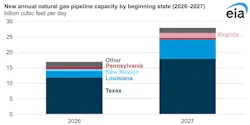
A wave of US natural gas pipeline expansions scheduled through 2027 is set to add 44.9 bcfd of capacity, with most projects tied to rising Permian basin production and growing LNG demand along the Gulf Coast, according to the latest project tracking data from the US Energy Information Administration (EIA).
About 31.6 bcfd of the planned additions—roughly 70% of the total—has already moved into the construction phase. Texas accounts for the largest share of the buildout at 29.7 bcfd, followed by Louisiana with 8.4 bcfd.
The expansion activity reflects continued efforts to move increasing volumes of associated gas out of the Permian basin while reducing congestion around the Waha Hub. Several projects are also aimed at supplying feedgas to new LNG export plants under development along the Texas and Louisiana Gulf Coast.
Among the largest projects advancing toward startup is the Rio Bravo Pipeline, a 138-mile line capable of transporting up to 4.5 bcfd. The system will connect Permian gas supplies to the Rio Grande LNG export project being developed by NextDecade, which is targeting service later this year.
The 365-mile Blackcomb Pipeline, designed for 2.5 bcfd of capacity, is expected online in third-quarter 2026. The line will move gas from the Waha area to the Agua Dulce market hub, providing additional relief for constrained Permian takeaway routes.
Another major Permian-linked expansion, the Hugh Brinson Pipeline project, will add 2.2 bcfd in phases. Initial flows are expected in fourth-quarter 2026, with full service planned for early 2027.
Louisiana projects also continue to advance alongside LNG growth. The Port Arthur Pipeline Louisiana Connector is expected to begin service in second-half 2026 with 2 bcfd of capacity. The Pelican Pipeline project is projected to enter service by end-2027, bringing total planned Louisiana additions to 8.4 bcfd.
Outside the Gulf Coast region, Virginia ranks third in planned additions over the next 2 years. Williams expects its Southeast Supply Enhancement Project—an expansion of the Transcontinental Gas Pipeline system stretching from Virginia to Alabama—to add 1.6 bcfd of capacity in 2027.