Hormuz closure emphasizes Iraq’s need for a second oil export route
Key Highlights
- Reviving the historic Kirkuk-Banias pipeline and developing new export routes will enhance Iraq’s energy sovereignty and bargaining power in global markets.
- Strengthening Iraq’s infrastructure and sovereignty in energy exports is essential for long-term stability, economic growth, and regional influence.
Iraq’s oil economy has always looked south, with Basra the center of gravity and the Persian Gulf the exit. But when the route through the Gulf shuts, Iraq’s budget, electricity system, public salaries, investment plans, and political stability all become hostage to events beyond Baghdad’s control. By fixing its dependence on the Strait of Hormuz, Iraq can help solve a supply problem for the whole world and reap enormous economic rewards at the same time.
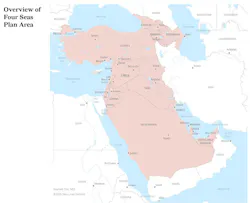
That is why the ‘Four Seas’ proposals matter so deeply for Iraq. Proposed in Washington DC by the New Line Institute and attracting endorsements in Damascus, Ankara, and Amman, the Four Seas network would link the Persian Gulf, the Caspian Sea, the Mediterranean, and the Black Sea through a new overland energy and infrastructure corridor centred on Syria and Türkiye (see map). For Iraq, the most important part is the rehabilitation and expansion of the Iraq-Syria corridor: a new version of the historic Kirkuk-Banias route upon which Iraq’s prosperity was once built. This route will take Iraqi oil westward to the Mediterranean and European markets, rather than leaving it dependent on southern maritime exports, vulnerable to price volatility, foreign wars, and blockades.
The proposed Iraq-Syria line could carry up to 1.4 million b/d. Enough to be considered, as it was in the past, a second national energy artery. At full capacity, the wider Four Seas system is projected to move 3-4 million bo/d and 40-50 billion cu m/year (bcmy) of natural gas toward Mediterranean and European markets. Iraq’s proposed western route would be one of the core pillars of that system, delivering a third of its capacity. It would place Iraqi energy at the centre of a new overland architecture linking the Gulf, the Levant, Türkiye, and Europe.
Three Seas precedent
On July 6, 2017, US President Donald Trump stopped in Warsaw, Poland, en route to the Hamburg G20 Summit. At the second summit of the Three Seas Initiative, a forum co-founded by Poland and Croatia linking 12 Central and Eastern European nations along the Baltic, Adriatic, and Black Sea axes, Pres. Trump offered the full weight of US political and commercial sponsorship to a project that had previously been regarded as a regional curiosity.
The Three Seas Initiative aimed to correct a structural imbalance: While Central and Eastern Europe had politically and economically integrated westward, its infrastructure still ran primarily east-west, leaving it dependent on Russian pipelines and Russian gas and exposing it to the geopolitical leverage that dependency conferred. By redirecting infrastructure flows along a north-south axis linking the Baltic LNG terminals in Poland and Lithuania with the Adriatic terminal in Croatia, and connecting the Black Sea’s energy resources to Central European markets the initiative sought to permanently alter the energy geography of the continent.
Pres. Trump’s endorsement was not rhetorical. The Three Seas Initiative Investment Fund, launched formally in 2020, attracted a $300 million financing commitment from the US Development Finance Corp. (USDFC) alongside nearly $1 billion in commitments from nine of the twelve member states.
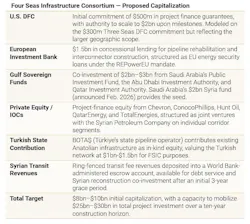
The Three Seas Initiative Investment Fund provides a proven template for mobilizing public development finance alongside private capital in politically sensitive infrastructure environments. The Four Seas Initiative should be structured around an analogous instrument: a Four Seas Infrastructure Consortium (FSIC) capitalized by a combination of USDFC commitments, European Investment Bank lending, Gulf sovereign wealth fund co-investment, and private equity from the energy firms already active in Syria (Table 1).
Infrastructure
The old Kirkuk-Banias pipeline carried Iraqi oil to the Mediterranean before it was closed in 1979. Reviving it today would restore both optionality and the prospect of multi-vector export diplomacy, just when such options have become a matter of national sovereignty. Iraq should not have to choose between Basra, Ceyhan, and Banias. It should have a national export system strong enough to use all three, and to be able to negotiate from a position of strength with buyers who understand that Iraq has alternative markets for its oil. Table 2 shows this and other Four Seas regional energy infrastructure.
Four Seas-related energy infrastructure
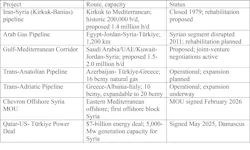
In early July 2026, the Iraqi Cabinet approved Basra Oil Co.’s signing a heads of agreement with Chevron Corp., US-based Capital TI, and Qatar-based construction firm UCC Holdings under which the companies would study the financial and technical feasibility of potential oil-export pipeline projects.
Energy security for Iraq would come not from enviable reserves or productive capacity, but from being able to move oil and gas to market through routes that no single crisis can shut down. But the Four Seas offers other benefits too.
First, it strengthens Kirkuk and the north. Iraq’s northern fields have been locked in political disputes, infrastructure damage, and disagreements between Baghdad and Erbil, the capital of Iraqi Kurdistan. A revived Iraq-Syria export route would give Kirkuk a larger strategic role in the national economy. Properly governed, it could also reduce the zero-sum nature of internal pipeline politics by expanding the number of routes available to the federal state, and growing the pie so that each region enjoys a proportionate share.
Second, it boosts Iraq’s wider development vision. Baghdad is already pursuing the Development Road: a project to turn Iraq into a goods logistics bridge between the Gulf and Europe through Türkiye. The Four Seas Initiative is the energy counterpart to that ambition. Roads, rail, ports, pipelines, power infrastructure and digital corridors are parts of the same national strategy to diversify Iraq’s economy by positioning the country as the logistics hub of the region and the ideal place for industrial investment.
The project must also include Iraqi engineers, Iraqi companies, Iraqi security planning, and Iraqi regulatory authority from the beginning. Iraq must therefore seek to enter the Four Seas as a founding partner, not as a supplicant later. That is how Iraq locks in its seat at the table and ensures that a fair share of the gains accrue to it.
Iraq needs infrastructure that serves Iraqi sovereignty. Sovereignty that Iraq has spent decades securing. In this dimension, diversifying export routes is not hostility toward any neighbour but basic statecraft; statecraft that will afford Baghdad option value and negotiating strength, both commercially and diplomatically. If Iraq wants a voice, and positive relations based on reciprocity, then it needs credible alternatives at its disposal.
A stable Syria is manifestly in Iraq’s interest. The Iraqi-Syrian border has too often been a corridor of insecurity. The Four Seas Initiative is the quintessential “trade not aid” approach to Damascus. It should become a corridor of trade, energy, and reconstruction that links Iraq to Europe. It is not to be a charity case. Indeed, it is no wonder that Syria’s president has endorsed the initiative. If Syria earns transit revenues, rebuilds its power system, and restores state capacity along the route, Iraq benefits too. An economically functioning Syria is a safer neighbour, and a better customer.
Pipelines can be attacked and Syrian institutions remain fragile. For Iraq, revenue must return to the Iraqi state, not disappear into factional channels. Not to mention, Baghdad and Erbil will need an equitable settlement that makes northern exports part of national strength building toward lasting cooperation rather than another front in internal competition.
Iraq has spent decades trying to recover sovereignty in politics and security. The next stage is sovereignty in infrastructure. A country of Iraq’s energy potential should not remain dependent on a single maritime exit. Iraq can wait for the next Hormuz crisis, or it can build the second artery now.
The authors
Azeem Ibrahim, OBE, is chief strategy officer at New Lines Institute for Strategy and Policy. He is also an adjunct research professor at the Strategic Studies Institute, US Army War College, and a columnist at Foreign Policy magazine. He completed his Ph.D. from the University of Cambridge and served as an international security fellow at the Kennedy School of Government at Harvard and a world fellow at Yale.
Dania Arayssi is a program head and senior analyst at New Lines Institute, where she works on policy research and analysis at the Central Asia Center, in addition to analysis of the dynamics of political economies in Lebanon, Syria, and the broader Middle East. Arayssi also engages directly with US policymakers and institutional stakeholders, producing analyses that inform congressional and executive branch decision-making. She serves as an adjunct assistant professor at Georgetown University’s Edmund A. Walsh School of Foreign Service and teaches at George Washington University. Before joining New Lines, Arayssi held analytical and research roles with the World Bank, USAID, Oxfam America, and the US Army War College. She holds a Ph.D. in political science from the University of Colorado-Boulder.