Eni secures financing for Sannazzaro biofuels plant
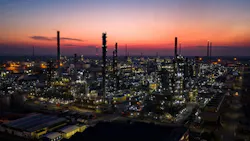
Italy’s Eni SPA has secured €500 million in long-term financing from the European Investment Bank (EIB) to support the operator’s previously confirmed project to convert selected units at its 180,000-b/d Sannazzaro de’ Burgondi refinery in Pavia province into a biorefining plant.
Signed on Apr. 1, the 15-year loan agreement will fund conversion of the site’s second hydrocracking unit (HDC2) to renewable fuels production, alongside construction of a pretreatment plant for waste-based feedstocks that will include used cooking oils, animal fats, and agri-food industry residues.
Planned for startup in 2028, the project targets production capacity of about 550,000 tonnes/year (tpy) of hydrotreated vegetable oil (HVO) diesel and sustainable aviation fuel (SAF), Eni said.
Announcement of the funding follows Eni’s February confirmation of its final investment decision on the Sannazzaro conversion project, which will enable the site to add biofuel production alongside ongoing conventional fuel output.
Project scope, configuration
The conversion centers on upgrading the HDC2 unit to process biogenic feedstocks via Ecofining technology, which Eni developed with Honeywell UOP LLC. The process produces HVO, a drop-in fuel compatible with existing diesel engines and infrastructure.
A dedicated pretreatment plant will prepare waste and residue feedstocks, enabling integration into the refining process. Hydrogen supply will be sourced from existing on-site production, limiting the need for additional infrastructure, according to the operator.
The project will allow Eni to leverage existing logistics and utilities at Sannazzaro, including pipeline and distribution networks in northern Italy, to support delivery of renewable fuels to road and aviation markets.
Strategic context
The financing marks Eni’s second agreement with the EIB tied to biorefining projects, following a €500 million loan signed in July 2025 for conversion of the Livorno refinery.
The Sannazzaro project forms part of Eni subsidiary Enilive SPA’s broader plan to expand biofuels capacity to 5 million tonnes/year by 2030, including more than 2 million tpy of SAF. Current biorefining capacity totals about 1.65 million tpy across Venice and Gela, with additional capacity under development in Italy and internationally.
Eni previously confirmed that Sannazzaro and the planned 500,000-tpy Priolo biorefinery will add a combined 1.05 million tpy of capacity by 2028. Both projects are designed to shift output between HVO and SAF depending on market demand.
Market, regulatory drivers
The investment reflects growing demand for low-carbon fuels driven by European Union policy frameworks, including the Renewable Energy Directive (RED III) and ReFuelEU Aviation regulations, which mandate increasing SAF blending levels.
According to Eni, SAF demand is expected to accelerate from 2030, supported by regulatory requirements and limited alternative decarbonization options for aviation. HVO is positioned as an immediate emissions-reduction solution across multiple transport segments, including road, marine, rail, and aviation.
Biofuels accounted for about 4% of global transport energy consumption in 2024 and are projected to rise to 9% by 2035 and 12% by 2050 under the International Energy Agency’s net-zero scenario.
Transformational trend
The Sannazzaro conversion underscores a broader shift among European refiners toward integrating renewable fuel production within existing assets. By using existing and established infrastructure and waste-based feedstocks, operators aim to reduce capital intensity while maintaining optionality in conventional refining.
In addition to strengthening its position as one of Europe’s largest biofuel producers, Eni said the Sannazzaro project supports diversification of product supply amid tightening emissions regulations and evolving fuel demand.
About the Author
 Robert Brelsford
Robert Brelsford
Downstream Editor
Robert Brelsford joined Oil & Gas Journal in October 2013 as downstream technology editor after 8 years as a crude oil price and news reporter on spot crude transactions at the US Gulf Coast, West Coast, Canadian, and Latin American markets. He holds a BA (2000) in English from Rice University and an MS (2003) in education and social policy from Northwestern University.