Italy’s Eni greenlights investments for new biorefining projects
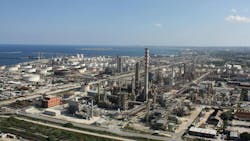
Eni SPA has taken final investment decisions (FID) to move forward with subsidiary Enilive SPA’s development of new biorefining projects at two of the operator’s existing manufacturing sites in Italy.
On Feb. 25, Eni confirmed approval of a project that will convert selected units at its 180,000-b/d Sannazzaro de’ Burgondi refinery in Pavia province into a 550,000-tonne/year (tpy) biorefinery.
The decision follows a separate investment approval and partnership agreement earlier this month for a 500,000-tpy biorefinery at Priolo, Sicily.
Both projects will be executed through subsidiary Enilive and are targeted for completion by yearend 2028.
According to Eni, the new units will provide operational flexibility to shift output between hydrotreated vegetable oil (HVO) diesel and sustainable aviation fuel (SAF), depending on market demand.
Sannazzaro conversion
At Sannazzaro de’ Burgondi, Eni will convert the refinery’s second hydrocracking unit (HDC2) using its proprietary Ecofining technology, developed with Honeywell UOP LLC, to process 550,000-tpy of waste- and residue-based feedstocks into HVO and SAF.
The project also includes construction of a pretreatment unit for biogenic feedstocks.
Hydrogen required for the process will be supplied from existing on-site production, and logistics systems—including pipeline and airport connections in Lombardy—will be adapted to accommodate renewable fuel distribution.
Eni said the project will not reduce the refinery’s existing conventional fuels production capacity but instead will add biofuel output alongside traditional refining operations.
Q8 partnership at Priolo
Earlier, on Feb. 3, Eni and Kuwait Petroleum International Ltd. (Q8), through Kuwait Petroleum Italia SPA, confirmed board approval of a joint investment to construct and operate the 500,000-tpy Priolo biorefinery.
Part of Eni subsidiary Versalis SPA’s broader basic-chemicals industrial transformation of the Priolo site in eastern Sicily, the new plant will be built within the existing complex, replacing the site’s Gargallo steam-cracking plant that ceased operations in 2024.
With engineering works for the Priolo biorefinery now completed, preparatory activities for awarding procurement and construction contracts are under way, and demolition works tied to redevelopment of the site are pending the final authorization process.
The partners anticipate completion of permitting and construction on the project by yearend-2028.
Eni said the plant will use Ecofining technology to convert waste oils, residues, and vegetable feedstocks into HVO diesel and SAF, with fuels produced at the site estimated to achieve at least a 65% reduction in greenhouse gas emissions (GHGs) compared with the fossil reference mix, in line with European Union (EU) renewable energy targets.
The Priolo development extends a 30-year partnership between Eni and Q8, which began with joint operations at the Milazzo refinery in 1996.
Capacity growth targets
Once operable, the planned Sannazzaro and Priolo projects represent a combined 1.05 million tpy of additional biorefining capacity.
As the EU’s second-largest producer of HVO, Eni currently operates 1.65 million tpy of biorefining capacity. The operator said it plans to increase total capacity to more than 3 million tpy by 2028 and more than 5 million tpy by 2030, with potential to produce up to 2 million tpy of SAF by the decade’s end.
The new projects complement ongoing refinery-to-biorefinery conversions in Livorno and earlier conversions at Venice and Gela, positioning Eni to expand renewable fuels supply to road, marine, and aviation markets while retaining optionality around conventional refining assets, the company said.
About the Author
 Robert Brelsford
Robert Brelsford
Downstream Editor
Robert Brelsford joined Oil & Gas Journal in October 2013 as downstream technology editor after 8 years as a crude oil price and news reporter on spot crude transactions at the US Gulf Coast, West Coast, Canadian, and Latin American markets. He holds a BA (2000) in English from Rice University and an MS (2003) in education and social policy from Northwestern University.