Why California gasoline prices are rising faster than the US average
Key Highlights
- California's strict CARB fuel specifications increase refining costs and limit supply flexibility.
- Refinery closures since 2020 have reduced local capacity by 30-35%.
- California's dependence on Middle Eastern crude makes it more vulnerable to geopolitical disruptions.
- Import constraints from Asia and Gulf region supply issues further tighten California's fuel supply.

Skip York
Baker Institute for Public Policy
Rice University
Gasoline prices in the US began rising almost immediately following the combined Feb. 28 attacks by the US and Isreal on Iran. In the last 4 weeks, according to the US Energy Information Administration (EIA), the increase in US gasoline prices has averaged $1.05/gal (above the pre-crisis average of $2.94/gal), but the greatest increase has been in California ($1.27/gal above the pre-crisis average of $4.44/gallon). While the price increase has been smaller than the rest of the US on a percentage basis, California prices were starting from an elevated level.
There are four reasons why California consumers were seeing higher pre-crisis gasoline prices than the rest of the US and are now realizing a disproportionate impact from the Iran war crisis.
Tighter California specifications
California Air Resources Board (CARB) gasoline has significantly more stringent specifications than other regional US gasoline blends because it is designed to minimize smog-forming emissions in California’s air basins. CARB has lower limits on sulfur, benzene, aromatics, olefins, Reid vapor pressure, and exhaust emissions of NOx and VOCs. These specifications require more severe refining (e.g., hydrotreating, reformulation, and blending optimization) and higher-cost blend components, which increases the cost of manufacturing CARB gasoline on the order of 20-30 cents/gal more than other gasoline blends.
In principle, any sufficiently complex refinery can produce gasoline that meets CARB specifications. The constraint is economic and logistical, not technical. It is a combination of certification requirements, capital investment in the right processing units, and the logistical cost (e.g., segregated tankage) of getting fuel into California's isolated terminal network. The relatively few refineries outside of California that are certified and configured to make CARB are mostly geographically proximate to California and already tied into the state’s supply chain.
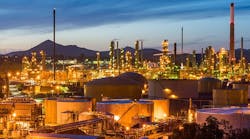 Valero Energy Benicia refinery, California
Closing California refineries
Since 2020, about 665,000 b/d of refining capacity has closed in California. Each closure has reduced operational slack, so routine maintenance, unplanned outages, or seasonal specification changes (e.g., winter vs. summer) impact remaining capacity. Refinery closures tend to push gasoline prices higher and make them more volatile, because they remove local capacity in a market that is supply‑constrained and poorly connected to other US refining hubs. As refineries closed (or converted to renewable fuels), the state lost about 30-35% of CARB‑capable capacity, tightening local supply. These lost barrels must be replaced with imports, largely from Asia, with ship movements that are slower, higher cost, and less flexible than in‑state production. Thus outages, demand spikes, or global disruptions translate more quickly into price increase at the wholesale rack and the pump. Beyond episodic price waves, losing in-state capacity raises the baseline differential between California and national gasoline prices. The California market is pricing in higher expected volatility, tighter supply, and greater reliance on imports.
In this Oil & Gas Journal ReEnterprised podcast episode, Robert Brelsford, Downstream Editor, dives deeper into the state of California’s decision to walk back more aggressive policies governing in-state refiners.
California’s Middle East crude oil imports
California is materially more dependent on Middle Eastern crude than the rest of the US, largely due to refinery configuration and logistics. California refineries are optimized for heavier, sour crude oil. Declining in-state production (e.g., San Joaquin Valley) and no pipeline connectivity to other US producing regions means California regularly imports a meaningful share of its crude slate from the Middle East.
Recent California Energy Commission data show that Iraq and Saudi Arabia alone provide 35-40% of total California barrels (roughly equivalent to California crude oil production), plus smaller flows from the UAE and others in the Persian Gulf. For the rest of the US, about 10% of crude oil imports come from Persian Gulf suppliers. As a result, California fuel prices are more exposed to disruptions or price spikes linked to Gulf supply and chokepoints like the Strait of Hormuz than refineries in other parts of the country.
Out-of-state refinery constraints
California imports roughly 20% of its refined fuels from Asia (a record 128,000 b/d of gasoline/additives in 2025), mostly from South Korea and India. These refiners are cutting back exports, prioritizing their own domestic markets, and scrambling to re-optimize crude slates as Hormuz disruptions squeeze Middle East supply.
Shortages of Gulf crude oil are forcing refineries to reduce runs and declare force majeure on product deliveries. Several governments or companies have temporarily suspended clean‑product exports, directly throttling flows of CARB‑grade gasoline and jet to the US West Coast. These refiners also are bidding up alternative crude oil barrels from other regions and paying longer‑haul freight rates, which raises their marginal cost of gasoline and narrows the price window to ship gasoline cargoes to California. Volumes available for California are at risk of shrinking and becoming more sporadic, while the barrels that do move come to California look to be priced at higher differentials relative to the rest of the US.
The current price surge in California is not simply a function of global crude market. It is the predictable outcome of a structurally tight, highly specialized, and increasingly import-dependent fuel system colliding with a geopolitical shock.
Stringent CARB specifications, declining in-state refining capacity, disproportionate reliance on Middle Eastern crude oil, and constrained external fuel suppliers each create their own upward pressure on prices. Taken together, they form a system with little flexibility and resilience. The current disruption is causing California to lose both local supply flexibility and access to marginal barrels from abroad at the same time. The risk is not only higher prices—a reality prior to the Iran war—but a sharp increase in volatility and a widening, more persistent premium versus the rest of the US.
Unless there is a meaningful easing of geopolitical tensions or a structural shift in how California balances supply resilience with environmental and market objectives, this pattern of outsized price response is likely to repeat in future disruptions.
About the Author
Harold "Skip" York
Harold "Skip" York, PhD, is the nonresident fellow in energy and global oil in the Center for Energy Studies at Rice University’s Baker Institute. He has over 30 years of experience working on strategic issues that shape the energy and mining industries. Before joining the Baker Institute, York was the head of Commodity Strategy for Petroleum at BHP. He is also the chief energy strategist at Turner Mason & Company, an energy consulting and advisory firm.