Pennsylvania investigates geothermal potential
A report by Project Innerspace, in collaboration with academic, law, policy, and engineering practitioners, outlined prospects for geothermal energy in Pennsylvania. Given the state’s extensive population of unconventional wells, repurposing aging wells for geothermal could reduce abandonment risks while creating new energy sources.
While the report suggests geothermal energy could meet much of Pennsylvania’s electricity, heating, and industrial energy demand, geological analysis indicates that subsurface temperatures are generally too low for widespread electrical power generation.
To advance geothermal development, the report recommends establishing a clear regulatory framework, expanding incentives, supporting ground-source heat pumps, promoting thermal energy networks, and strengthening clean-energy market policies.
A US Department of Energy-funded EGS pilot in Indiana County will convert an existing natural gas well to geothermal to evaluate performance, drilling, and heat production from the Utica shale. Findings from this project are expected to guide future geothermal development across the state.
Pennsylvania geothermal potential
Pennsylvania has more than 15,000 unconventional wells. Repurposing these wells at the end of their operational lives could avoid plug and abandonment expenses and prevent them from becoming an environmental hazard. These converted wells could provide heat for industrial, commercial, and residential applications.
Project Innerspace, in collaboration with researchers at four Pennsylvania universities and outside practitioners, examined the prospects for geothermal energy in Pennsylvania. The resulting report, “The Future of Geothermal Energy in Pennsylvania: Leveraging the Commonwealth’s Legacy of Energy Leadership,” reviewed the political, economic, legal, and technical basis for the Commonweath’s geothermal potential.
The report suggests that geothermal could provide 100% of Pennsylvania’s electricity, heating, and low-to-medium temperature industrial process requirements in as little as 10 years, but examination of the data reveals limitations to Pennsylvania’s subsurface thermal environments which restrict geothermal largely to moderate temperature applications (below 100°C.) such as building heating and cooling and low-temperature industrial processes.
Pennsylvania geothermal policy, regulations
Pennsylvania is the nation’s fourth largest industrial consumer of energy, but this sector does not use large-scale geothermal energy. Instead, the Commonwealth produces the second largest amount of energy in the US through its extensive oil and gas infrastructure.
Currently, Pennsylvania lacks a designated regulator for geothermal developers to submit plans for approval. The water-well drilling statute imposes minimal requirements for non-oil and gas wells which protect water resources from pollutants, but these provide inadequate guidance for wells which will be more akin to oil and gas wells in depth and construction.
Leveraging its oil and gas drilling experience, the state can adopt existing policies and implement new measures to develop geothermal energy using six key areas of focus including:
- Regulatory certainty and elimination of red tape.
- Ground source heat pumps (GSHP) for building heating and cooling.
- Incentives for direct-use geothermal applications for industrial and agricultural sectors.
- Thermal-energy networks to serve residential, commercial, academic, and public buildings.
- Comprehensive state and regional power market policies to promote clean, firm, flexible power.
- Geothermal development strategies.
Targeted actions within these six groups have been identified to develop geothermal in Pennsylvania. Policies, programs, and incentives already in place to help this development include the following:
- Alternative Energy Investment Act (AEIA) programs: These programs, passed in 2008, establish several grants and loans for businesses, municipalities, and individuals to pursue alternative energy projects.
- Alternative Energy Portfolio Standard (AEPS): This standard established a set of statewide mandates for electric distribution companies in Pennsylvania to buy power from alternative generation sources.
- Pennsylvania Energy Development Authority (PEDA) funding: The funding finances clean energy projects in the Commonwealth, primarily through loans and loan guarantee programs.
- Reducing Industrial Sector Emissions in Pennsylvania (RISE PA): This program, passed in 2024, reduces emissions from the state’s industrial sector.
Implementing these policies and recommendations requires input from stakeholders from governmental authorities such as the General Assembly, Governor, Pennsylvania Public Utility Commission, and Department of Environmental Protection (DEP). Private industrial stakeholders include executive agencies with large buildings (to serve as anchor tenants with long-term contracts).
Appalachian basin
Appalachian basin extends from New York to Alabama and west across the Appalachian Plateau. It encompasses the northcentral, northeast, and western side of Pennsylvania and contains shale, sandstone, and limestone sedimentary rocks near the surface. Non-sedimentary rocks lie near the surface outside the basin in southeastern and southcentral Pennsylvania.
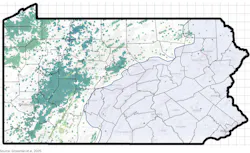
The demarcation between inside and outside the basin has ramifications on the estimated geothermal potential in their respective areas. Fig. 1 shows well locations from oil and gas activity which provided subsurface temperature data for geothermal assessments. Direct measurements were made in the basin, while the shaded area east of the blue line required geological models to estimate temperature due to the lack of wells available for analysis.
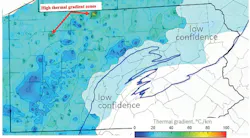
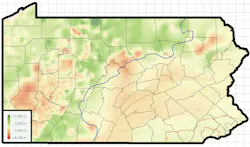
Fig. 2 shows geothermal gradients corrected for reservoir cooling in the immediate wellbore area after drilling. Corrected temperatures are about 18-20% higher than measured data due to near-wellbore cooling from drilling fluids.
The blue line in the figure represents the eastern boundary of the Appalachian basin. The area in light blue shows the limit of available corrected temperature data and mapping. Geological modeling and extrapolation in this area provide low-confidence temperature estimates. Temperature gradients in the white area east of the low-confidence zone were also modeled, also at low confidence, but not indicated on the map.
The western part of Pennsylvania has two 25-30°C./km geothermal gradient bands separated by a zone of lower gradient (about 15-20°C./km). Two relatively high thermal gradient areas of nearly 60°C./km exist, one in Pennsylvania’s northern border in McKean County and a small zone in the northeast corner of Forest County.
*Based on corrected temperature data
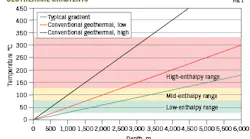
Fig. 3 compares the corrected Pennsylvania geothermal gradients with a typical 30°C./km low-enthalpy gradient representing areas without anomalous underground heat sources. The blue line represents Pennsylvania’s average gradient, and the green line shows the high end of the downhole data except for the two high temperature regions (for example Mckeon County, in red). The data show that Pennsylvania has an overall gradient lower than average, but the higher gradient areas in the dataset fall along the averages.
Appalachian basin contains a thick bed of sedimentary rock layers between Virginia and West Virginia along the western edge of the Appalachian Mountains. Little, if any, sedimentary cover exists across much of the greater Philadelphia area, which has exposed basement rock at surface.
Thick sediment can insulate mantle-advective heat flow (movement of magma and groundwater through cracks, fractures, and porous rock), resulting in lower overall subsurface temperatures. Although this insulating layer decreases towards the southeastern end of the state, it does not result in a significant increase in subsurface temperatures due to the thin crust in this area. Crust contains radiative elements which generate radiogenic heat, adding to the overall thermal gradient. The relatively thin crust in the Appalachian basin, however, provides little additional heating through this mechanism, resulting in Pennsylvania’s relatively low average subsurface temperatures.
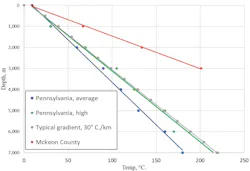
Fig. 4 shows the minimum depth required to reach 100°C. (212°F.) and includes all eastern low-confidence areas based on regional geological modeling. Although the southeast area inside the red dotted lines lies within the same thermal regime as surrounding areas, detailed geological modeling indicates a higher temperature gradient in this zone, but the actual gradient was not included in the report.
Based on geothermal gradients, a bottom-hole temperature of 120°C. is typically accessed within 5 km (16,400 ft) TVD in central and western areas (Allegheny County and surrounding areas, and above State College). Beyond these areas, the gradient increases, reducing the depth required to reach 120°C. to about 3 km (9,842 ft).
Two locations, the northeast corner of McKean County and the northwest corner of Forest County, reach 150°C. (300°F.) at less than 3-km depth. Other areas in the state can reach 150°C. at about 3.9 km (12,795 ft). This depth is beneath the sedimentary rocks and requires drilling into older and typically harder basement igneous and metamorphic rock.
Aquifer vs. enhanced geothermal
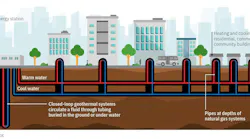
Geothermal taps hot or supercritical water in aquifers or accesses heat from hot dry rocks (HDRs) using enhanced geothermal systems (EGS) or advanced geothermal systems (AGS). EGS creates fracture networks in the HDRs where water is injected into the well to return as heated fluid. AGS uses a closed loop, keeping water or a working fluid such as CO2 within a pipe or series of pipes in contact with HDRs.
Pennsylvania geothermal will require EGS or AGS. Pennsylvania aquifers typically have 3-18% porosity and 0.05-1 md permeability, though there are a few higher permeability aquifers with 100 md permeability.
These low averages result from deep burial and strong compaction of Appalachian basin sediments before uplift and erosion of the overburden. The transmissibility of these aquifers will not support production rates necessary for geothermal applications, and they would require stimulation or a closed loop system like EGS or AGS in HDRs.
Geothermal applications
Fig. 5 shows the different types of geothermal applications in the state. Pennsylvania’s geology limits realistic geothermal potential to below 150°C. in most places, and dark green portions of the map outline areas limited to ground-source heat pumps (GSHP) for heating and cooling. Light green and yellow areas are suitable for heat pumps but also direct district heating and industrial process heat. Areas in orange and red could supply heat for electrical generation.
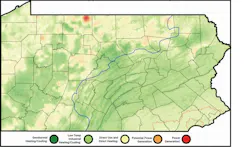
Wells drilled in 20-25°C./km areas are suitable only for climate control of residential and commercial buildings. This includes most of the areas in and surrounding Allegheny County and Center Country (State College). Wells drilled in 30°C./km gradients can provide enough heat for district heating, cooling, and low-temperature (< 120°C.) industrial processes but not efficient electrical generation (requiring at least 150°C.).
Most of the geology in Pennsylvania, therefore, is unsuitable for direct power generation except for two small areas with high geothermal gradient. By contrast, Pennsylvania’s subsurface temperatures make geothermal suitable for lower-temperature applications. Up to 7.49 TBtu of heating demand exists statewide in the 0-99°C. range which could be supplied by geothermal.
The Pennsylvania geothermal report suggests that direct use geothermal would be most applicable in petroleum and coal refineries in Philadelphia, Delaware, and McKean counties, the agriculture industry in York, Lancaster, and Chester counties, in the manufacturing sectors in Philadelphia, Delaware, McKean, Butler, and Warren counties, and in the pharmaceutical sector in Montgomery County.
Note that these counties, except Warren and Butler, lie in the east, where gradients are currently estimated, not measured.
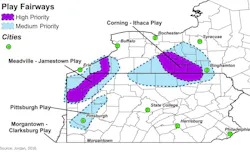
Fig. 6 shows the most favorable play fairways within the Appalachian basin based on four risk factors which include thermal resource quality, natural reservoir quality, induced seismicity, and utilization opportunities.
Geothermal drilling demand
The Pennsylvania geothermal report estimates that, for current 90°C. applications, 878 commercial wells, 64 industrial wells, and 1,174 residential heating wells totaling 2,116 wells would be required to meet demand. These estimates were based on 55 Gw-hr thermal production per well pair (injector-producer).
Based on current Pennsylvania oil and gas drilling activity (571 wells Jan. 1, 2025-Jan. 1, 2026), these wells could be drilled within 4 years. That estimate, however, requires the same drilling intensity as oil and gas drilling. It is unrealistic to expect oil and gas companies to give up rigs for geothermal drilling, and additional rigs would need to mobilize to meet this demand. Baker Hughes reports 16-18 rigs working in Pennsylvania for 2025-26, indicating a modest scale of mobilization required. For context, Texas picked up 35 rigs from August 2025 to August 2026.
Western and central Pennsylvania lithology consists primarily of sedimentary sandstone, shales, and limestone down to 5,000 m (16,404 ft), the deepest drilling expected for most geothermal applications (Fig. 7). Given Pennsylvania’s generally normal geothermal gradient and lithology in these areas, no special modifications would be required to convert oil and gas rigs to geothermal drilling.
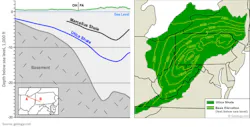
Harder igneous and metamorphic basement rocks on the eastern side of the state, including Lower Paleozoic and Precambrian, may result in slower drilling times, higher bit wear, and consequently higher drilling costs. These areas encompass some of the highest-density industrial and commercial activity in the state and therefore would expect to have the most drilling activity. They are also the areas with the most geothermal gradient uncertainty.
Geothermal pilot program
An upcoming field pilot for an enhanced geothermal system (EGS) will study the conversion of an existing horizontal natural gas well for geothermal use to assess well design and geothermal potential in a typical western Pennsylvania location.
In second-quarter 2026, The DOE Office of Geothermal awarded $14 million to support an EGS field test in Indiana County, Pa. Led by the Pennsylvania Department of Environmental Protection, the project will tap the Appalachian Utica Shale to assess EGS in the eastern United States.
The project will convert a horizontal natural gas well owned by CNX Resources Corp. Repurposing existing oil and gas infrastructure avoids additional land disturbance for the trial. The project will assess optimal well orientations, placements, and techniques to create the fracture networks required for EGS.
The project’s news release suggested that the well will provide both electrical power and thermal energy, but it is not in a high-enthalpy area and would have to be drilled deep to access temperatures required for electrical generation. Based on data in the Innerspace report, it would require a depth of about 6,000 m (19,685 ft) to reach 150°C., the temperature required for electrical generation. The Marcellus shale typically ends at 2,700 m (about 9,000 ft) below sea level which is why the pilot is tapping the deeper, hotter Utica shale.
The first phase of the project will assess thermal resources and develop a geothermal model from data obtained from CNX’s Marchand 3 pad in North Mahoning Township. Figs. 4 and 5 show the location of this pad. Depending on the results of the investigation, Marchand 3 may become one of the wells in the EGS pilot pair. Findings from the first phase of the project will drive decisions on pilot design.
DEP will lead the project in partnership with the Department of Conservation and Natural Resources, Bureau of Geological Survey, Gradient Geothermal Inc., Teverra Inc., Lehigh University, Idaho National Laboratory, CNX-subsidiary CNX Green Ventures, and Seequent.
While not in Pennsylvania, a geothermal pilot is currently being performed in Ithaca, NY, in an Appalachian play fairway similar to the northwestern region of Pennsylvania. This area comprises a low-temperature geothermal zone suitable for direct-use applications (e.g. district heating, greenhouses, and industrial processes) or electrical coproduction, but not suitable for sole electrical generation. The well will be drilled to about 2,983-m (9,790-ft) TD into crystalline basement rock.
Bibliography
Baker Hughes rig count. https://rigcount.bakerhughes.com/na-rig-count
Barnes, J.H., “Rocks and Minerals of Pennsylvania,” Pennsylvania Geological Survey, 4th series, Educational Series 1, 2004. https://elibrary.dcnr.pa.gov/PDFProvider.ashx?action=PDFStream&docID=1752493&revision=0&docName=ES1_Rx-Mins_Pa&nativeExt=pdf&PromptToSave=False&Size=3981123&ViewerMode=2&overlay=0
Commonwealth of Pennsylvania, “Shapiro Administration Secures $14 Million for Enhanced Geothermal Systems Pilot Demonstration Project in Pennsylvania,” DEP Newsroom, April 16, 2026. https://www.pa.gov/agencies/dep/newsroom/2026-04-16-shapiro-administration-secures-14-million-for-enhanced-geothermal-systems-pilot
DEP office of Oil and Gas Management, Pennsylvania Department of Environmental protection. https://s3.documentcloud.org/documents/28093095/marchand.pdf
Frazier, R., “Federal Money will Pay for ‘Enhanced’ Geothermal Project in Pennsylvania,” The Allegheny Front, May 4, 2026. https://www.alleghenyfront.org/pennsylvania-indiana-county-enhanced-geothermal-well/
Grossman, G., McFadyen, T., Nelson, D., “The Future of Geothermal in Pennsylvania,” Project Innerspace and Penn State CELP, February 2025.
Jordan, T.E., “Low Temperature Geothermal Plat Fairway Analysis for the Appalachian Basin,” DE-EE0006726, Cornell Univ., Openei, Nov. 18, 2026.
Repetski, J.E., Ryder, R.T., Weary, D.J., Harris, A.G., and Trippi, M.H., “Thermal Maturity Patterns (CAI and %Ro) in Upper Ordovician and Devonian Rocks of the Appalachian Basin: A Major Revision of USGS Map I–917–E Using New Subsurface Collections,” US Geological Survey Scientific Investigations Map 3006, 2008.
US Department of Energy, “OG Selects $14 Million Enhanced Geothermal Systems Demonstration Project in Pennsylvania,” Geothermal Technologies Office, Apr. 16, 2026. https://www.energy.gov/hgeo/geothermal/articles/og-selects-14-million-enhanced-geothermal-systems-demonstration-project
About the Author
 Alex Procyk
Upstream Editor
Alex Procyk is Upstream Editor at Oil & Gas Journal. He has also served as a principal technical professional at Halliburton and as a completion engineer at ConocoPhillips. He holds a BS in chemistry (1987) from Kent State University and a PhD in chemistry (1992) from Carnegie Mellon University. He is a member of the Society of Petroleum Engineers (SPE).