DOE data repository supports geothermal development
The US Department of Energy (DOE) hosts the Geothermal Data Repository (GDR), a major open-access platform that houses data from geothermal research, development, and operations. The repository ensures that data are discoverable and reusable.
The repository supports district geothermal energy pilots, contains a data lake of all DOE-funded geothermal projects, provides analyses on all US geothermal play fairways, and facilitates an enhanced geothermal system (EGS) collaboration project.
A Geothermal Center of Excellence has also been established to accelerate gigawatt-scale geothermal development through collaboration among industry, academia, and national laboratories.
GDR
The US Department of Energy GDR hosts free access to data generated from projects funded by the DOE’s Office of Geothermal and supporting projects and partnerships. The GDR contains data from all aspects of geothermal research, development, and operations, including data on:
- Geothermal energy production.
- EGS.
- Geothermal heat pumps.
- Community programs and district heating.
- Frontier Observatory for Research in Geothermal Energy (FORGE).
- Play-fairway analyses.
The GDR uses findable, accessible, interoperable, and reusable (FAIR) and FAIR + AI readiness and reproducibility (FARR) guiding principles to provide standardized, discoverable, accessible, and free data.
Data curators review metadata provided with each data submission for accuracy, completeness, and relevance to the data submitted. The curators make sure the data are suitable for eventual public release and do not inadvertently contain personally identifiable information (PII) or other inappropriate content. The curators do not review or validate the quality of submitted data.
As of mid-2026, the repository contained 764 TB of information, about 60 million total downloads, 1,400 datasets, and 145 data providers.
GDR subsections
The GDR contains subsections on the following:
- District-Scale Geothermal Energy Pilots. These are initiatives to develop and deploy geothermal-district heating and cooling systems in communities across the US.
- Data lakes. This section contains curated and diverse datasets on the funded projects.
- Play-Fairway Analysis (PFA). Fairway analyses integrate quantitative geoscience data to identify prospective geothermal trends at various scales for further exploration.
- EGS Collab Project. A collaborative, experimental suite of intermediate-scale (~10-20 m) field test beds, coupled with stimulation and interwell flow tests.
Details about the initiatives follow.
District-scale geothermal energy pilots
The District-Scale Geothermal Energy Pilots initiative, formerly the Community Geothermal Heating and Cooling (CommGeo) initiative, aims to develop and deploy geothermal district heating and cooling systems (including district-scale systems often referred to as thermal energy networks) in communities across the US. The goal is to create replicable models and case studies that demonstrate the viability of these systems on a community scale nationwide, with an emphasis on environmental and economic sustainability. The projects are designed to meet at least 25% of the heating and cooling needs in each community.
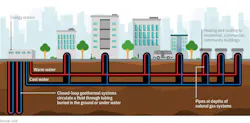
These low temperature, shallow systems comprise multiple boreholes connected to district energy stations. An underground heat collector, a heat pump, and a heat distribution subsystem are the three key elements of a geothermal heat pump (GHP) system (Fig. 1). Central loops distribute hot and cold water to buildings. To better understand these systems, the Office of Geothermal compiled 24 case studies on GHP applications across different US climate zones, highlighting various system types, sizes, and benefits.

Phase 1 of the pilot initiative formed coalitions of local stakeholders including governments, nonprofits, academia, and industry to collaboratively design, deploy, and refine geothermal systems tailored to each community's needs. It identified 11 communities in ten states to assess and design community-scale geothermal heating and cooling systems.
The second phase chose three communities, two urban-suburban and one rural, from this pool for system installation. They will employ a range of system sizes, technologies, and innovations to provide diverse installation templates for other communities to study for their geothermal requirements. The selected project locations and leads are shown in the accompanying table.
Data lakes
Database submissions for 2026 to the data lake include the geothermal limitless approach to drilling (GLADE) project, the Lightning Dock geothermal field, Cornell University Borehole Observatory (CUBO), Utah FORGE, supercritical drilling, and US manufacturing thermal load profiles.
GLADE, funded by the US Department of Energy Geothermal Technologies Office and executed by Oxy, tests the adaptation of standard oil and gas drilling to geothermal well construction in deep, hot, hard-rock environments in DJ Basin, Colo. The project includes drilling GLADE West and GLADE East wells through the sedimentary section and into deep Precambrian granitic basement rocks. Drilling data and operational lessons learned are in curation and will be available April 2027.
The Lightning Dock Geothermal Field Data Package contains curated geoscience, well, and plant-operations data for an Organic Rankine Cycle (ORC) binary power generation system in Animas Valley, Hidalgo County, southwestern NM. ORCs generate electricity from low-to-medium temperature heat sources. The Lightning Dock data package contains data for 41 wells, interwell tracer test campaigns, geophysics, daily plant operations, shallow groundwater monitoring, and produced fluid geochemistry.
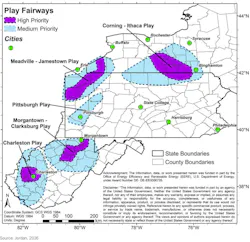
The CUBO stratigraphic well characterizes potential EGS resources from a well drilled on campus property in central New York. The Corning-Ithaca Play Fairway (mostly in New York) includes locations with favorable risk metric scores and small degrees of uncertainty. The risk metrics are based on four factors which include thermal resource quality, natural reservoir quality, induced seismicity, and utilization opportunities. Fig. 2 illustrates the play-fairway priority rankings.
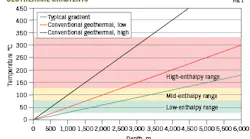
This area comprises a low-temperature geothermal zone suitable for direct-use applications (e.g. district heating, greenhouses, and industrial processes) or electrical coproduction, but not suitable for sole electrical generation (Fig. 3). These low-temperature geothermal resources are more common in the US than high temperature areas for electrical generation, and the project will evaluate the suitability of these regions for direct use geothermal.
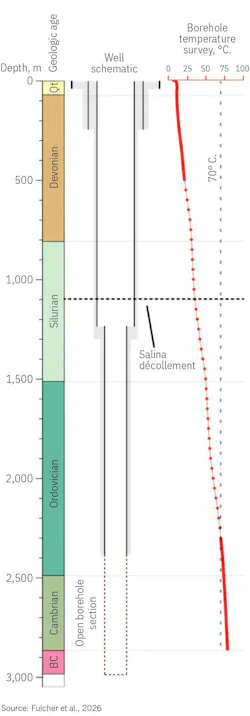
The well spudded on June 21, 2022, and was drilled to 9,790 ft TD. The upper part of the well was drilled through 9,400 ft of sedimentary rocks before penetrating 390 ft of crystalline basement rock. Sidewall cores included 25 samples at 7,885-9,505-ft depths. The lower six cores were collected from the crystalline basement rock. Data files include photographs, tomographic images, and thin section images of the cores. Data submission is in progress.
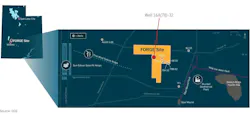
At FORGE, an uploaded dataset contains three-component surface nodal seismic waveforms recorded during the FORGE Observation Array Linear #1 (FOAL 1) experiment during the hydraulic stimulation of well 16A(78)-32 (Fig. 4). The project tested geophysical imaging and time-lapse monitoring to image basement contact and deeper structures at this EGS pilot site.
A supercritical drilling materials database includes information on geothermal wells drilled into supercritical and near-supercritical conditions. Supercritical geothermal wells (>373 ˚C. and 22 MPa) can produce about an order of magnitude more heat than typical geothermal wells. But supercritical drilling has experienced near catastrophic problems.
A multi-laboratory collaboration has been assembling a database on drilling and completion materials, fluid chemistry, and laboratory validation studies for supercritical wells. The data are drawn from well reports, scientific literature, and laboratory testing programs.
The well-component files document materials used during drilling and completion and include component type, material, specifications, issues observed, and references. The fluid chemistry file contains aqueous and vapor-phase geochemical measurements from selected geothermal wells and fields, including concentrations of major, minor, and trace elements as well as gas compositions. A material validation and testing file compiles laboratory results on the performance of metals, cement, proppants, lost circulation materials, and wellbore hydraulics under simulated supercritical geothermal conditions, with associated conditions, limitations, results, and recommendations.
To estimate geothermal opportunities, a database containing the thermal load-profiles for US manufacturing subsectors includes annual, quarterly, and hourly energy demand and operational profiles for 63 US manufacturing subsectors. The dataset integrates US Energy Information Administration (EIA) Manufacturing Energy Consumption Survey (MECS) data with a quarterly operating schedule reconstruction based on the US Census Bureau Quarterly Plant Capacity Utilization (QPC) dataset. A project-specific methodology translates capacity utilization, operating days, and shift structures into consistent hourly operating schedules and end-use energy allocations.
The dataset contains annual total estimated thermal energy demand by end use and fuel type for each manufacturing subsector, quarterly operating characteristics derived from QPC-based utilization data disaggregated into hours, shifts, and operating states, and quarterly operating structures converted into hourly load allocation-profiles that distribute energy demand across the year at hourly resolution.
PFA
The PFA project screens geographic areas for promising geothermal properties, ultimately to produce regional-scale maps which reduce exploration uncertainty for further development.
Phase I identified 96 areas for study within geothermal play fairways. Identification of the types of plays in the study areas combined heat, permeability, and fluid properties. Land access was also considered in terms of candidacy for moving forward with study-area awards.
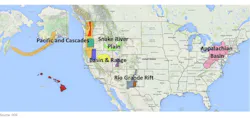
Phase II selected prime fairways for future study. These included the Eastern Great basin, Hawaii, Modoc Plateau, Nevada Great basin, Rio Grande Rift, Snake River Plain, Tularosa basin, and Washington State (Fig. 5). Phase III tested PFA models via exploratory drilling campaigns. Four teams completed targeting and drilling of temperature gradient wells at seven plays and discovered anomalously high temperatures and gradients at four of them.
EGS Collab Project
EGS Collab (a.k.a. SIGMA-V) bridges laboratories and full-scale EGS technology tests at SURF. The NLR provides a secure, collaborative data management platform while the Data Foundry platform allows collaboration among member organizations. These organizations include nine US DOE National Laboratories (Lawrence Berkley, Sandia, Lawrence Livermore, Pacific Northwest, Idaho, Los Alamos, National Laboratory of the Rockies, Oak Ridge, and National Energy Technology), seven universities (Stanford University, the University of Wisconsin, South Dakota School of Mines & Technology, the University of Oklahoma, Penn State University, the Colorado School of Mines, and Rice University), and two companies (McClure Geomechanics LLC and TDoeGeo Rock Fracture Consulting).
The project’s primary objective is to efficiently implement EGS through crystalline rock at the 10-m scale at about 1.5 km MD to examine hydraulic fracturing and shear stimulation.
The project uses step-rate injection method for fracture in-situ properties (SIMFIP) to directly measure fracture opening and shear. Continuous active source seismic monitoring (CASSM), distributed temperature sensing (DTS) and distributed strain sensing (DSS), acoustic emissions (AE), passive seismic, and electrical resistance tomography (ERT) actively monitor fractures in the test bed. Collecting this data during stimulation and flow tests provides a direct comparison with results from numerical models to validate and refine modeling techniques.
Geothermal Center of Excellence
The DOE Hydrocarbons and Geothermal Energy Office (HGEO) launched a Geothermal Center of Excellence (CoE) on Sept. 3, 2026, to coordinate activity among industry, academia, and national laboratories. The center will accelerate the discovery and development of gigawatt-scale geothermal energy. CoE goals include reducing technical barriers, accelerating industry-lab partnerships, and connecting industry with specialized expertise across the national laboratory system.
The National Laboratory of the Rockies (NLR) will lead the consortium, with support from the National Energy Technology Laboratory (NETL). The HGEO will provide strategic direction, oversight, and alignment of center activities with DOE priorities.
Bibliography
Akindipe, D., Smith, F.M., Witter, E., Pauling, H., Oh, H., Podgorny, S., Rane, J., Harmon, J., Javed, S., Simpson, J., Shlosberg, D., Holt, E., Guitton, W.T., Levine, A., Schmidt, B., and Pedersen, A., “2025 U.S. Geothermal Market Report,” NLR/TP-5700-91898, National Laboratory of the Rockies, June 2026. https://docs.nlr.gov/docs/fy26osti/91898.pdf
DOE Geothermal Data Repository (GDR), https://gdr.openei.org/about
DOE, “Pilots and Demonstrations: Next-Generation Field Tests and Drilling for New Resources,” Sept. 21, 2026. https://www.energy.gov/hgeo/geothermal/pilots-and-demonstrations-next-generation-field-tests-and-drilling-new-resources?utm_medium=email&utm_source=govdelivery
EGS Collab Project Overview, Open EI. https://openei.org/wiki/EGS_Collab_Project_Overview
Fulcher, S.A., Jordan, T.E., Laubach, S.E., Elliott, S.A., and Herrera, V.N., “Improving borehole fracture characterization using oriented sidewall cores for geothermal assessment – an example in central New York State USA,” 103589, Geothermics, Vol. 136, March 2026. https://doi.org/10.1016/j.geothermics.2025.103589
Geothermal Research, https://www.nlr.gov/geothermal
Geothermal Technologies Office, Geothermal Center of Excellence. https://www.energy.gov/hgeo/geothermal/geothermal-center-excellence?utm_medium=email&utm_source=govdelivery
HGEO, “DOE Announces Geothermal Center of Excellence,” DOE, Sept. 3, 2026, https://content.govdelivery.com/accounts/USEERE/bulletins/427b105
Jordan, T.E., “Low Temperature Geothermal Plat Fairway Analysis for the Appalachian Basin,” DE-EE0006726, Cornell Univ., Openei, Nov. 18, 2026. https://gdr.openei.org/files/899/GPFA-AB_Final_Report_with_Supporting_Documents.pdf
Kacapyr, S., “Borehole of opportunity’ attracts international scientists,” Cornell Chronicle Feb. 6, 2000. https://news.cornell.edu/stories/2020/02/borehole-opportunity-attracts-international-scientists
Kibikas, W., Pyatina, T., Meng, M., Schill, E., Taverna, N., Mello, S., Broadhurst, T., and Dobson, P., “Supercritical Geothermal: Resources, Drilling Experience, and Technological Gaps,” 51st Workshop on Geothermal Reservoir Engineering, Feb. 9-11, 2026. https://pangea.stanford.edu/ERE/pdf/IGAstandard/SGW/2026/Kibikas.pdf
Kim, J., Ajo-Franklin, J., Shadoan, T., Sobolevskaia, V., Correa, J., and Freifeld, B., “Using a dense linear array for passive seismic converted wave imaging at a geothermal site: The FOAL 1 experiment at Utah FORGE,” Geophysics, Vol. 91, No. 2, March-April, 2026. https://pubs.geoscienceworld.org/seg/geophysics/article-abstract/doi/10.1190/GEO-2025-0248/723785/Using-a-dense-linear-array-for-passive-seismic?redirectedFrom=fulltext
Pauling, H., Taverna, N., Trainor-Guitton, W., Witter, E., Kolker, A., Warren, I., Robins, J., and Rhodes, G., “Geothermal Play Fairway Analysis Best Practices,” Technical Report NREL/TP-5700-86139, September 2023. https://docs.nlr.gov/docs/fy23osti/86139.pdf
About the Author
 Alex Procyk
Upstream Editor
Alex Procyk is Upstream Editor at Oil & Gas Journal. He has also served as a principal technical professional at Halliburton and as a completion engineer at ConocoPhillips. He holds a BS in chemistry (1987) from Kent State University and a PhD in chemistry (1992) from Carnegie Mellon University. He is a member of the Society of Petroleum Engineers (SPE).