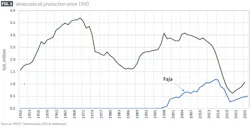
New hydrocarbon legislation introduced in 2026 has opened upstream opportunities for private operators to increase production in Venezuela. Venezuela’s oil production has declined to about 1 million b/d today from a peak of 3.7 million b/d in 1970 (Fig. 1), despite more than 450 billion barrels of conventional oil discoveries across 320 fields. At the end of 2025, about 250-300 active conventional fields outside the Orinoco heavy oil belt were producing about half of Venezuela’s production.
The Eastern basin contains an estimated 9 billion barrels (Bbo) of remaining recoverable oil. The Western, or Maracaibo, basin remains Venezuela’s most prolific conventional oil province, and major producing areas still hold significant undeveloped resources.
Although much smaller, the Barinas-Apure basin contains lighter crude and offers redevelopment potential despite a steep production decline.
Venezuela opportunity
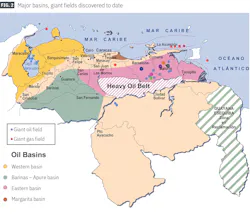
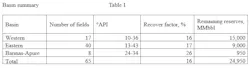
Of the more than 450 Bbo of traditional oil discovered in 320 fields, 73% is in Western basin, 23% in Eastern basin, and only 1% in Barinas-Apure basin (Figs. 2-3, Table 1).
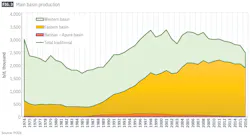
The Western basin had 100 plus active fields producing about 200,000 b/d while the Eastern basin produced 250,000 b/d from 120-150 wells (Fig. 3). Overall, there are about 15,000 shut-in and abandoned wells.
Venezuela offers opportunities to significantly increase production from fields in Eastern, Western, and Barinas-Apure basins. This article provides an estimate of reserves and suggestions for development in prominent fields in these areas.
Eastern basin
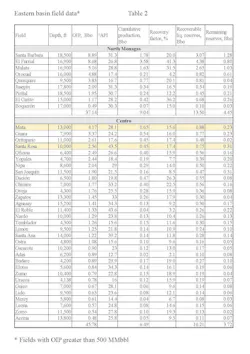
A thorough review of reserves and production data from more than 60 oil fields in Eastern basin suggests that about 9 Bbo remain to be extracted with about half in North Monagas fields and half in Centro, including 300 MMbbl in the Anaco trend (Table 2). By early 2026, with the new hydrocarbon law granting private companies direct upstream access through new licenses.
Santa Barbara
Fig. 4 shows Santa Barbara field’s production history, peaking at 223,000 b/d from 203 wells in 1998, followed by a semi plateau to about 175,000 b/d from 2000 to 2013. Output has since dropped to 32,000 b/d from 114 active wells, with no official data after 2016. Water injection began in 1992, preceding high-pressure gas injection later in the 1990s to maintain reservoir pressure and prevent retrograde condensation in the gas cap. Gas and water injection had kept production stable for more than 25 years, but gas injection (560 MMscfd) was halted after an accident in March 2021.
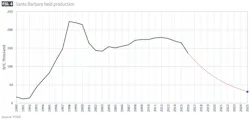
Despite its difficulties, Santa Barbara has yielded 1.7 Bbo of high-quality crude oil (31°API), representing 20% of its OOIP, with an estimated 1.3 Bbo remaining which may be recoverable using current technologies.
Advanced drilling and completion fluids, along with improved procedures, now facilitate efficient reservoir drainage with fewer wells and minimized pressure drops. More sophisticated drilling and completion fluids and procedures are available, requiring fewer drainage points (wells) and allowing lower pressure drops at the wellbore. Additionally, underbalanced safe drilling and completion techniques for extended-reach, high-angle wells have become standard practice.
Limited availability of injection fluids suggests implementing a stacked reservoir strategy, prioritizing the most promising reservoirs while depleting the less prospective ones. Historically, inadequate artificial lift systems have contributed significantly to declining individual well production rates. The deployment of modern lift equipment and systems can substantially enhance production, particularly given current lower flowing pressures.
El Furrial
El Furrial, discovered in 1986, comprises the main field of the Furrial Trend in North Monagas and contains about 8.7 Bbo of 27° API oil within Oligocene-Cretaceous sandstones containing 2,500-ft gross thickness. The discovery well produced 7,300 b/d at a depth of 13,800 ft with 11,000 psi. Reservoir oils are highly undersaturated to 4,800 psi.
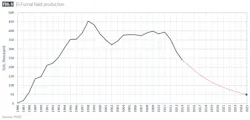
Peak production hit 453,000 b/d in 1998 from about 260 wells (Fig. 5). Water injection started in 1992 at 550,000 b/d when reservoir pressure was about 8,000 psi. Injection rates held steady through to 2012.
This project was followed by, and continued alongside, a massive high-pressure gas injection project that started in 1998 at rates of 450 MMscfd and pressures exceeding 9,000 psi. Reservoir pressures were below 7,000 psi at the start of gas injection. The massive volumes of gas (2.3 bcfd) used for injection in all Furrial Trend fields (Santa Barbara, El Furrial, and Carito) came from associated gas produced directly from those same HPHT giant fields and the nearby Pirital field.
PDVSA built one of the world’s most complex gas-handling infrastructures (PIGAP) to gather and compress the produced gas to 9,000 psi. Likewise, the huge volume of water for injection came from freshwater aquifers in the producing fields.
Asphaltenes are characteristic of the North Monagas region, particularly El Furrial. They flocculate when pressure falls below 6,000 psi, blocking pores, tubing, and valves. Modern treatments for asphaltenes use polymer inhibitors squeezed into the rock formation, preventing molecules from clumping together. Oil production fluctuations shown in Fig. 5 stem from both technical and non-technical issues and produce significant investment difficulties.
The field has been successfully exploited as shown by an integrated model study by PDVSA and Beicip-Franlab, which reviewed geological interpretation, reservoir, and operational strategies from 20 years of field history. Despite numerous difficulties, 3.4 Bbo have been recovered (41% recovery factor), and more than 800 MMbbl remain.
Although a 41% recovery factor may appear high for Venezuela, El Furrial’s design target was 60%, and the project was progressing well until frequent technical issues at the plant, such as interruptions in fluid injection, hindered advancement.
Pirital
Pirital first became known in 1945 for shallow Miocene oil at 5,000–9,000 ft in La Pica and Carapita formations. The field later extended into the deeper Oligocene Naricual formation after El Furrial’s discovery. Pirital-3, the discovery well, reached more than 18,000 ft—among the world's deepest at the time—and in 1987 tested 8,000 b/d of 30° API oil with high undersaturation (5,000 psi).
Fig. 6 shows Pirital's location alongside nearby North Monagas fields, especially Santa Barbara to the south. Both share reservoirs developed at different times. Pirital was a major source of high-pressure associated gas for El Furrial, Santa Barbara, Carito, and itself.
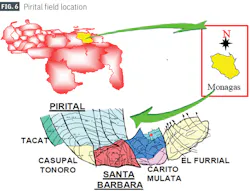
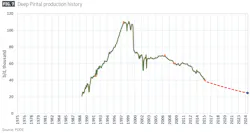
Fig. 7 presents the production history of Deep Pirital (Oligocene and Cretaceous), which peaked at 110,000 b/d in 1998. To date, only 12.2% (238 MMbbl) of its 2 Bbo OOIP has been produced. Initial reserves were 446 MMbbl, with 208 MMbbl remaining.
Pirital field faces similar but more severe operational difficulties as Santa Barbara, including pressure issues, asphaltene deposition, and high temperatures due to greater depth. To recover its reserves, Pirital will require productivity improvements like targeted mutual solvent treatments, coiled tubing lift, and displacement fluids to reduce residual oil saturations. Additionally, liquid load-up will need to be addressed during final depletion combined with methods to lower abandonment pressure.
Mata
Mata (often referred to as the Mata-Acema Area) is the largest of eight giant discoveries in the Centro area of Eastern basin, with remaining OIP of 4.2 Bbo across 300 sq km. Most output is from the highly productive Oficina (Miocene-Oligocene) and Merecure (Oligocene-Eocene) formations, with 463 distinct reservoirs at 11,500-13,500 ft.
This field is notable for yielding light-to-medium crude oil (22°-47° API) as well as significant quantities of natural gas.
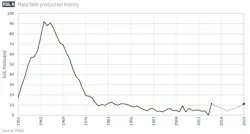
In the 1990s, Venezuela opened its mature fields to foreign investment in a period known as “Apertura,” during which private companies worked as contractors for Petróleos de Venezuela SA (PDVSA). Between 1997 and 2005 innovations like 3D seismic technology and horizontal drilling increased production to 28,000 b/d. In 2006, production began to decline, falling to 12,000 b/d by 2015. Fig. 8 shows the production history of Mata.
Mobil Oil Venezuela, facing low production from condensate gas reservoirs, introduced a "Packaged Exploitation Program" in the Mata field area. The project reinjected dry gas into major reservoirs while selling condensates separately and optimized recovery through gas injection. Smaller depleted reservoirs provided make-up gas and were produced by blowdown, as modelling showed gas injection was ineffective on them.
This project was a first in the country and performed flawlessly. Mata has now produced 15.6% (650 MMbbl) of its 4.2 Bbo OOIP. Initial reserves were 877 MMbbl, and 229 MMbbl remain.
Santa Rosa
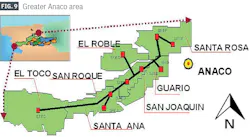
Santa Rosa is part of the Anaco Trend, which began production in the late 1930s and 1940s (Fig. 9). The area features high gravity oil (33-47°API) and substantial associated gas at depths of 7,500-10,000 ft, leading to rapid growth.
The prolific Miocene Oficina formation lies significantly deeper (6,000-9,500 ft) compared with the Greater Oficina region (5,000-7,500 ft). Miocene Oficina features multiple stacked sandstone layers, 28 of which are saturated with oil, with 15 containing natural gas. About 2% of layers hold condensates, with Oligocene Merecure (8,500-11,000 ft) representing the major condensate target. Most reservoirs have a gas cap, and the crude contains 15% wax.
Santa Rosa contains an estimated 2.6 Bbo OOIP with 450 MMbbl cumulative production to date (17.4 %). Estimated EUR is 751 MMbbl, indicating that about 300 MMbbl remain available for future extraction. Additionally, the field contains an initial gas volume of nearly 12 tcf, present in both the condensate gas caps and the oil legs.
Fig. 10 shows the production history of this field. Production reached its peak in 1966 at 50,000 b/d and, unsurprisingly, the single RG-14 COL E/F reservoir accounted for about half of that total rate at the time.
Field revitalization will require tapping into previously untouched reservoirs, a strategy particularly pertinent in Centro, which contains multiple resources like Mata field with its 463 reservoirs. Typically, wells in these fields featured dual-completions, leaving numerous behind-the-casing reserves untouched. Combining these sands provides an effective approach to boosting production.
Production optimization can come from fiber-optic monitoring in new wells which provide real-time flow and pressure data, enabling automatic choke adjustments to improve oil output and manage water breakthrough.
Western basin
Western (Maracaibo) basin played a key role in Venezuela’s rise as a global energy leader. The basin contains 13 giant oil fields and about 270 billion barrels of OOIP. More than 40 Bbo have been produced.
Major field developments like Lagunillas, Tia Juana, and Bachaquero occurred from the 1920s to 1970s. Key productive layers include the Eocene Misoa sands, La Paz and Mara Cretaceous carbonates, and Icotea and Santa Barbara formations. These are noted for their high permeability. Fig. 11 shows the general location of Western basin and its major fields.
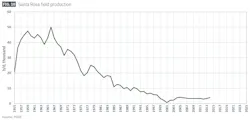
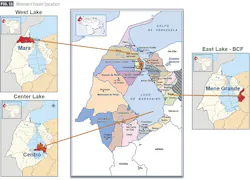
Table 3 provides key data on reserves and production for 17 mature fields with over 230 Bbo in place in Western basin. The table categorizes fields in three regions: East Lake (also referred to as Bolivar Coastal Fields (BCFs) which includes both onshore and shallow water sites up to 5 ft deep in Lake Maracaibo), Center Lake, and West Lake.
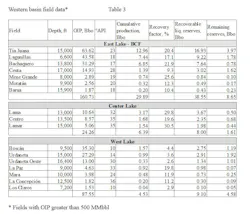
West Lake fields are marked by the presence of lighter oils (30-35°API) in principal fields La Paz, Mara, and La Concepcion which produce from Cretaceous carbonates. Further south and west lies Boscan field, notable as an outlier with very heavy oil (10°API) sourced from the Eocene Misoa at 4,500-5,000 ft deep.
Deeper reservoirs dominate towards the center of Lake Maracaibo. The Misoa provides thick, high-quality sandstone production, while the Cretaceous La Luna yields substantial carbonate output. In upper sections, Lagunillas produces heavy oil. High-pressure gas injection maintains pressure in Misoa, while waterflooding maintains pressure in Lamar fields.
Venezuela's prolific oil-producing region on the eastern side of the lake includes super giants such as Lagunillas, Tia Juana, and Bachaquero, which collectively account for about 38% (140 Bbo remaining OIP) of the oil available from the nation’s traditional discoveries.
Despite nearly a century of production activity and the application of steam injection methods, there remain recoverable reserves of more than 9 billion bbl of heavy oil in marginal fields within BCFs, 1.6 Bbo of light oils in Centro Lago fields, and 4.6 Bbo of heavy to light oils in West Lake fields of the La Paz-Mara trend.
Additionally, the Cretaceous La Luna formation provides the source rock for most reservoirs in Western basin. It is comprised of carbonate and poses drilling difficulties such as high pressure and H2S. The US Energy Information Administration (EIA) classifies it as a quality unconventional shale oil deposit with about 13.4 Bbo of technically recoverable reserves.
Three principal fields, Mene Grande, Centro Lago, and Mara, have been selected in this article for performance analysis.
Mene Grande
Located on Lake Maracaibo’s eastern shore, Mene Grande marked Venezuela’s first commercial oil field and paved the way for the development of the vast BCFs.
While Shell PLC was exploring thermal recovery in the 1950s, the breakthrough for cyclic steam stimulation happened accidentally at Mene Grande field in 1959. Once the concept was proven Shell moved quickly to apply it to all the fields along the eastern shore of Lake Maracaibo containing viscous oils (10-15°API) at shallow depths.
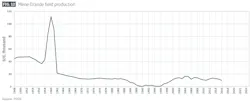
Fig. 12 displays Mene Grande’s production history, which peaked at about 110,000 b/d in 1960 mainly due to cyclic steam injection. Mene Grande has produced 740 MMbbl to date or 25.6% of the original 2.9 Bbo in place.
After steam injection, other methods for marginal heavy oil fields include injecting solvents like propane or butane to lower oil viscosity using CO2 or adding surfactants and foams to direct steam into bypassed reservoir areas. BCFs, including Mene Grande, still contain more than 9 Bbo of heavy oil reserves.
Centro Lago
Production from Centro Lago historically came from the C-sands of the lower Eocene Misoa formation, known for their high-quality reservoir properties and light crude oils (30-40°API) at 7,000-10,000 ft depths. By 1977, reservoir pressure in the CL-2 area had declined to 1,200 psi from an initial 5,125 psi at 11,300 ft deep.
A flank water-injection project was started in 2000 involving 102 producers and 10 injectors. The system was later modified into a dispersed injection system. The field originally contained 8.3 Bbo. Current recovery stands at about 22%, which is much lower than the 36% forecast by models. Sweep efficiency has been sufficiently hindered by the complex fault system in Centro. Much bypassed oil remains. Methods like water alternating gas (WAG) could boost recovery to 30%, or about 70 MMbbl.
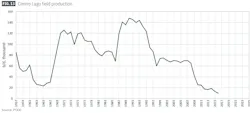
Fig. 13 shows how oil production trends have shifted over 70 years due to changes in data grouping as more blocks were included.
In 2025 China Concord Resources Corp. launched a $1-billion project to reactivate fields in Lake Maracaibo, including Lago Cinco and Lagunillas Lago. The company expects to boost production to 60,000 b/d from 12,000 b/d by end-2026.
Mara field
Mara field lies on the Mara-La Paz trend and represents a significant geological structure. This onshore site lies west of Lake Maracaibo near the city of Maracaibo.
The field is geologically complex, with production mainly from Cretaceous limestone formations (accounting for 80%) as well as fractured deep igneous basement rock reservoirs. Open hole comprises the standard well completion.
The primary hydrocarbon reserves are found in the Cretaceous Apon formation, which contains the main accumulation of oil in the field. Porosity averages about 2% but can increase to 20% in the upper zones of the roughly 50-ft thick interval. Permeability is generally 0.01-3 md and occasionally can be as high as 50 md.
The volumetrically weighted oil gravity averages 22-24°API for the field. Certain blocks and intervals have higher API gravity, making the average value a misleading indicator of the physical distribution of oil gravity levels throughout the field. Fig. 14 shows Mara’s production history.
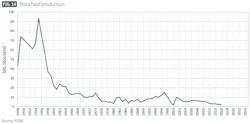
In the early years of development, production data for Mara and neighboring La Paz fields were combined. Mara had 3.9 billion barrels of OOIP with 475 MMbbl (12%) produced to date. EUR is 727 MMbbl, leaving 252 MMbbl yet to be recovered.
Barinas-Apure basin
Barinas-Apure, Venezuela’s smallest oil-producing basin, lies south of Maracaibo basin and borders Colombia (Fig. 15). The basin holds just more than 1% of Venezuela’s reserves. Most Venezuelan basins contain heavy crude (22° API on average), but this basin contains 25.5°API crude. Hydraulic fracturing has been used to optimize output.
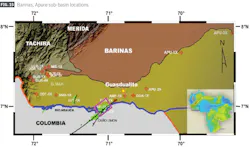
Its main reservoirs are the classic Eocene Gobernador formation and some Cretaceous Escandalosa limestone reservoirs. Major fields in the Barinas Sub-basin include Silvestre and Sinco with significant production targeting Cretaceous reservoirs at 2,000-5,000 ft.
Following development of Barinas-Apure fields and Occidental Petroleum Corp.’s discovery of Cano Limon field on the Colombian side of the border, the Apure Sub-basin was explored. Locations of these fields are shown in Fig. 16.
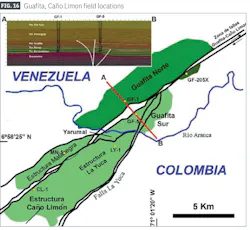
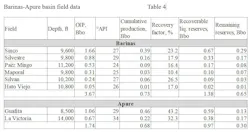
Barinas-Apure, though lacking the massive reserves of Eastern basin and Western basin, has been a small but steady contributor to Venezuela’s total production. Production in the basin has decreased significantly, dropping to 27,000 b/d by 2016 from a peak of 142,000 b/d in the late 1990s. Table 4 provides key data on reserves and production for the fields in the basin. Guafita field was selected for performance analysis.
Guafita
The southern part of Guafita field contains an extension of the Caño Limon structure. Guafita produces from both the Oligocene Guafita formation and the Cretaceous Quevedo Member. Reservoirs are typically found at about 7,500 ft, with net oil pay ranging 20-150 ft with high porosity (25%) and permeability (>2,000 md).
The Guafita discovery well produced 2,000 b/d of highly undersaturated, high-quality oil with a 10-scf/bbl gas-oil ratio (GOR) and 30 °API gravity which naturally flowed from the G-10 sand.
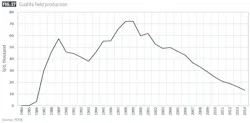
Fig. 17 shows that field production declined to 13,340 b/d by 2014 from a peak of 72,000 b/d in 1998. With 1.1 billion bbl OOIP and a 42% recovery factor driven by strong natural water influx, managing the high-water production is a key operational factor. About 130 MMbbl remains for revitalization. Fifty to sixty wells are active.
Acknowledgement
Thanks to Yeni Fereira for her valuable data research expertise on this project. The task was truly demanding.
Bibliography
Acosta, L., Marin, E., Labastidas, E., Bello, J., Jimenez, J., Cordoba, P., Pascual, J.C., Auxiette, G., Gou, Y., and Thorsen, B., “Reservoir Study V9 of El Furrial Field, Venezuela,” SPE-95047, Latin American and Caribbean Petroleum Engineering Conference, Rio de Janeiro, June 20-23, 2005.
Albornett, L.R., “Feasibility of Alternate EOR Projects in the SBC-01 Reservoir of the Santa Barbara Field, North Monagas,” Thesis, Oriente University of Venezuela, Jan. 2006.
Goddard, D.A., “Venezuela Sedimentary Basins: Principal Reservoirs & Completion Practices,” 2006.
Sandrea, R. and Martin Essenfeld, M, “The Future of Venezuela’s Oil Industry,” EPRINC, Washington DC, Sept. 2021.
Schlumberger, Well Evaluation Conference, 1997.
Authors
Rafael Sandrea is president of IPC Petroleum Consultants Inc. in Tulsa. He holds a PhD (1967) in petroleum engineering from Penn State and is a life member of SPE, member of the United Nations ad hoc Group of Experts on Fossil Resources, Geneva, and a distinguished fellow at Energy Policy Rsearch Foundation (EPRINC), Washington, DC.
Martin Essenfeld is president of EGEP Consultores SA. He holds a PhD (1970) in petroleum and natural gas engineering from Penn State University, is a life member of SPE, and has more than 30 years teaching experience while working with EGEP.