GIIGNL: US LNG growth drives record global trade in 2025
Key Highlights
- Global LNG trade reached a record 56.3 bcfd in 2025, up 5.4% from the previous year.
- US LNG exports increased 26% to 15.1 bcfd, raising the country’s share of global trade to 26%.
- EIA forecasts US LNG exports will continue rising through 2027 as new capacity enters service.
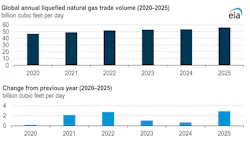
Global LNG trade reached a record 56.3 bcfd in 2025, with expanded US export capacity fueling most of the growth, according to the International Group of Liquefied Natural Gas Importers (GIIGNL), an industry association that tracks worldwide LNG trade.
The US recorded the largest increase among LNG exporters during the year, with shipments averaging 15.1 bcfd, up 26% from 2024, according to the US Energy Information Administration’s (EIA). The increase lifted the US share of global LNG exports to 26%, compared with 21% a year earlier.
The US, Qatar, and Australia—the world’s three largest LNG exporters—accounted for 63% of global LNG trade in 2025, compared with 60% in 2024. Canada’s LNG export market contributed an average 0.3 bcfd during the year, following the June startup of LNG Canada.
Qatar posted the second-largest increase among LNG exporters, with volumes rising 3% to 10.6 bcfd in 2025. However, LNG market conditions shifted in 2026 after disruptions to Qatari exports following the closure of the Strait of Hormuz, affecting a major portion of global LNG supply.
The disruption has increased competition for spot LNG cargoes as buyers in the Asia Pacific—which received more than 80% of Qatar’s LNG exports in 2025—compete with European importers seeking to rebuild natural gas inventories.
Among other exporters, maintenance activity contributed to lower LNG shipments from Malaysia, Australia, and Norway. Russian LNG exports declined 8%, or 0.4 bcfd, the largest volumetric decline among exporters, amid the continued impact of European Union sanctions.
Europe recorded the largest regional increase in LNG imports in 2025, with volumes rising 29%, or 3.8 bcfd. GIIGNL attributed the increase largely to reduced pipeline gas deliveries following expiration of the Ukraine-Russia gas transit agreement at the end of 2024. The seven largest European LNG importers each increased purchases by roughly 0.4-0.6 bcfd.
Asian LNG imports declined 4% to 35.7 bcfd, largely because of lower Chinese demand. China reduced LNG purchases by 15%, or 1.5 bcfd, as increased domestic natural gas production and expanded pipeline imports supplied a larger share of the country’s gas demand.
Egypt increased LNG imports to 1.2 bcfd in 2025 from 0.3 bcfd in 2024 as domestic supply shortages increased demand for imported gas. Bahrain and Senegal each received their first LNG cargoes during the year.
The US LNG export outlook remains positive, with EIA forecasting exports will average 17.4 bcfd in 2026 and increase further to 18.6 bcfd in 2027, according to its Short-Term Energy Outlook.