CERAWeek: ExxonMobil maintaining long-term upstream strategy amid market volatility
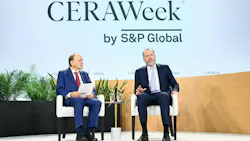
ExxonMobil is maintaining a long‑cycle, operations‑focused upstream investment strategy amid market volatility, with continued emphasis on production growth, technology deployment, and portfolio durability, ExxonMobil upstream president Dan Ammann said at CERAWeek by S&P Global on Mar. 25, 2026.
"We've had a long-standing view that the global demand for energy is only going to continue to grow. And we've been focused on building our capability and our presence to support that over the last several years," he said.
 xom_barrels_1
US unconventionals
Ammann pointed to ExxonMobil’s US unconventional operations, including its Permian basin position, as a source of production growth driven by technology rather than basin expansion alone. Recovery rates in unconventional reservoirs remain low, creating opportunities to increase output through improved completion and recovery techniques, he said.
“The recovery rates in the unconventional business today are single‑digit percentages...5%, 6%, 7%, depending on how you measure. We’ve set an ambitious goal of doubling that.”
ExxonMobil has been investing for several years in completion‑focused technologies and materials to improve recovery efficiency, he said.
“We’re deploying technologies today, like lightweight proppant, and we’re seeing up to 20% increases in recovery just from that one technology,” Ammann said, adding the company has "a whole suite of additional technologies lined up behind that."
ExxonMobil developed a petroleum coke-derived product as an additive in propped fracture treatments for more effective packing of distal fracture extensions, and light weight ceramics have been used to more effectively pack horizontal wells. Read about it here.
Guyana production “up and to the right”
Guyana is a leading example of production growth supported by long‑term investment, fiscal stability, and regulatory clarity, Ammann noted.
Since discovery in 2015 and first production in 2019, ExxonMobil's oil output from Guyana has risen to more than 900,000 b/d, following the startup a fourth FPSO. Additional production is expected as the operator recently submitted plans for the development of Longtail, he said.
“It’s the fastest ramp‑up of any country’s oil production industry in the world,” he said.
Asked about the company’s expected track in Guyana from here, Ammann said plainly, “up and to the right.”
Ammann attributed Guyana’s production trajectory to alignment between operators and the government on long‑term development planning and execution.
Venezuela
The question of alignment applies to resource-rich Venezuela, as well. Venezuela’s current production stands at under 1 million b/d, compared with historical levels of roughly 3 million b/d, Ammann said.
“The challenge isn’t, is there a resource…the challenge is, is there the right environment?”
Investment to restore production from under 1 million b/d could reach hundreds of billions of dollars "over a very long period of time,” he said, while confirming that ExxonMobil currently has an evaluation team on the ground in the country.
While findings were not yet available, Ammann said the company would be evaluating infrastructure readiness, fiscal terms, and stability to support long‑cycle upstream investment before any commitment to large‑scale redevelopment.
On the whole, ExxonMobil’s upstream portfolio strategy is designed to offset depletion while supplying anticipated long‑term growth in oil and gas demand, he said.
“We know we’re in a depletion business…[A]nd if you’re in a depletion business with a growing backdrop, you need to be prepared to make the investments in technology, in projects, in new resource acquisition, to support that growth trajectory over the long term."
About the Author
 Mikaila Adams
Mikaila Adams
Managing Editor, Content Strategist
Mikaila Adams has 20 years of experience as an editor, most of which has been centered on the oil and gas industry. She enjoyed 12 years focused on the business/finance side of the industry as an editor for Oil & Gas Journal's sister publication, Oil & Gas Financial Journal (OGFJ). After OGFJ ceased publication in 2017, she joined Oil & Gas Journal and was later named Managing Editor - News. Her role has expanded into content strategy. She holds a degree from Texas Tech University.