OPEC+ to begin unwinding voluntary cuts as market risks intensify

OPEC+ producers will begin gradually unwinding a portion of their voluntary production cuts starting in April, adding supply to global oil markets as escalating geopolitical tensions in the Middle East heighten uncertainty over near-term trade flows and pricing.
The group of eight OPEC+ countries responsible for voluntary production cuts—Saudi Arabia, Russia, Iraq, UAE, Kuwait, Kazakhstan, Algeria, and Oman—agreed Mar. 1 to resume unwinding the April 2023 cut of 1.65 million b/d. The group will increase production by 206,000 b/d in April and meet again on Apr. 5 to assess next steps.
The decision comes as crude prices have strengthened in recent weeks, supported by rising geopolitical risk premiums tied to escalating tensions after the US and Israel launched a massive attack on Iran that killed Iran's Supreme Leader Ayatollah Ali Khamenei.
Oil production adjustments
OPEC+ officials emphasized that the production adjustment will be gradual and subject to market conditions, maintaining flexibility to pause or reverse increases if prices weaken or demand growth slows.
Saudi Arabia and Russia—leaders of the alliance’s supply management strategy—are expected to account for a significant portion of the incremental volumes.
Despite the planned increase, OPEC+ retains substantial spare production capacity, largely concentrated in Saudi Arabia, the United Arab Emirates (UAE), and Kuwait. However, analysts caution that not all spare capacity can be mobilized immediately. While headline spare capacity appears significant, operational and logistical constraints mean only part of it could return quickly.
Strait of Hormuz
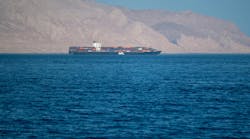 Sea container ship in the Strait of Hormuz, near Iranian coastline, 2021
Meanwhile, the effectiveness of additional OPEC+ supply may depend heavily on geopolitical developments, particularly risks to shipping routes in the Middle East.
About 20 million b/d of crude oil and petroleum products transit the Strait of Hormuz, a corridor linking Persian Gulf producers to global markets. Any sustained disruption to tanker flows could overshadow incremental production increases.
"The OPEC+ decision does not come as a surprise, due to the uncertainty surrounding the US-Iran tensions, and that the market for non-sanctioned crudes is tight," said Alan Gelder, senior vice-president, Wood Mackenzie. "There is, however, a risk that the OPEC+ decision is moot if flows do not resume through the Strait of Hormuz."
About the Author
 Conglin Xu
Conglin Xu
Managing Editor-Economics
Conglin Xu, Managing Editor-Economics, covers worldwide oil and gas market developments and macroeconomic factors, conducts analytical economic and financial research, generates estimates and forecasts, and compiles production and reserves statistics for Oil & Gas Journal. She joined OGJ in 2012 as Senior Economics Editor.
Xu holds a PhD in International Economics from the University of California at Santa Cruz. She was a Short-term Consultant at the World Bank and Summer Intern at the International Monetary Fund.