Diamondback shifting to full-field development of Barnett holdings

Teams at Diamondback Energy Inc., Midland, have made enough progress on costs in the Barnett shale to encourage chief executive officer (CEO) Kaes Van’t Hof to shift to full-field development in the play.
Diamondback executives unveiled a 200,000-acre Barnett position in February and have since added 24,000 net acres there. The company’s costs in the area started the year around $1,000 per lateral ft drilled but have since moved nicely in the direction of Van’t Hof’s goal of $800. And with “nothing that scares me or scares the team from continuing to push on,” the CEO said Nov. 3 that plans now call for the development of up to five section developments by the end of February.
“What was once a geologic success is now turning into meaningful value for the company, and we’re moving into kind of full-field development,” Van’t Hof said on Diamondback’s third-quarter earnings conference call.
Al Barkmann, Diamondback’s chief engineer, told analysts some of the upcoming drilling will focus on lease obligations the company has and added that those will focus on an area near where teams already have drilled some wells. Some areas, he said, are competing for capital today thanks in part to Diamondback’s 40% ownership of mineral- and royalty-focused Viper Energy Inc.
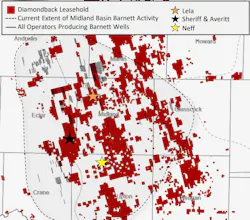
The leaders of Diamondback think their Barnett holdings could support the development of 878 gross (561 net) locations over time and Van’t Hof said on the earnings call that the company’s acquisition of some of the deeper parts of the zones appears to be paying off in terms of recovery efficiency. That dynamic should pay off more as costs continue to fall.
“Early on in these developments, we kind of gold-plate everything and then start to work our way down,” Van’t Hof added.
Other notes from the Diamondback call included:
- An early sign that executives aren’t planning for a notable production increase in 2027 – The plan for now is for Diamondback to run 19-20 rigs and 5 frac crews that turn in line 120-140 wells per quarter, in line with the third quarter's 135. Asked if he was being cautious, Van’t Hof said “it’s always good to prepare the company for a swing to the downside” but that he thinks oil prices will be higher for longer. “But we prepare the business to keep our cost structure low and execution in perfect shape,” he added.
- A clear answer as to whether Diamondback miight join the multi-basin M&A fray – Diamondback has spent $406 million on ground-game acquisitions in the Permian basin and Van’t Hof’s letter to investors said his team is prepared to acquire others in the region. But beyond that? Executives have looked, the CEO said, but each time settled on being an expert in the area they know best: “At the end of the day, I think our investors would rather us spend the extra $100 million on surfactant tests to improve our overall recoveries and duration than go explore outside the basin that we don’t know as well.”
Shares of Diamondback (Ticker: FANG) were down about 25% to nearly $195 in midday trading on Nov. 3. Over the past 6 months, they are have fallen about 5%, which has trimmed the company’s market capitalization to about $55 billion.
About the Author
 Geert De Lombaerde
Senior Editor
A native of Belgium, Geert De Lombaerde has more than two decades of business journalism experience and writes about markets and economic trends for Endeavor Business Media publications Healthcare Innovation, IndustryWeek, FleetOwner, Oil & Gas Journal and T&D World. With a degree in journalism from the University of Missouri, he began his reporting career at the Business Courier in Cincinnati and later was managing editor and editor of the Nashville Business Journal. Most recently, he oversaw the online and print products of the Nashville Post and reported primarily on Middle Tennessee’s finance sector as well as many of its publicly traded companies.
Related
 Fang Well Bw
 oil_well_2067615_natalia_bratslavsky_dreamstime

