EQT plans to buy Range and create gas giant with 9+ bcfed of production
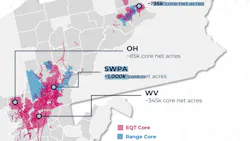
EQT Corp., Canonsburg, Pa., plans to buy Range Resources Corp. and create an integrated natural gas producer, transporter, and marketer that will have net production of more than 9 bcfed.
If the all-stock transaction is completed as expected early next year, the combined company also will operate more than 3,700 miles of midstream assets and control more than 30 years of inventory across about 2.8 million net acres in Appalachia. Nearly 90% of the company’s pro forma net production would be gas.
“This combination creates a must-own energy company capable of generating durable, through-cycle free cash flow while compounding value for shareholders for decades to come,” Toby Rice, president and chief executive officer (CEO) of EQT, said in a statement.
On a conference call with analysts and investors—which Bernstein analyst Bob Brackett pointed out was being held on the exact 22nd anniversary of Fort Worth-based Range drilling the first viable well in the Marcellus basin—Rice and other executives said the planned Range acquisition will lower EQT’s breakeven price per million btu to below $2 and put the company in a better position to serve the growing demand for natural gas.
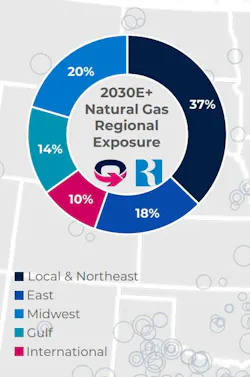
That’ll be the case particularly in Appalachia, where many EQT and Range operations sit side by side and where new power generation facilities are being built to serve demand from data centers and other users. Rice said EQT today is exposed to 3 bcfd of demand from local markets.
“That’s before we think about adding the sustainable growth,” Rice added. “We’ve got a significant amount of supply that we’re going to be able to support with gas supply contracts. This long-duration inventory that we have is going to allow us to continue to extend that opportunity set.”
EQT CEO Jeremy Knop added that Range’s acreage along and near parts of the Ohio River is “almost like beachfront real estate” as economic development leaders in the region look to capitalize on long-term tailwinds from the data center, energy and advanced manufacturing sectors.
Those factors, Rice said, helped kick EQT-Range talks into gear from a timing perspective. He told analysts that the long-term prospect of Range assets growing their capacity to 5 bcfd from today’s roughly 2.5 bcfd and EQT growing its productive capacity to more than 12 bcfd will allow the combined organization to be more aggressive in the market.
“Seeing how we can put these companies together and take a significant piece of this opportunity, I think to me was the compelling catalyst for us to act now,” Rice said.
Another contributor to making the deal work is Range’s natural gas liquids production, which accounts for about 30% of the company’s total output. Andrew Dittmar, principal analyst at Enverus Intelligence Research, said working more liquids into its profile has been a key strategic priority.
“It helps lower the cost of supply relative to gas prices and improves cash flow when gas struggles, as it has through 2026,” Dittmar wrote. “That furthers EQT’s goal of being a highly resilient producer through a cyclical commodity price business.”
EQT’s offer for Range is about 21% above where shares of Range (Ticker: RRC) ended trading last week. Dittmar said investors have of late been more skeptical of mergers and acquisitions without a clear path to operational synergies but added that the EQT-Range tie-up plan “clears that bar” because executives are counting on more than $300 million in added value from midstream and marketing work as well as new supply deals.
In midday trading, Range stock was up about 15% while EQT shares (Ticker: EQT) were down about 2%.
About the Author
 Geert De Lombaerde
Senior Editor
A native of Belgium, Geert De Lombaerde has more than two decades of business journalism experience and writes about markets and economic trends for Endeavor Business Media publications Healthcare Innovation, IndustryWeek, FleetOwner, Oil & Gas Journal and T&D World. With a degree in journalism from the University of Missouri, he began his reporting career at the Business Courier in Cincinnati and later was managing editor and editor of the Nashville Business Journal. Most recently, he oversaw the online and print products of the Nashville Post and reported primarily on Middle Tennessee’s finance sector as well as many of its publicly traded companies.