Permian Resources leaning on more workovers to ‘kind of hit the gas pedal’

Leaders of Permian Resources Corp., Midland, Tex., plan to continue ramping workover activity to capitalize on higher oil prices and have lifted their full-year oil production guidance by about 2%.
Permian Resources roughly doubled its workover rig count during the first quarter and is building on that ramp this quarter, co-chief executive officer (CEO) James Walter told analysts. From replacing hardware on fewer than 40 wells early this year, Permian Resources teams are now completing about 90 workovers per month.
That work will lead to a slight increase in spending from early this year but Walter and fellow CEO Will Hickey aren’t committing capital to adding rigs as some of their peers in the Permian basin are adding.
“We have the flexibility that, with the existing kind of equipment we’re running today, we can accelerate TILs [turned-in-line] above and beyond what our original base plan highlighted,” Hickey said on a May 7 conference call with analysts and investors. “The general plan today is to really kind of hit the gas pedal but do it within the confines of the equipment we’re running today.”
Permian Resources' average total production totaled nearly 413,000 boe/d (192,300 b/d of oil) in the 3 months ended Mar. 31, which was an increase of more than 10% from first-quarter 2025. Executives credited strong runtime and good performances from new wells for that number, which they’re looking to increase slightly this quarter. The midpoint of the full-year oil production target is now 192,500 b/d versus 189,000 b/d in February.
The operator is looking to turn in line 250 wells this year. Hickey said that number could grow by 5% or more by teams “doing the easy things” such as compressing cycle times and drilling more quickly.
“Easy is probably understating it,” Hickey joked on the conference call. “My team will slap me for that.”
Hickey and Walter said they’re not committing to a firm second-half plan for Permian Resources. The price of a barrel of oil will dictate whether they add more activity across the company’s roughly 500,000 net acres in the Delaware basin or pull back slightly from the higher levels of today. Capital allocation between different regions will remain unchanged, though: New Mexico assets are set to get about 65% of the $1.75-1.95 billion in funds earmarked for drilling, completion, and infrastructure work in 2026.
 Diamondback oil and gas operations at sunset
 Drilling rig
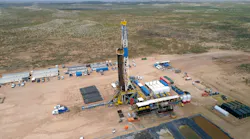 drilling rig onshore US
Oil production over natural gas
Also not changing is Permian’s emphasis on oil production over natural gas, the prices of which haven’t followed crude up since the start of the Iran war.
“I don’t see us in the next two to three to four to five years targeting gas zones at anything that looks like the current strip environment,” Walter told analysts. “I’d say, even with the normalization of Waha pricing, our oil-weighted wells […] are just so much higher rate of return that capital allocation is naturally going to flow to oil-weighted development.”
Permian Resources produced a first-quarter net profit of $50.4 million, a number hurt by $340 million in losses on derivatives, on revenues of $1.39 billion. A year earlier, those figures were $391 million and $1.38 billion. The company’s operating income slipped to $467 million from $504 million.
Shares of Permian Resources (Ticker: PR) were changing hands around $20.10 in midday trading on May. Over the past 6 months, they have surged more than 50%, growing the company’s market capitalization to $17.3 billion.
About the Author
 Geert De Lombaerde
Geert De Lombaerde
Senior Editor
A native of Belgium, Geert De Lombaerde has more than two decades of business journalism experience and writes about markets and economic trends for Endeavor Business Media publications Healthcare Innovation, IndustryWeek, FleetOwner, Oil & Gas Journal and T&D World. With a degree in journalism from the University of Missouri, he began his reporting career at the Business Courier in Cincinnati and later was managing editor and editor of the Nashville Business Journal. Most recently, he oversaw the online and print products of the Nashville Post and reported primarily on Middle Tennessee’s finance sector as well as many of its publicly traded companies.