Chevron eyeing 7-10% output growth, more efficiency gains in 2026
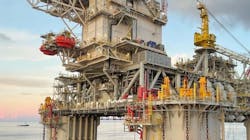
Offshore assets will provide the bulk of Chevron Corp.’s expected 2026 production growth of 7-10%, executives said Jan. 30.
In conjunction with fourth-quarter results, chief executive officer Mike Wirth and his team said they are planning to hold flat 2026 production in the Permian basin at a little more than 1 MMboe/d, a level the company first hit in second-quarter 2025. The company’s holdings in the Bakken will create most of the remaining growth in shale and tight production, which is expected to be 130,000 boe/d more than 2025’s number.
Chevron reorganized its businesses last year to group all its shale and tight assets, which also include operations in the Denver-Julesburg basin and Argentina, in one business group. The focus there and more broadly across the business, Wirth said, is on driving efficiencies, including from Hess Corp. team members brought in last summer.
“We’ve got to drive break-evens down because we’re in a commodity business. We can never forget that. And we’ve got to apply base business excellence to everything that we do,” Wirth said on a conference call with analysts. “I see people, practices, technology, standards being shared.”
 Nigeria flag on blue sky
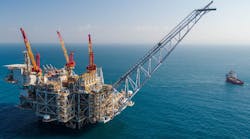 Leviathan production platform offshore Israel
Offshore holdings drive growth in 2026. Wirth noted that 2025 acquisitions and project startups are the main drivers of an expected rise of about 200,000 boe/d. Roughly 125,000 boe/d of that is forecast to come from Guyana while the Gulf of Mexico should provide 60,000 boe/d more than in 2025 and Eastern Mediterranean projects will add roughly 20,000 boe/d. Based on Chevron’s 2025 average total production of 3.72 MMboe/d and the 7-10% growth target, the company’s 2026 output is estimated at 3.98-4.1 MMboe/d.
Venezuela possibilities, fourth-quarter numbers
Given Chevron’s track record of remaining active in Venezuela over the past decade, its operations and plans were a regular topic of conversation on the conference call. Wirth said the company’s teams now produce about 250,000 b/d there and added that they “see the potential” to push that number to 375,000 b/d in the next 2 years if they’re authorized to do so.
On the downstream side, Wirth said, Chevron today brings about 50,000 bbl to its Pascagoula, Miss., refinery. That number could triple, Wirth said, as Chevron has capacity in Pascagoula and at its West Coast refineries.
Chevron produced a fourth-quarter net profit of more than $2.84 billion on revenues of nearly $47 billion. Those numbers were down from $3.26 billion and $52.2 billion, respectively, in late 2024 because of lower commodity prices. The company’s cash flow from operations grew to $10.8 billion in the quarter from $8.7 billion a year earlier.
Shares of Chevron (Ticker: CVX) were up nearly 1% to roughly $172.50 in midday trading Jan. 30. Over the past 6 months, shares have climbed about 12%, growing the company’s market value to $348 billion.
About the Author
 Geert De Lombaerde
Geert De Lombaerde
Senior Editor
A native of Belgium, Geert De Lombaerde has more than two decades of business journalism experience and writes about markets and economic trends for Endeavor Business Media publications Healthcare Innovation, IndustryWeek, FleetOwner, Oil & Gas Journal and T&D World. With a degree in journalism from the University of Missouri, he began his reporting career at the Business Courier in Cincinnati and later was managing editor and editor of the Nashville Business Journal. Most recently, he oversaw the online and print products of the Nashville Post and reported primarily on Middle Tennessee’s finance sector as well as many of its publicly traded companies.