Gulf oil, gas exporters grapple with losses from closed Strait
Key Highlights
- The closure of the Strait of Hormuz has led to the largest outage in global oil supply, affecting about 10% of the world's oil exports.
- Oman and Saudi Arabia have mitigated some impacts through strategic infrastructure, with Oman increasing exports and Saudi Arabia utilizing the East-West Pipeline to maintain significant export levels.
- Iran has managed to increase exports despite extensive attacks, controlling the Strait and benefiting from shadow fleet operations, though US sanctions threaten its windfall.
- Countries like Iraq, Qatar, Kuwait, and Bahrain face near-total export shutdowns, suffering major revenue losses and infrastructure damage estimated at over $25 billion.
- The conflict has accelerated the need for alternative transport routes and infrastructure investments to reduce dependence on the Strait of Hormuz and enhance regional energy security.
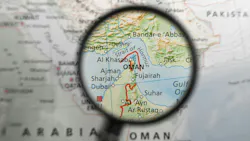
The US-Israeli war on Iran has been hugely damaging for Iran and for its noncombatant Gulf neighbors, which have suffered both widespread attacks and an inability to export oil and gas at customary levels. A country-by-country assessment shows these damaging effects are unevenly spread, with one or two countries seeing windfall revenues while others undergo devastating losses.
The March 2026 closure of the Strait of Hormuz—triggered by US-Israeli strikes on Iran—has brought about the largest outage of oil exports in the history of the oil market, roughly 10% of global supply. The war also triggered shortages of numerous commodities that affect food supply, metals refining, computer chips, the medical industry and several others.
 Stacked oil barrels painted with the colors and emblem of the Iranian flag
 oil and gas infrastructure with US flag and sunset background
For exporters in the Persian Gulf, the lost revenue from the closure ranges to $2 billion/day, and the cumulative losses for March alone amounted to about 400 million bbl, roughly equal to the planned releases by the International Energy Agency (IEA) and US government of strategic oil stocks.
The strait typically handles 20% of global oil exports, a combination of 15 million b/d of crude and 5 million b/d of refined products. About two-thirds of that remained trapped inside the Gulf in early April. Faring even worse was LNG, with a full 20% of global LNG supply of around 86 million tonnes per year (tpy) unable to depart the Gulf.
Tallying effects on oil and gas revenues for the month of March on the eight Persian Gulf states sorts the Gulf countries into two distinct categories, with advantages and disadvantages based on geographic exposure, availability and capacity of workarounds, and intensity of bombardment.
The advantaged (Oman, Saudi Arabia, UAE, Iran)
National oil companies in some Gulf states either retained access to the strait, had prepared in advance for the closure by building bypass pipelines, or in one case, enjoyed favorable geography outside the maritime chokepoint.
Oman
If there was a "winner" in the Iran war, Oman makes the most plausible case. Nearly all of Oman’s oil and gas fields, and all its export infrastructure lie outside the Gulf, far from Hormuz. Oman exported close to 1 million b/d of crude oil in March, up from its normal 0.8 million b/d. A rough estimate suggests Oman’s export revenue will jump to $3.7 billion in April from around $1.5 billion in February due to record-high spot prices for Omani crude, which averaged $122 for the month.
Saudi Arabia
Saudi Arabia's longstanding foresight in building the 750-mile-long East-West Pipeline (Petroline) has paid off. The East-West Pipeline has been transporting up to 7 million b/d of oil to the Saudi west coast, allowing it to utilize 4 to 5 million b/d of export capacity at Yanbu on the Red Sea. As throughput and exports ramped up toward the end of March, the kingdom was able to attain roughly 70% of its pre-war export levels.
Higher oil prices are expected to more than offset volume losses, with April earnings potentially reaching $18 billion. However, Saudi Red Sea exports also depended on non-interference from the Yemeni Houthi, since most of the cargoes were shipping to Asia through the Houthi-supervised Bab al-Mandeb Strait. Iran-aligned Houthi have since late 2023 demonstrated their ability to block the Bab al-Mandeb. Doing so again would whittle down Saudi exports even further, forcing Saudi cargoes to exit the Red Sea by the capacity-constraining Suez Canal and SUMED Pipeline.
United Arab Emirates
The United Arab Emirates (UAE) has been availing its ADCOP Pipeline to bypass the strait. ADCOP can transport up to 1.8 million b/d to the Fujairah export terminal on the Gulf of Oman. However, this bypass route has been subject to Iranian drone attacks that have repeatedly interrupted loading. It is not clear exactly how much oil was loaded during March, although some industry estimates point to around 1.4 million b/d, about half the UAE’s February loadings of 3 million b/d.
If Fujairah exports remained consistent at 1.8 million b/d then the UAE would be in a similar position to Saudi Arabia, exporting about two thirds of pre-war volumes. That could mean higher prevailing oil prices potentially offsetting revenue losses from reduced volumes. Abu Dhabi is also an LNG exporter. Its typical exports of around 6 million tpy have no bypass route. No LNG cargoes have exited the Gulf since end-February.
Iran
Despite being the target of thousands of attacks that have destroyed its military, industrial and civilian infrastructure, and killed its head of state and top leadership, Iran managed to increase exports by 300,000 b/d during US-Israeli attacks on its soil. Iran’s exports appeared to approach 2 million b/d in March. Iran’s de facto control of the Strait of Hormuz meant it was the only one of the eight Gulf states whose tankers enjoyed consistent passage. Iran’s network of "shadow fleet" vessels continued to load crude at Kharg Island and other Iranian terminals—including the Jask terminal outside the strait—and proceeded to market unmolested. In addition, some 140 million bbl of Iranian crude already on ships at sea received a temporary US sanction waiver to offload at destination ports.
Iran probably also earned a substantial windfall from higher oil prices, but its reliance on shadow fleet vessels and non-dollar gray market sales make tallying revenue difficult. However, at the time of writing Iran’s windfall was under challenge from the US blockade that took effect Apr. 13.
The hard-hit (Iraq, Qatar, Kuwait, Bahrain)
With Hormuz bypass options ranging from insignificant to zero, the other four Gulf exporters faced major shut-ins of production and near-total evaporation of export revenues. As the war dragged on, treasuries in these countries faced major revenue shortages.
Iraq
Exports plummeted from 3.6 million b/d to a paltry 0.2 million (or 0.3 million if truck exports to Syria and Jordan are tallied). Revenues dropped to $1.9 billion in March from $7 billion in February and will fall further in April. Iraq’s only outlet was to the Turkish Mediterranean coast via a once robust pipeline now beset by maintenance problems, capacity constraints, and transit risks across Iraqi Kurdistan and Turkey. Shutting in most Iraqi oil production also cost Iraq dearly in lost associated gas, which brought about widespread domestic power outages.
Qatar
The world’s No. 3 gas exporter lost nearly all oil and LNG export capacity. Monthly revenue of $6 billion has effectively vanished, leaving only about 2 bcfd of natural gas exports to the UAE and Oman via the Dolphin Pipeline. This gas sells below market prices, reaping revenue of just $125–200 million/month.
Kuwait
Normally exporting 2 million b/d worth roughly $4 billion in an average month, Kuwait's export revenue would have plummeted to near zero by end-March, although fiscal buffers and sovereign wealth fund holdings remained substantial.
Bahrain
The tiny island kingdom faced a total loss of its 100,000 b/d of refined product exports. With foreign exchange reserves covering only 2 months of imports, Bahrain faced fiscal crisis and the potential for pressure on its currency peg with the US dollar.
Repairs not included
Compounding these privations was the mounting toll of war damage upon infrastructure that looks likely to sideline various export capacities even after Hormuz reopens.
An estimate from Rystad Energy put the damage in March 2026 to Gulf energy infrastructure at a minimum of $25 billion, with LNG, gas-to-liquids, refineries, storage, pipeline compression, processing and export terminals all in need of repair. Qatar was among the worst affected. Two gas liquefaction trains owned jointly by QatarEnergy and ExxonMobil—trains S4 and S6 with 12.4 million tpy capacity—have been destroyed, about 17% of Qatar’s total capacity. These two trains alone are said to require up to 5 years to rebuild. Also at Ras Laffan, Shell’s Pearl GTL gas-to-liquids plant suffered major damage to one of the two 70,000 b/d trains producing ultra-clean diesel and other products.
Longer-term workarounds
The relative ease of throttling shipping through the Strait of Hormuz—and a fervent desire to avoid future disruptions—provides strong impetus for additional workarounds. Given the possibility of Iran’s longer-term control of Hormuz transits, new bypass options will be required. Several were under construction or consideration, including revival of long-abandoned lines that once brought oil to the Mediterranean from Iraq and Saudi Arabia.
The risks of dependence on the Strait of Hormuz are no longer hypothetical. Six weeks of closure have demonstrated the enormous cost of war in the region and the importance of finding alternate transport routes.
About the Author
Jim Krane
Jim Krane is the Diana Tamari Sabbagh Fellow in Middle East Energy Studies and co-director of the Middle East Energy Roundtable at Rice University’s Baker Institute.
Justin Alexander
Justin Alexander is a Nonresident Fellow at the Edward P. Djerejian Center for the Middle East and heads the consultancy Khalij Economics, Rice University’s Baker Institute.